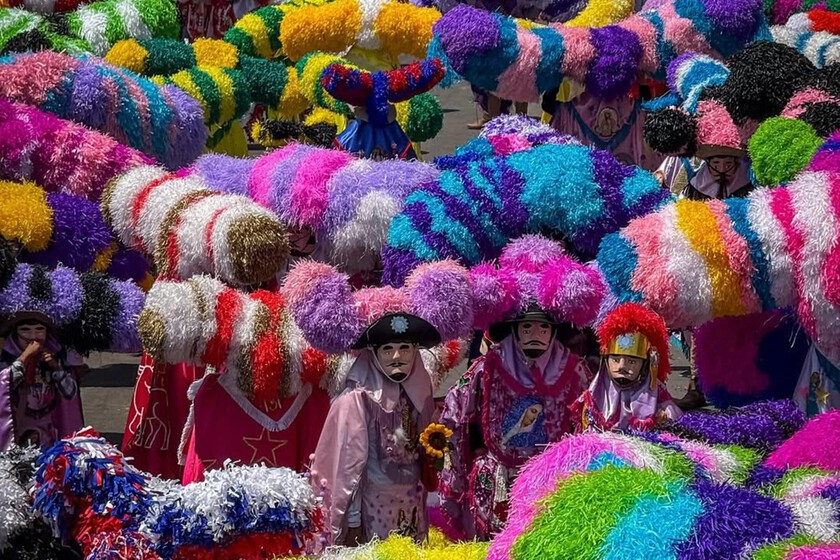
Holy Week arrives and in the cobbled streets of Tetela del Volcán there are no Nazarenes but a scene that seems taken from a surrealist painting: a parade of figures with embroidered capes, leather masks and enormous multicolored headdresses reminiscent of giant caterpillars.
It is evident that we are not facing just any party but rather a unique event that exudes particularity. In this small municipality in the state of Morelos, on the slopes of the Popocatépetl volcano, Easter is celebrated with a unique tradition that mixes religious history, popular theater and collective spectacle.
The main protagonists are the executioners, characters that represent the soldiers who participated in the crucifixion of Jesus and who parade through the town every year in costumes that have been made for months.
A tradition of more than three centuries
This celebration has more than 350 years of history and has its origins in colonial times, when European missionaries introduced theatrical representations of biblical episodes to spread Catholicism among indigenous communities.

Over time, these original representations adopted features of the local culture until they became the unique ritual that has survived to this day. In this way, every year, during the weekend that closes Holy Week, hundreds of inhabitants dress as executioners and walk the streets representing scenes related to the Passion of Christ.
Some embody figures such as Pontius Pilate or Judas, while others parade banging machetes against the ground, symbolically imitating Roman swords.
The famous caterpillar-shaped hats
Without a doubt, the most striking element of the celebration are the headdresses worn by the executioners. These hats, made from hundreds of strips of tissue paper, form large plumes that sway as you walk and that, seen from afar, resemble giant, brightly colored caterpillars.
They were originally intended to imitate the helmets of Roman soldiers. However, over the years they have transformed into true ephemeral sculptures. Some can be up to two meters long and require weeks of manual labor. There are those who use close to 900 sheets of tissue paper to construct them, cut into fine fringes that create that characteristic undulating effect.
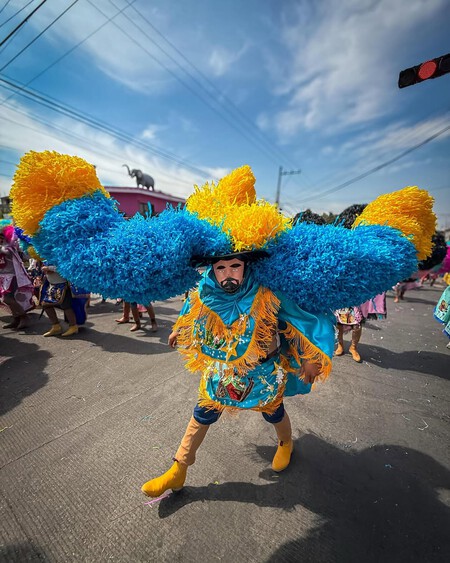
In addition to the hat, the costume is completed with capes embroidered with religious images, leather masks with a beard and mustache, and leather boots. The set can weigh between 15 and 20 kilos, so many participants use cushions or metal structures.
A party that closes the fire
After months of work, the fate of these hats has something in common with the ninots of the Fallas: they end up burning. On Easter Sunday afternoon, the sayones participate in a procession through the streets of the town that culminates with neighbors and spectators throwing lit matches at the paper headdresses.
The huge structures then begin to burn as participants run or try to put out the flames. Although there are emergency services present and the authorities are trying to control the fire, the commotion is part of the ritual and is usually celebrated with cheers.
For many participants, it is a moment that symbolizes a form of penance or sacrifice where the effort invested for months disappears in a matter of minutes.

A tradition that remains local
Unlike other very popular Mexican celebrations (such as the Day of the Dead) this festival continues to have a mainly community character and is unknown to many tourists.
Every year more than a thousand people participate, but the majority are residents of the municipality itself or nearby towns. Entire families collaborate in making the costumes, embroidery and headdresses that will later be paraded through the streets.
For those who grow up in Tetela del Volcán, putting on the sayón mask is almost a rite of passage. For a few days, the town is transformed into a setting where history, religion and popular creativity coexist in one of the most peculiar Easter celebrations in Latin America. Don't miss it if you have the chance.
Cover photo | Morelos Tourism