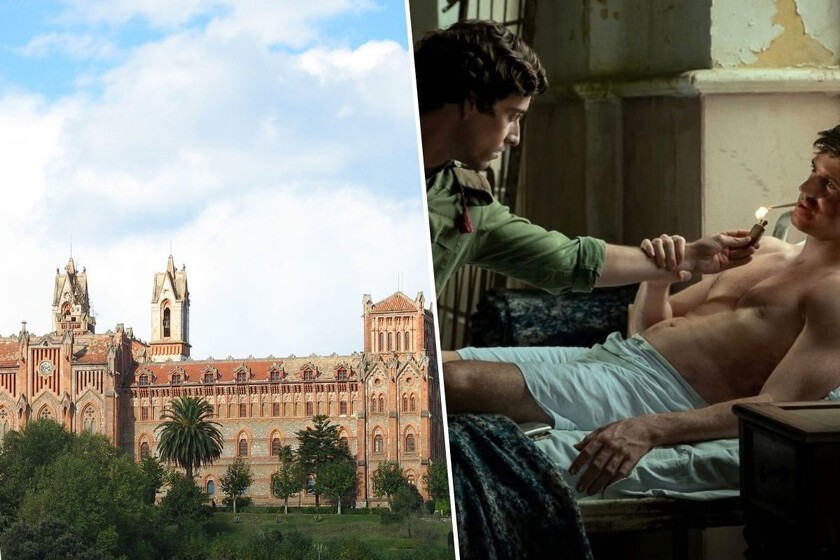
Anyone who has ever been to Comillas and sees 'The Black Ball' will recognize something more than a set on the big screen. In this Cantabrian town, at the top of a hill and above the houses and the sea, rises a set of buildings so large that it looks like a small city separated from the town. This is the old Pontifical University, where Los Javis filmed part of their film, turning the old seminary into the scene of the Civil War scenes starring Guitarricadelafuente, Miguel Bernardeau and company. However, once the filming was finished, the place has once again shown its two usual faces: that of the recovered spaces and that of the abandoned pavilions.
The best known is that of the Major Seminary. You can enter this part of the complex with a guided tour and discover its cloisters, the church and the ornate spaces in which Lluís Domènech i Montaner intervened. It also continues to be a place of study because, currently, it houses the Comillas Foundation and its university center. It is evident to the eye that it is a building with stage presence without even needing to place cameras and spotlights.
Nacho Castejón Martínez
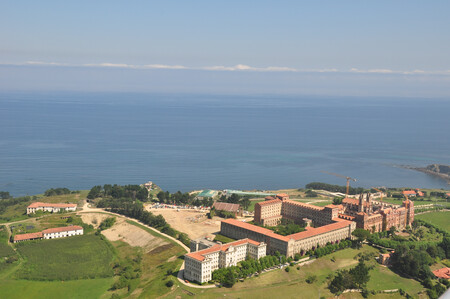
However, the old university does not end at the restored rooms of the Major Seminary. As the institution grew, other buildings were raised on the hill. One of them is the Minor Seminary, built at the beginning of the 20th century and now converted into the setting for 'The Black Ball'. Another is the Hispano-American Pavilion, begun in 1946 and inaugurated in 1950, although its architectural project was never completed as planned (large tower included).
The abandoned sets of 'The Black Ball'
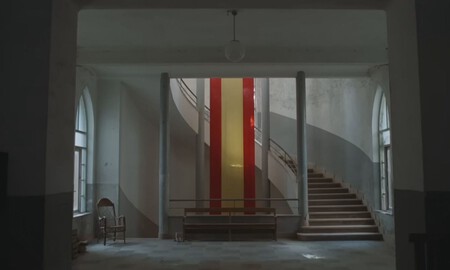
The Javis were looking for a location in the north for the plot of Rafael Rodríguez Rapún and Sebastián during the Civil War. According to Clara Salvador, the film's location manager, they found an unrenovated building in the old university that they transformed into the prison and hospital where part of the plot takes place.
The black ball
It was the Minor Seminary, where there were plants growing inside and the crew had to remove them before recording. The choice also contains a historical coincidence: Salvador said that the building used had functioned as a blood hospital. Thus, the same place that in the film houses a war wounded was also intended to treat wounded people during the real Civil War. For filming, however, a large set was built that recreated a field hospital.
Another is the Hispano-American Pavilion, which is part of the same complex, but whose history is different. Construction began in 1946, ten years after the war. When the recovery of the old campus was planned, it was proposed to demolish it to open a garden area and clear the views of the Major Seminary. That proposal was not finally carried out, it remains in disuse and its future is unknown.
@hluquin96 The new Los Javis film, The Black Ball, was filmed in my town, Comillas, and part of the filming took place in the abandoned premises of the old Pontifical University. 🏛️ While the Major Seminary looks rehabilitated, buildings as imposing as the Hispano-American Pavilion or the Colegio Máximo languish waiting for a project that will save them from ruin. The demolition of some of them has even been considered. Hopefully the cinema loudspeaker will serve to rescue this 20th century heritage from oblivion before it is too late. Did you know this architectural giant in Comillas? I read you in comments. 👇 #Comillas #Cantabria #Patrimonio #LaBolaNegra #LosJavis
♬ original sound – hectorluquin
What to see in Comillas beyond the settings of 'La pelota negra'
The old Pontifical University is at the top of La Cardosa hill, so the visit can start there and continue downhill towards the center of Comillas. Of course, it must be taken into account that the guided tour of the university only includes the Major Seminary and the rest of the buildings are not part of the tour, at least for now.
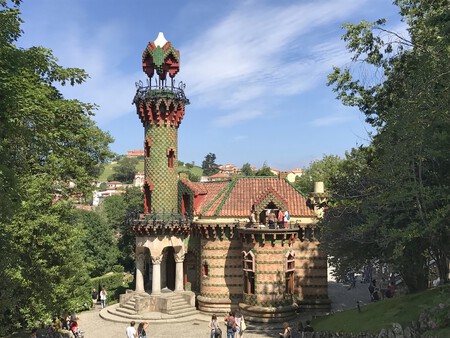
Once in the town, there are two essential stops that help you understand where so much extraordinary architecture came from in a town of its size. One is El Capricho, the house designed by Antoni Gaudí with its characteristic sunflower tiles. The other is the Sobrellano Palace, built by order of the Marquis of Comillas, next to the family chapel-pantheon. From there, it is worth continuing to walk leisurely through the streets of the historic center and down towards the beach and the port.
Triplecane
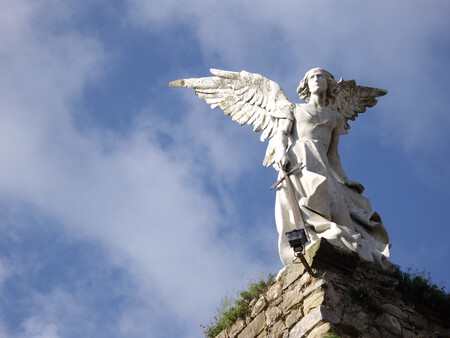
If you have time, the cemetery offers a last (and curious) encounter with the architectural history of the place. Domènech i Montaner intervened in its construction on the ruins of an old 15th century church, and there is the famous sculpture of the angel by Josep Llimona. It is a closing getaway very typical of Comillas, where even when it seems that you have already seen everything with its most famous buildings, another corner appears that makes you stop.
PB Obregon
That is why it is worth approaching Comillas with more time than what is required to take a photo with the facade of the seminary. It is a place where, in a few steps, you can go from the constructions built during the splendor of Comillas to the buildings that, although abandoned, are still monumental. 'The black ball' is the perfect excuse to discover this landscape whose history began long before Los Javis.
Cover photo | The black ball and Esther Westerveld
In Motorpasión | Changes are coming from October 1: the Government extends the discounts on diesel and gasoline, and is also going to intervene in the price of gas
In Xataka | A boy from Sierra Leone began collecting scrap metal to make his own battery. What he achieved took him directly to MIT at the age of 15