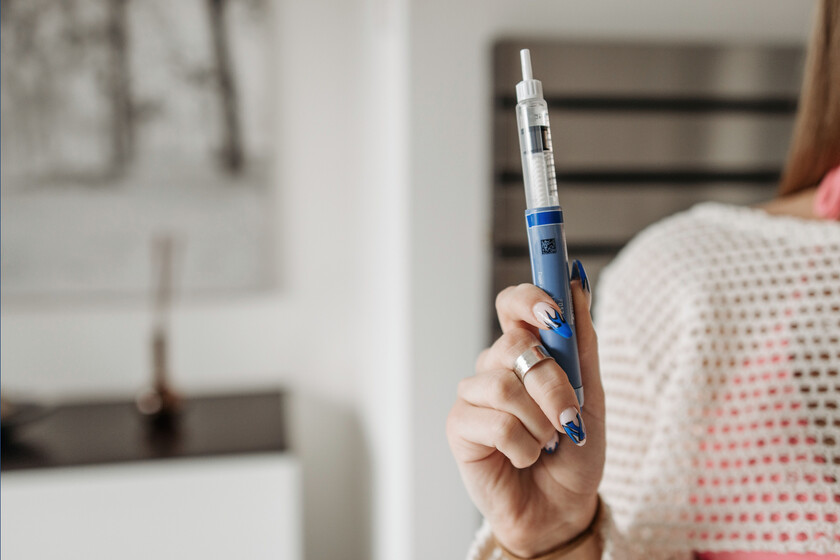
In recent years we have heard a lot about Ozempic. This injectable medication, originally designed to treat type 2 diabetes, belongs to the family of GLP-1 type drugs that mimic a hormone that regulates appetite and blood sugar, and to which Wegovy and Mounjaro also belong. All of them have become a tool to combat obesity and overweight, but also a kind of magic formula for losing weight.
Celebrities use it even if they don't have illnesses that justify its use, and it works. And it does it so well that its fame has grown like wildfire in recent years, causing the fall of the body-positive that fashion has celebrated, and generating consequences such as the “Ozempic face”, that aged and flaccid appearance of the face when a lot of facial fat is lost in a short time, which beauty brands are now willing to solve.
How Ozempic reinvents the beauty market
According to Reuters, Pfizer estimates that the anti-obesity drug market could reach $150 billion in annual sales by 2030. JP Morgan estimates that GLP-1 users in the US could reach 30 million in 2030, around 9% of the population. In Spain, as far as we have been able to verify, there is no clear public figure of how many people use this medicine today, but in 2024, semaglutide was the active ingredient with the highest turnover of all SNS pharmaceutical services: 403.9 million euros, 36.2% more than in 2023.
All these numbers make us think that GLP-1 is forcing the beauty world to change again. The speed and magnitude of fat and weight loss causes changes in the face, and the industry, of course, wants to take a cut. In fact, it already does so because L'Oreal announced that its sales increased by 7.7% in the third quarter of the year, exceeding analysts' expectations.
L'Oréal CEO Nicolas Hieronimus said the rise of LPG-1 was “having an impact on the consumption of beauty products and, in particular, the consumption of skincare products.” It is not surprising if we pay attention to Dr. Paula Rosso and Dr. Lajo Plaza, who explain to us that “when there is significant weight loss, facial adipose tissue is also lost. We can observe loss of volume in certain areas, changes in the oval, greater visibility of some furrows and skin that may appear more lax.” Forty-eight percent of patients taking GLP-1, according to one study, reported significant facial changes three to six months after starting treatment, including more wrinkles, duller skin, and an overall tired, sagging appearance.
This change is no longer anecdotal and has caused the market to go from selling hydration and serums to illuminate the skin, to selling a reconstruction of volume, firmness and density to mitigate the effects of the use of GPL-1. The rise of medications such as Ozempic, Wegovy or Mounjaro has become a market opportunity for cosmetic brands.
Although accelerated skin aging is a side effect of GLP-1 medications, one more on a seemingly endless list, experts say there are products that can help with these effects. What's more, there is now a “GLP-1 beauty” with firming creams, solutions for hair loss (another effect of this medication), post weight loss routines and products that promise collagen, elastin, hydration and protection of the skin barrier.
The market beauty It even has products labeled for GLP-1 users like Image Skincare's Vol.U.Lift or Dr. Few Skincare DermaReverse, both targeting sagging, loss of facial volume, and dehydration with a product that claims to mimic the volume provided by lost adipose tissue. The second explains that “it has been tested in people who use GLP-1 therapies to achieve visibly firmer, smoother and more resistant skin.” That is to say, they are beauty products created expressly for a problem that did not exist five years ago, the Ozempic face. There are also products that already existed but have been repositioned to fit this new paradigm shift.
L'Oreal is also developing products intended to be used in conjunction with GLP-1 medications and treat skin problems related to rapid weight loss. According to Delphine Viguier-Hovasse, the brand's innovation director, “we are testing products on LPG-1 users in separate studies, as this consumer group is becoming increasingly important and represents a significant number of people around the world.”
What can brands promise?
In the European Union, cosmetic brands are limited and have to be able to demonstrate what they promise. A cream can leave your skin more hydrated, smoother or better looking, but it cannot transform the body, like returning the fat you have lost from your face by taking Ozempic. If a brand promised that, it would be saying more than a cosmetic legally can because Regulation 655/2013 requires that claims be truthful and supported by evidence, such as a study, to support them.
This does not prohibit a brand from saying 'for LPG-1 users'. The brand can put that label on its product and the law does not prevent it, but it should have proof that it works for those people. This is exactly what is at stake in statements like Dr. Few's claim that his product “has been tested in people using GLP-1 therapies.” It is something that must be able to be supported with a study that anyone can consult. And it is one thing for a cream to improve firmness or hydration, and another for it to replenish the volume that facial fat provided. The closer the message is to the latter, the more evidence there should be behind it.
The real problem: a new yoke of beauty upon us
Manuel Krauss, director of innovation and R&D at Natura, stated that “GLP-1 is creating new beauty needs at an unprecedented speed, but it is also showing us that the future of beauty cannot be defined solely by creams.” That is why new medical aesthetic treatments have appeared such as injectable Sculptra, a collagen stimulator, or Restylane, a hyaluronic acid filler, both from Galderma. It sounds like if before we took care of ourselves with a simple routine like skin cycling, now we will have to add even aesthetic interventions.
In Spain, the appetite for aesthetic operations was already growing before GLP-1. In 2021, the total number of cosmetic surgery interventions increased by 215% compared to 2014 data according to the Spanish Society of Plastic, Reconstructive and Aesthetic Surgery (SECPRE), and 85% of them were performed on women. Dr. Oriol Bermejo, member of SECPRE, stated on Antena 3 that today there is an increase of between 30% and 50% compared to the latest official data. “The pace of operations has not stopped growing. It is a booming business,” he says.
Where this growth is most noticeable is in injectables. A market research report confirms that the business of facial injectables such as Botox or hyaluronic acid in Spain foresees an annual increase of more than 12% between 2024 and 2029. Ozempic injectable treatments for the face will add to that figure and, if the use of GLP-1 continues to rise, it is likely to push the rise of these data even further.
There are risks that are not being talked about. Medicalize a body that has simply changed. Feed, even more, anxiety about aging. This only ties us more to an ideal of beauty of which we are victims from the moment we are born. As Leticia Salas says in her essay 'Give me poison I want to live' “we have not replaced one aesthetic tyranny with another, but rather we have multiplied it.” Remediating the “Ozempic face” is just one example of an industry for which there are never enough of us.
None of this questions those who take these drugs for a medical need such as type 2 diabetes, or for whom GLP-1 treatment is a health tool. The criticism is directed at an industry that turns a side effect into a new source of insecurity.
Salas says that “the sacrifice involved in following a daily skin routine does not make me much freer. When, every morning and night, I apply the cream with great attention, what my hands seek is to stop aging. (…) Nothing in my actions speaks of freedom.” With this new market opening, the author's reflection seems more relevant than ever.
Note: some of the links in this article are affiliated and may provide a benefit to Trendencias.
In 3DGames | A cave in Cantabria was blocked for 16,800 years. Inside there is a Stone Age house with more than 4,600 objects
In DAP | José Andrés is full of praise for Ángel León after his restaurant in Cádiz came last on the list of the best restaurants in the world