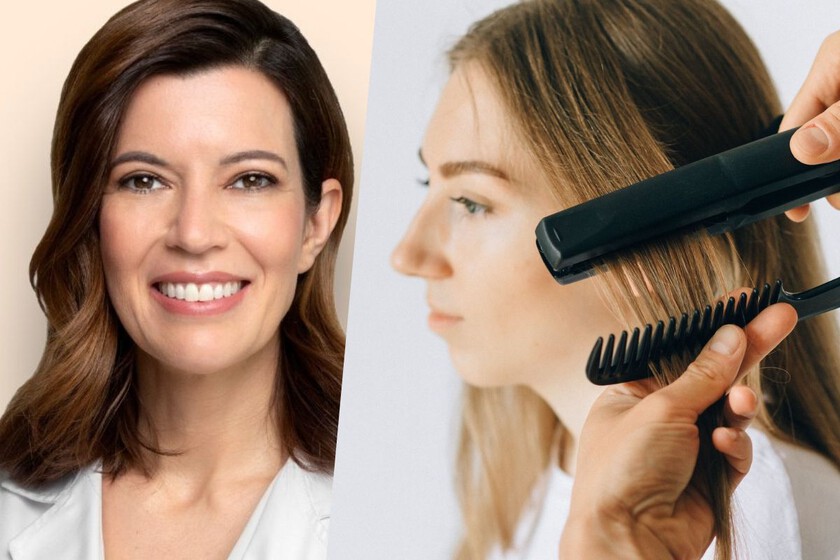
When what we want is to achieve straight, perfectly polished and frizz-free hair, hair straighteners become one of our best tools. Now, although straighteners are capable of leaving hair very beautiful, that does not mean that they are improving or treating the hair but rather, as dermatologist Ana Molina indicates, we can actually compare it as if it were “an Instagram filter that leaves your skin divine, but hides the reality of what is underneath,” she says.
What happens is that “when you iron, you apply heat and pressure, causing the cuticle to flatten completely,” something that the doctor compares to perfectly arranging all the tiles on a roof. When the cuticles are flat, the hair reflects light better, therefore it shines more and has less frizz.
The irons act like makeup but do not improve the problem
It is undeniable that hair straighteners are of great help when our hair is very frizzy, unruly or difficult to manage. “The immediate effect is wonderful, it reflects light better, the hair looks shinier, silkier and with less frizz because it absorbs less humidity from the environment,” explains Molina.
Now, although the results we achieve with hair straighteners are so beautiful and surprising that they even seem like magic, the truth is that behind this effect there is a physical process that we must know. “We must be clear that it is not about repair, it is 'thermal makeup' because inside that extreme heat dehydrates the fiber, alters its proteins and causes split ends, roughness and breakage in the long term,” warns the dermatologist.
It is not about banishing the iron but about using it wisely
It is normal to think that, if straighteners can be so harmful to our hair, it would be best to put them in the trunk of memories and stop using them. However, it is not about giving them up, but about learning to use them correctly. To do this, the dermatologist recommends following certain steps that will help make the use of this tool less harmful.
The first thing Molina points out is not to use the straightener with wet hair, “if you hear it sizzling, it's a bad sign,” he says. This occurs because intense heat can cause the water that remains inside the hair fiber to evaporate quickly, causing damage to its structure. For this reason, you have to “avoid using a wet iron so as not to boil the hair fiber inside,” he explains.
Another aspect that must be taken into account is the temperature of the iron. This is very important so as not to burn the hair and damage it. The expert recommends always using thermal protector before any heat tool and of course “lowering the temperature of the styling tools so as not to dehydrate it,” says Molina.
It is also very important “not to go over the same strand of hair ten times”, since this will only punish the hair. The recommendation is one pass per strand since heat can damage and weaken the fiber. In addition, it is essential to allow days of rest to avoid subjecting the hair to constant heat, and allow it to retain its hydration and strength. But what the dermatologist also recommends and that will do wonders for your hair is to “apply masks and conditioner constantly to repair hydration,” says Ana.
In Xataka | A jaguar travels 2,100 kilometers crossing all of Brazil with one goal: to preserve its species
In DAP | Toshisuke Kanazawa, 90-year-old Japanese bodybuilder: “I don't eat meat, fish, milk or yogurt. My three daily meals are based on brown rice, natto and miso soup”