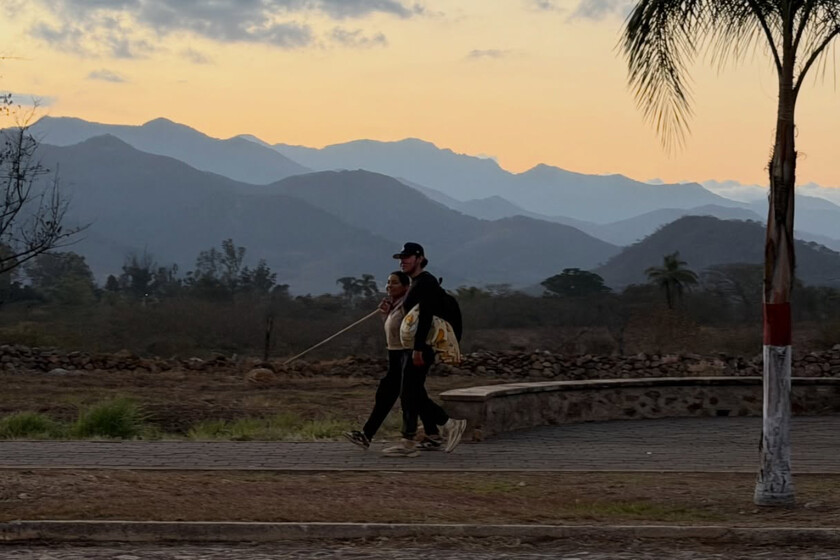
They say that the Camino de Santiago works as a kind of internal earthquake that changes your life. A journey that connects you with nature and with yourself on a spiritual route in which you do not end up being the same person who finished their steps, whether you are a believer or not. In Jalisco, Mexico, there is something similar that runs through the mountains until reaching Talpa de Allende to venerate the Virgin of the Rosary, the Pilgrim's Route.
For more than 200 years, the 117 kilometers of its route that begins in the city of Ameca, cross mountains of the Sierra Madre Occidental and end in the town of Talpa de Allende, one of the magical towns of Mexico, in the Basilica of Our Lady of the Rosary. There awaits a carving modeled by the Tarascan Indians of Michoacán who arrived in Talpa in the year 1585. The Virgin of the Rosary of Talpa has long, wavy, black hair, like that of the women of the region. Brown skin and a distinctive mole on one of his cheeks.
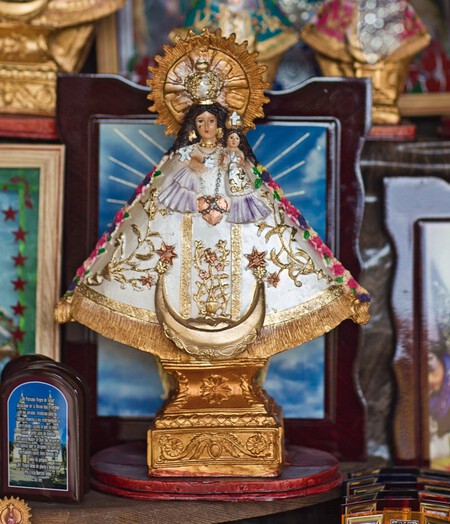
According to the studies of Ricardo Lancaster Jones, the virgin has the typical finish of the images made by the Michoacan hands of Pátzcuaro, Uruapan or Quiroga, and the sculpture bears resemblance to the Virgins of San Juan de los Lagos and Zapopan. In 1644 the miracle of renewal occurred and, according to the expert, before that the Virgin was a sculpture made of corn cane paste that was transformed into what it is now: a sculpture carved from tepehuaje wood in a single piece 38 centimeters high. It does not need more to attract more than 3 million people every year who come to venerate it, especially at Easter. Traveling this route full of mountains, rivers, viewpoints, hermitages and lodges is worth it at any time of the year, and regardless of the faith you have.
The experience that thousands of pilgrims live when traveling the route to Talpa de Allende to venerate the Virgin of the Rosary is similar to that experienced by those who walk the Camino de Santiago. The tradition combines physical effort with devotion, but it is also a journey in itself that confronts those who travel it to their own limits, that connects them with nature and that brings them closer to themselves for several days.
In addition to nature, the route takes us through different points in which architects from China, Chile, Mexico and Switzerland participated. The Monument to Gratitude, in Lagunillas and near Cerro del Obispo is one of them. The Cerro del Obispo Viewpoint, a white tower that represents a beacon for pilgrims, is another. The Stone Hermitage, next. Each one of them represents something different. Las Majadas, a hermitage of two interlocking pieces, represents the union between pilgrims.
One of the most spectacular points of the route is the Mirador del Espinazo del Diablo that culminates in one of the hardest areas at 1,950 meters high. This area also represents something, because it has a piece that is the silhouette of the virgin and when the sun falls on the image, it is reflected inside the structure as the light that pilgrims need to finish the path. The last of the architectural works is the Hermitage of San Rafael in Mascota, with a circular shape that represents the beginning and the end.
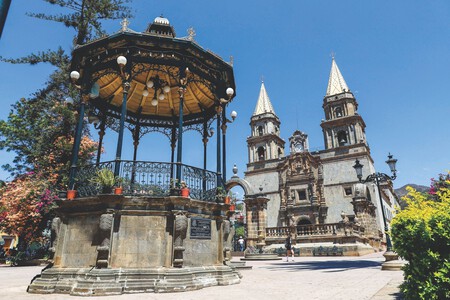
When everything is over and you arrive in Talpa, you are welcomed by a basilica built in 1782 in a Churrigueresque and Gothic style. There is the Virgin and the end of a path that promises to be transformative.