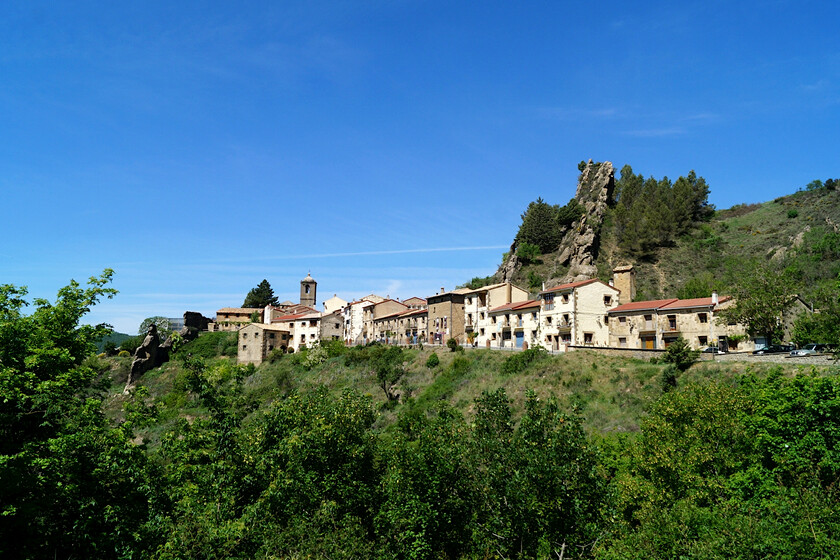
It could be said that Petilla de Aragón is an island without a sea. But not in the same sense as Jorquera, where the water has drawn an almost perfect meander around the rocky spur on which the town stands. In this case it is due to the fact that a small piece of Navarra appears on the map completely surrounded by the province of Zaragoza, just 12 kilometers from the border with the rest of the regional community. A geographical whim that is not the fault of any absent-minded cartographer, but of a debt between kings whose consequences persist eight centuries later.
At the beginning of the 13th century, Sancho VII the Strong of Navarre lent money to Pedro II of Aragon to finance his military campaigns. As collateral he received, among other possessions, the Petilla castle. However, the Aragonese monarch died before being able to repay the loan and his successors were also unable to pay off the debt within the agreed period. This is how the territory ended up being definitively incorporated into the Kingdom of Navarra, although physically it remained within Aragon.
Navarro Tourism
Plus, the weirdness doesn't end there. The municipality in which it is located is made up of two separate territories, Petilla and Los Bastanes, both surrounded by Aragonese lands. The first is the only inhabited area, located at more than 840 meters above sea level and with only 29 neighbors. The truth is that few towns need a little geopolitics class before explaining where they are.
What to see in Petilla de Aragón (even if it is from Navarra)
Petilla rises between rocks and forests in the foothills of the Santo Domingo mountain range. Its street is small and can be explored without having to open Google Maps, between stone houses, fountains and an old laundry. Above the town is La Torreta, the rock on which the castle was built that ended up changing kingdoms due to that medieval debt. Only a few grooves excavated in the rock remain of the fortress, but from there its ancient defensive function is better understood and there are good views of the Onsella valley.
Navarra Tourism
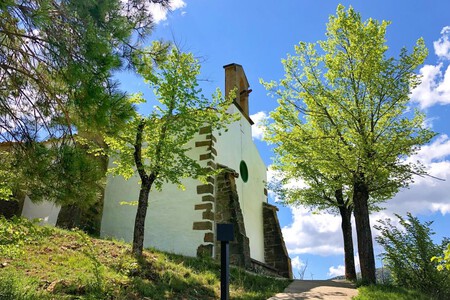
The most important building in the town center is the church of San Millán, originally built in Romanesque style and later modified by wars, fires and Gothic reforms. It still preserves part of the old façade, decorated with Jaquese checkering, while inside the ribbed vaults and their carved keys stand out. Nearby is the hermitage of Our Lady of Charity, patron saint of the town.
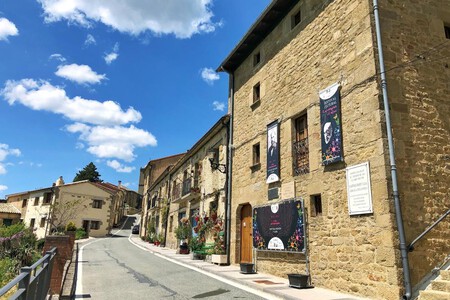
However, Petilla's most famous neighbor was neither a king nor a saint. Santiago Ramón y Cajal, considered the father of neuroscience and winner of the Nobel Prize in Medicine in 1906, was born here in 1852. His birthplace, a stone building on Calle Mayor, is now a museum that reproduces his titles and decorations in a recreation of a house from the mid-19th century. Of course, it must be taken into account that the visit is made by appointment.
Navarra Tourism
Outside the urban area, the landscape is made up of pine forests, oaks, gall oaks, walnut trees and almond trees. The trails allow you to enter a relief of ravines and large sandstone and conglomerate formations known in the area as “rayas”. One of the most special excursions ascends Mount Selva, which reaches 1,159 meters and offers views over the Onsella basin.
Where to eat delicious and cheap in Petilla de Aragón
The offering is as tiny as the town, but Petilla has the Hostal Santiago Ramón y Cajal, whose bar-restaurant serves homemade local cuisine in a dining room with a fireplace. To find more options you have to drive about 15 kilometers to Sos del Rey Católico. There, the Landa Bar Restaurant has a menu, portions and combined dishes, as well as a terrace under the arches of the old medieval market. Another possibility is Vinacua, a restaurant with traditional cuisine and menus with typical food from the area.
What to do around Petilla de Aragón
Navarra Tourism
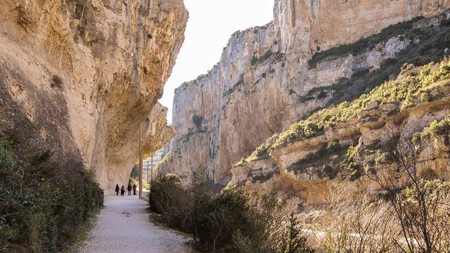
Just six kilometers from Petilla are the Sibirana towers, two defensive constructions from the 10th century perched on a rock formation. It can be reached by following the GR-1 towards Biel. The same path, but in the opposite direction, leads to the remains of Roita Castle, another medieval fortress hidden in the forest.
Also nearby are the Pigalo pools, natural pools formed by the Arba de Luesia river, and the Santo Domingo mountain range. About 15 kilometers away is Sos del Rey Católico, one of the best preserved medieval complexes in Aragon and the birthplace of Ferdinand the Catholic. Its cobbled streets, the Jewish quarter, the Sada Palace and the remains of the castle are enough to complete the day without having to leave the Cinco Villas region.
Navarra Tourism
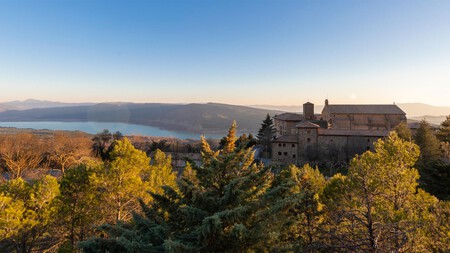
If you have more time, Uncastillo (yes, all the same) is about 35 kilometers away and brings together six Romanesque churches, a castle and a historic center declared a historical-artistic complex in the same town. The route can still be extended further to the Javier castle, the Leyre monastery or the Lumbier Gorge. Although all without forgetting that the getaway had begun in that small Navarrese mole that Aragón has been surrounding for more than 800 years, but that has never been recovered.
Cover photo | Jialxv
In Xataka | In 1807 they released pigs on an island to feed shipwrecked people: 192 years later, they found very different creatures
In 3DGames | Blood Contact Kumite was a lie, and a cassette tape buried under 3 tons of concrete almost ruined Jean-Claude Van Damme