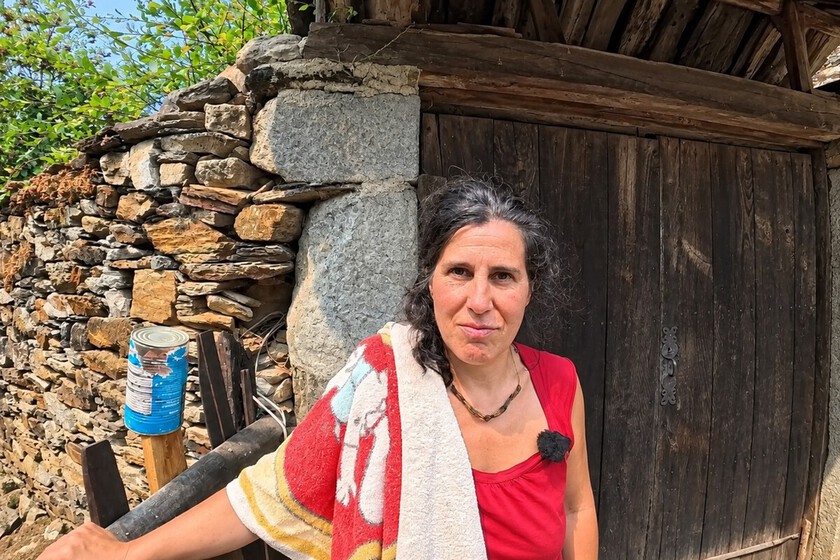
Living off what the land provides sounds idyllic until you experience firsthand how, in fact, the beans do not pack themselves and the firewood does not appear piled next to the fireplace by spontaneous generation. Sureyna Cadenas Muñiz has been following this lifestyle for more than two decades in a small village in Asturias, where she grows much of what she eats, preserves the harvest to get through the cold months and makes preparations with plants that she then sells at fairs.
The YouTube channel Hilux Aventura has traveled to Aguanes, in the council of Allande, to find out how Sureyna and her two daughters organize themselves there. Of course, her relationship with the place did not begin with a sudden move in search of a radical life change and connection with nature… She grew up there.
As he explains in the video, his parents came to the town more than 30 years ago, when they were looking for a place where they could lead a more self-sufficient life. They came from Madrid and it took them a while to settle in because first they had to rehabilitate the house. Later, Sureyna would leave to study, although she would end up returning when she was 23 years old. Otherwise, he has lived practically his entire life in the town.
Living with less also requires more work
Sureyna insists on dismantling the bucolic version that many have of self-sufficiency. The one in which one moves to the country and spends the afternoons reading under a tree while the garden takes care of itself. “There are people who think that coming here means lying in the sun, but no,” he explains. “You have to grow plants to provide food and that already takes work, organization and management.”
In your case, the house is delimited by the walls. The garden, the pantry, the forest and the spaces where the firewood is stored are also part of it. The calendar for everything to work is set by the harvests and preparation for winter. Something that entails everything from planting, collecting and preserving food to obtaining fuel for the colder months.
It is a way of life that, as he defends, involves reducing material needs and reviewing our relationship with consumption: “We have to change the consumption chip that we have, we don't need so many things,” he summarizes.
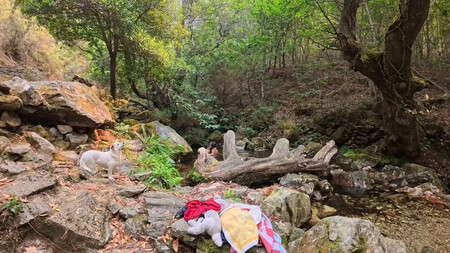
The garden that fills the pantry during the winter
As we have been pointing out, Sureyna grows different fruits and vegetables and cans a part of the harvest to consume it when the season ends. “It's what sustains me throughout the winter. We package everything and then I don't have to buy vegetables,” he says.
Although self-sufficiency is not complete, she herself talks about going shopping with the money she gets at fairs. What is certain is that the garden allows you to reduce a good part of the expenditure on fresh food. This also makes the pantry one of the most important rooms in the house.
As you can imagine, life in Aguanes is not always an escape from stress either. Sureyna says that she went through a period marked by financial problems, a complicated relationship and a cancer diagnosis. Then he decided that the best thing was to temporarily leave the village: “I thought it was best to leave here and recover. I left with what I was wearing.”
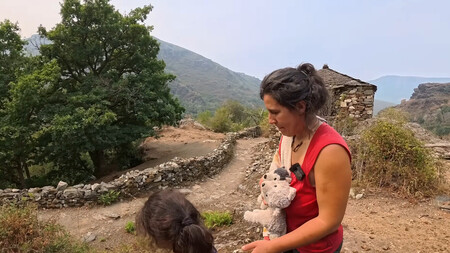
Plants as a profession and a history marked by fires and rural abandonment
Another of the pillars of her life are plants and their traditional uses, knowledge that, as she says, she learned since she was little and now shares with her daughters. Sureyna studied naturopathy and phytocosmetics, teaches workshops and makes vegetable preparations, which she calls “plant medicines”, which she sells at fairs as a way to earn income. “We spend the day, I get some money and do the shopping,” he says about the fair days. Its economy thus combines what it produces for self-consumption with what it obtains by selling its preparations.
Sureyna's relationship with the territory goes beyond her house, her garden and the craft fairs. In 2018, it launched the Sembrando Canchales project, with which it sought to recover, using native species, part of the mountains devastated by the fires of 2011 and 2017.
That same year she also reported the access and school transportation problems that her daughter encountered getting to school from Aguanes. The minor had to travel several kilometers because the bus could not access due to the poor condition of the track.
Her story is not, therefore, only that of a woman who decided to consume less and grow her own food. It also shows the work (domestic, physical and economic) that supports that choice and the specific difficulties of facing raising a family in one of the most depopulated and poorly communicated areas of Asturias. It is the least photogenic part of rural life, but the one that best explains what it really consists of.
In Xataka | He spent 680 days in Morocco and continued collecting his pension in Spain. Justice has just confirmed the consequences: 32,857 euros
In DAP | Neither aggressive degreaser nor vinegar: the simple remedy to clean a sticky extractor hood in minutes