
Vacations can sometimes turn into a nightmare due to something that can happen to all of us at some point: the loss of your luggage. Last August my partner and I decided to go to Sicily for two weeks. We love Italy, and Sicily was a pending part of this country that we were looking forward to. But there were two things that complicated our trip: the eruption of the Etna volcano, and the loss of all our suitcases when we arrived in Palermo. Some suitcases that did not appear on the entire vacation.
The result? Nerves, helplessness and a crash course on what to do when an airline loses your suitcases. And with them, a little piece of your life. It all started when we were already sitting on the Iberia plane, the captain informed us that due to the eruption of Etna the flight was suspended and we had to get off the plane. And from there, without a prior protocol or clear guidelines from the Spanish airline staff, we began to try to be relocated to another flight.
After many attempts (including wanting to send us to Sicily via London, spending the night at the airport, and even though the ETA was needed), Iberia put us on their flight to Rome for the next day, where we had to board an ITA Airways flight to Palermo, given that the Catania airport was constantly opening and closing due to the ash from the volcano.
We checked the suitcases in Madrid-Barajas, and in theory we picked them up in Palermo. Mistake. Upon arriving in Palermo, and while my partner went to look for the rental car, I stayed waiting for the suitcases to come out. Of course, in vain. As the minutes passed, the feeling of anguish at not seeing any of our suitcases appear increased. That feeling of emptiness in your stomach, while the tape stops and you are left alone looking at a black hole through which nothing comes out, is one of the few things that manages to suddenly bring down the illusion of a trip.
And in fact, there began a race to recover our luggage, which still, a month or so later, has not ended, since there is still one suitcase left to recover (although we do know that it has flown from Italy to Lisbon, then returning to Rome and Palermo, whose airport it must be at at the moment). This feeling of abandonment and lack of empathy from both Iberia and ITA Airways is almost worse than the loss of the suitcases themselves.
Because losing a suitcase isn't just about being left without clothes. It means being left without a toiletry bag, without comfortable shoes designed to walk for hours without your feet hurting, without the clothes you had planned for going out to dinner, or even without the gifts that my partner brought for my birthday. And also, and above all, it is starting a vacation with your mind focused on calls, forms and waiting, instead of what you went there to do, which is to rest and disconnect.
What to do as soon as you realize that the suitcase has not arrived
First of all, it is important to be aware that the problem will not be solved immediately. So you have to accept it, keep a cool head, forget your nerves and stay calm to face the procedures that must be carried out. Having said this, the first thing to be clear about when an airline loses your suitcases is not to leave the baggage claim area without having put the incident in writing.
In this area there is a counter of the airline itself or the ground handling company in smaller airports, where what is known as a PIR (Property Irregularity Report) is filled out, a document that includes your name, the flight, the date and a description of the missing suitcase. Your personal information (telephone and email) will also appear in this document, so they can contact you. And they will also ask you for the date of your stay, as well as the address where you are going to stay, so that they can send the luggage if it appears. They should also ask you for your home address, in case they have to send your suitcases to you once you have returned from the trip.
This document, the PIR, is key, since without it, any subsequent claim becomes very complicated, so it is a good idea to do it even if there is a queue. And as a tip, in addition to writing down the PIR number in a notebook or in the notes on your cell phone, I would take a photo of the document, in case it is lost or damaged during the trip.
It is also important to keep your boarding pass and the baggage check-in tag, which is usually attached to the ticket. And, although it may seem like an unimportant detail, taking a photo of the suitcase before checking it in helps a lot when it comes to describing it if it is lost, because when filling out the PIR, with nerves, it costs more than it seems to remember details such as the exact color or if it had a distinctive sticker. And even more so, if you arrive at a foreign airport where you may have problems communicating.
In addition to that first claim at the airport, the airlines have a section on their website where you can follow the status of the location of the suitcases, as well as instructions to claim or provide a list of the belongings you were carrying in the lost luggage.
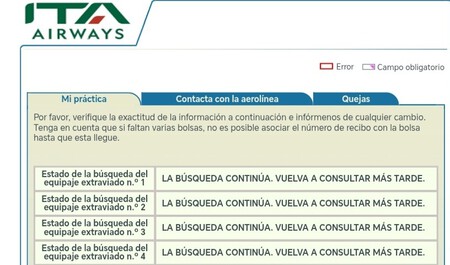
From there, an ordeal of calls and email and website checks begins to see if there is progress in the investigation of the airline company. Not to mention the waste of time buying clothes, hygiene products, beach towels, footwear…. Because in addition, you buy those things little by little, with the hope that your luggage will end up showing up.
What are you really entitled to?
This is where there are usually the most gaps, because many people do not know that there is an international regulation that regulates this. This is the Montreal Convention, which sets the limits of airlines' liability in the event of loss, damage or delay of luggage. Since the December 2024 update, this limit stands at 1,519 SDR (Special Drawing Rights), which is equivalent to approximately 1,920 euros per passenger, as AirAdvisor explains in detail in its guide to the Montreal Convention.
This limit is the maximum that can be claimed, unless at the time of check-in you have made a special declaration of value by paying a supplement, something that almost no one does and that makes sense especially if you carry valuable items in your checked bag, something that is generally not recommended.
It is advisable not to confuse this agreement with Regulation (EC) 261/2004, which regulates compensation for delays, cancellations and denied boarding, not for lost luggage. They are two different regulations that are sometimes mixed, and that cover different travel situations.
The deadlines that make the difference between delay and loss
Sometimes the suitcases appear the next day, others a week, others return home once the vacation is over. And in other cases, they never return. In our case, part of the luggage arrived at our house a week or so after returning to Spain, pending the arrival of one last suitcase that seems to have flown through Lisbon and Rome before returning to Palermo.
In this sense, it is important to know that the airline has a period of 21 days from the date on which it should have delivered the luggage to consider it officially lost, and not simply delayed. After that period, even if the suitcase appears later, you have the right to claim the maximum compensation established by the Montreal Convention.
In addition, the deadline for filing a claim through court, if the airline does not respond or does not offer reasonable compensation, is two years from the arrival of the flight or from the date on which it should have arrived. In practice, most complaints are resolved first through administrative channels, by submitting the PIR and the corresponding supporting documents through the airline's own complaint form or a consumer organization. At this point, it is important to save the invoices for what you had to buy throughout the trip due to the loss.
Connections, the weakest link of the trip
If there is a time when a suitcase is likely to get lost, it is during a connection. When you check in at origin and your flight has a stopover, the luggage passes through more hands, more belts and more planes, and any delay in the first leg can leave the suitcase on the ground while you are already boarding the next flight. This is just what happened to me.

Iberia put us on their flight to Rome, and from there, they offered us a ticket to Palermo on an ITA Airways flight. The problem is that our flight left late, and arrived in Fiumicino at 7:00 p.m., instead of at 6:00 p.m., which was the scheduled time. Our flight with ITA left at 20:00, and in fact, we almost missed the flight. And that was where our suitcases stayed.
And that point is key to determining who is in charge of searching for the suitcase. Iberia washed its hands, because the final destination was operated by ITA Airways. And according to the Montreal protocol, the responsibility falls on the last company that operates the route, even if the delay occurred on a section operated by another airline, and even if the ticket is part of a single itinerary. It is an important nuance, because many people assume that they have to complain to the airline with which they flew the first leg, and in reality, that is not the case.
What you have to do yes or yes: be careful with hand luggage, it can also be taken into the hold at the last second
To avoid problems, and if you have to check-in because you are away for a long time, always carry a carry-on suitcase with everything you need to survive if your suitcase is lost. And even so, you should know that if the luggage spaces in the cabin are full, the airline may ask you to take your carry-on bag to the hold. Therefore, it is important to carry a backpack with medication, hygiene products, a day's change and your most valuable belongings.
Carrying all of this in your backpack greatly reduces the initial stress level while the incident is resolved. It is also essential to always save your flight and luggage documentation until the trip is over. Furthermore, it is important not to give up on your suitcase at the first opportunity, nor to resign yourself to the fact that the airline is not going to do anything: even if you feel like you are hitting a wall and with the lack of empathy from the people on the other end of the phone, you have to calmly complain and save each document and each written communication, since that is what in the end makes the difference between being left with nothing and recovering, at least, financial compensation that helps alleviate the displeasure.
It also doesn't hurt to take out insurance that covers the event that the suitcase is not found. And as an alternative, and to avoid having to wait to check-in, collect suitcases, or avoid loss, more and more people send their luggage by courier. In addition, they usually have quite competitive prices so that it is even cheaper than invoicing.
Photographs | John Waco,jr, Eric Prouzet, Miguel Ángel Sanz on Unsplash Eric Prouzet
In Xataka | Today in Action (and discounted) the solution to have light in the patio, terrace or garden without the need for plugs
In 3D Games | “We will treat the players like kings and queens.” Not playing GTA 6 at launch will be rewarded in a popular game as a service