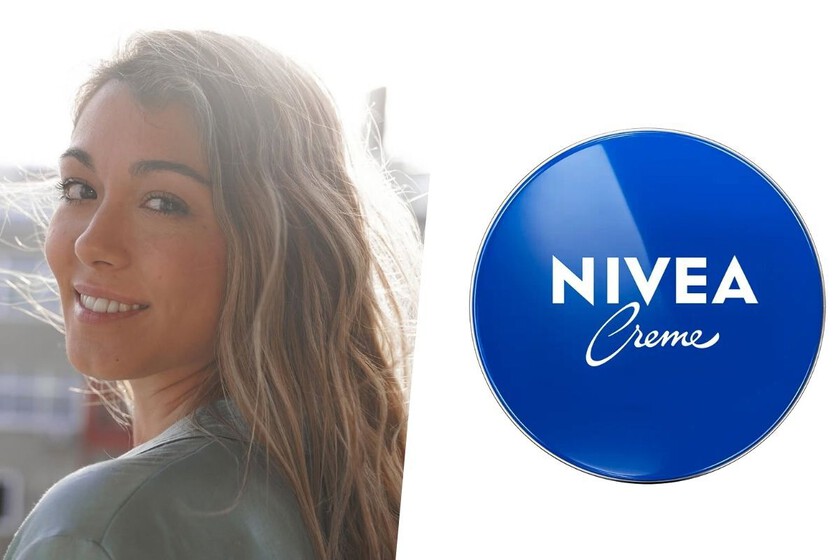
There are classics that never completely disappear, but suddenly they are everywhere again. This is what has happened with the legendary Nivea cream in the blue can, which in recent times has regained prominence thanks to social networks. TikTok and Instagram have once again put the focus on this lifelong staple, showing that, decades later, it still has a place among the most sought-after beauty products.
It is true that now more than ever we are looking for a minimalist routine and versatile products that can fulfill several functions. And that is where the traditional Nivea has found its great opportunity: it has become a true wild card of beauty to which countless uses are attributed, from treat wrinkles until you use it as a hair mask or even as a makeup primer.
Now, to know how much truth there is in these uses and to separate reality from the trends that circulate on social networks, we wanted to have the opinion of pharmacist Miriam Arenas (@farmatologist), who has helped us resolve some of the most common doubts about this mythical cream. One of them has to do with its application on the face, since many women have incorporated the blue canned Nivea into their facial routine. But is it really suitable for use on the face?
The expert clarifies that by “power it could be used, but it would not be my first recommendation, or at least not in a generalized way,” she points out. “There may be very, very dry skin, especially in cold and dry climates, that has the skin barrier very damaged because they have used it and it suits them well. But that does not mean that it will suit all skin types in the same way,” he explains.
As we well know, each skin has different needs and, therefore, not all creams work the same for all people. Exactly the same thing happens with the Nivea in the blue can: “For example, for oily, combination or acne-prone skin, I prefer to recommend lighter, less occlusive formulas that have a composition suitable for this type of skin,” says the pharmacist.
The important thing, as Arenas indicates, is to individualize. “Just because a cream works well for one skin does not mean that it will work well for all. Just the opposite, just because a cream does not work for one skin does not mean that it will not work for any skin. Individualized advice for each skin is important,” he says.
For what type of skin is Nivea cream in the blue can recommended?
The blue can Nivea is known for its dense and creamy texture, a characteristic that can already give us some clue about the type of skin it can best adapt to. Even so, it is still one of those creams that raises doubts about whether it is really suitable for everyone.
“The Nivea cream in the blue can is a timeless classic with an emollient and occlusive formula, which means that it softens, reduces dryness and prevents water loss. Therefore, it is indicated for dry and very dry skin. And especially those areas that are more prone to dehydration such as hands, elbows or knees,” Miriam highlights.
A LOOK AT…
SHEIN
Style guide for autumn: power dressing, retro remix and folk revival within reach of your wardrobe
“Although not so dry skin can also use it. But perhaps this type of skin finds it too dense and prefers to opt for other lighter and less heavy formulas.”
Among the ingredients of Nivea cream is paraffin, which is a petroleum derivative. Should we avoid it?
Here the expert is super clear, “no, we do not have to avoid certain ingredients simply because they are derived from petroleum,” she points out. For example, “Vaseline and paraffin are ingredients widely used in cosmetics, and when they are correctly purified, they are safe for the skin,” adds the pharmacist.
In addition, Miriam also highlights that these ingredients have a very interesting function “because they create a kind of protective film that helps prevent the skin from losing water and keeping it hydrated,” she says. Something essential to keep the skin hydrated and without dryness, and achieve a healthy, soft and comfortable appearance.
“So rather than focusing on whether an ingredient “sounds good or bad” due to its origin, what is important is its degree of purification, its toxicological characteristics and, above all, that it complies with European cosmetic legislation. That is what makes a product safe,” the professional clarifies.
Nivea as an anti-aging cream, yes or no
There are many comments that we find on social networks from people who claim to use Nivea cream to prevent or reduce wrinkles. However, “I would distinguish between hydrating/protecting the skin and having a specific anti-aging effect. Well-hydrated skin can look smoother and small expression lines may be less visible. Dry skin is less flexible, folds more easily and expression lines are more marked,” explains Miriam.
In fact, the pharmacist comments that hydration is important to improve the appearance of the skin, “but that does not mean that a moisturizing or protective cream has anti-aging action as such,” she clarifies.
“Therefore, I would not expect classic Nivea to treat wrinkles or directly stimulate collagen production. It can be part of a minimalist routine, but it does not replace the pillars of anti-aging care, especially photoprotection, antioxidants or transformers,” emphasizes Arena.
In Xataka | Today at Lidl, for 9.99 euros, the folding table to use your laptop and tablet on the sofa or bed: it has a drink holder and even a drawer
In DAP | Ferran Adrià: “My wife and I thought about having children, but we had to decide between that and my career”