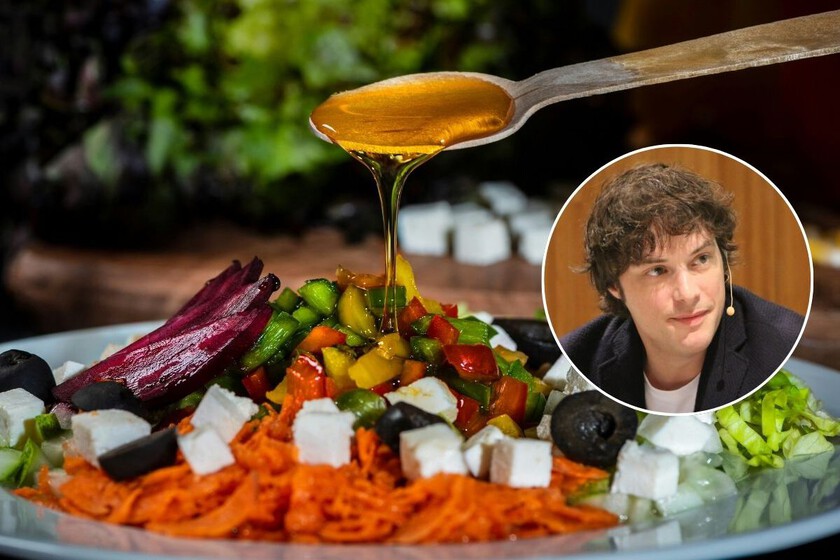
There are gastronomic debates that never seem to be resolved: does the potato omelette have onion or not? Is the pasta rinsed? Is the coffee drunk before or after dessert? And, in a category that goes more unnoticed, there is another that has probably been the protagonist of more than one discussion over a salad bowl: what do you add first? Oil, vinegar or salt?
Jordi Cruz has a clear answer. The Catalan chef has shared his particular way of dressing a salad on TikTok and, although he recognizes that each person can do it “in the order and quantity they want”, there is a sequence that, in his opinion, makes the most sense from the point of view of culinary logic: first the vinegar, then the salt and, finally, the oil.
The reason is the way these ingredients behave when mixed. As Cruz explains, salt needs an aqueous medium to dissolve and vinegar allows generating a solution in which the salt can be integrated. Oil, on the other hand, can act as a barrier and make it difficult for salt crystals to dissolve properly.
The result of adding the oil first can therefore be to find small grains of salt that have not been well integrated into the dressing. A seemingly minor issue, but one that can completely change the experience of eating a salad.
So, in the sequence proposed by the cook, first the vinegar is added, then the salt and the mixture is beaten to dissolve it. Only then does the fat (oil) arrive and everything is mixed again until a homogeneous dressing is obtained.
It does not mean that a salad will be inedible because the order is altered, but it is a technical recommendation if we want the salt to be distributed correctly throughout the dressing.
Jordi Cruz's vinaigrette recipe that is prepared in seconds
And if the goal is to stop improvising with quantities, the chef also shares a simple formula to prepare a vinaigrette at home. Its proportion starts from 150 milliliters of olive oil and 50 milliliters of the vinegar that we like the most. To this mixture add 3-4 grams of salt and 15 milliliters of water, an ingredient that if added, as he explains, helps to achieve a more stable emulsion.
In addition to water, to turn that basic mixture into a more elaborate vinaigrette, you just have to add mustard and honey and emulsify for a few seconds. Cruz suggests incorporating 10 grams of mustard and 10 grams of honey, although he leaves open the possibility of adapting it to taste.
Once all the ingredients have been gathered, simply place them in a food processor or work with a whisk for a few seconds. The objective is to integrate all the components well until obtaining a homogeneous vinaigrette.
The formula also allows you to play with the balance between acidity, fat, salt and sweetness. To do this, you can use the vinegar that you like the most and add or omit the mustard and honey depending on the type of salad you are going to prepare.
Cover photo | eeyush Kale and univgirona
In Motorpasión | Juan José, mechanic: “to go over bumps and not break down the car you have to slow down and accelerate progressively”
In The Salmon Blog | Mario, Spanish farmer in Australia: “I earn 1,808 euros every week, the difficulty is putting up with working so many hours for several months”