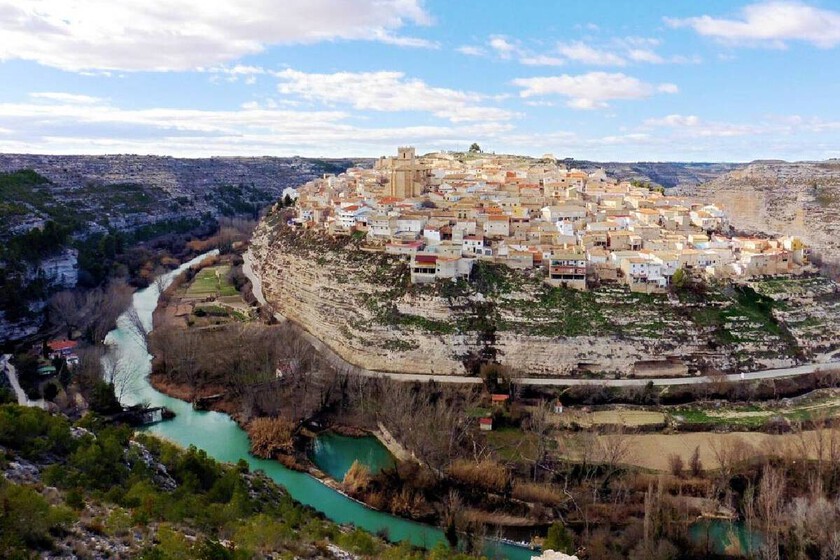
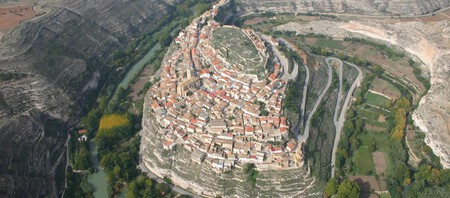
In Jorquera, the Júcar river seems to have surrounded the town for good measure. The water draws an almost perfect meander around the rocky spur on which this small town in Albacete stands. From the viewpoint located before entering, its houses can be seen piled high and protected by the remains of a medieval wall. It is difficult to decide if what we are looking at is a town or an island in the middle of the rest of the peninsula.
Only 356 people live in Jorquera, which belongs to La Manchuela, a region whose landscape has little to do with the completely flat image that we usually associate with this part of Spain. Here the Júcar has been excavating gorges, gorges and ravines among which appear towns perched on the rocks and small villages hidden next to the water.
Spanish association of friends of castles
What to see in Jorquera
The best place to understand the strange shape of Jorquera, as we said, is its viewpoint. The panoramic view allows you to see how the river breaks the plain and embraces the promontory on which the hamlet sits. Of course, once inside, you have to walk through its steep streets and look out to the ends of the town, where the facades end practically at the edge of the canyon walls.
In the highest part, the walls of Almohad origin are preserved, built as part of the Muslim defensive line built along the Júcar during the 12th and 13th centuries. Its high walls and prismatic towers have been protected as an Asset of Cultural Interest since 1980. Within the old fortified area there is also the castle, whose space is currently occupied by the municipal cemetery. This is truly dying with a view, but really.
Santiago Lopez-Pastor
Also notable is the White Tower or Doña Blanca, built in the mid-15th century to defend one of the entrances to the town. Local legend, however, says that it was built to keep a woman named Blanca captive. Since August 2026, it has housed a new interpretation center dedicated to the medieval history of Jorquera and its relationship with the Júcar valley.
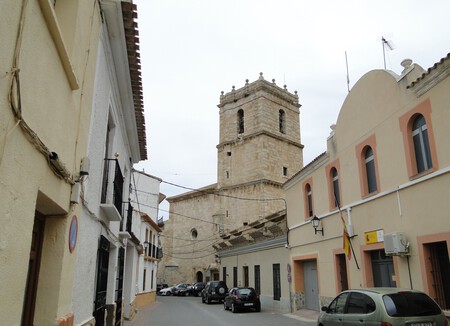
The walk continues through the church of Santa María de la Asunción, the Casa del Corregidor and the old noble houses, on whose facades you can still see stone shields. Further down, next to the river, there is a recreational and bathing area that in summer allows you to see the town from another perspective. POV: with your feet in the water and the walls suspended above your head.
Jorquera Town Hall
Where to eat delicious and cheap in Jorquera
To try traditional La Mancha cuisine, one of the most affordable options is the Ruti Restaurant Bar. It has a terrace with views of the Júcar gorges and its menu includes local dishes such as Manchego gazpachos and ajo mataero, as well as rice dishes and tapas. In the center of the town is the Hogar del Jubilado, a simple bar where you can stop for a snack without turning the meal into the entire budget of the getaway.
Next to the dam is La Playa de Jorquera, a restaurant surrounded by the river and specializing in rice and grilled meats. Its name is not a poetic license: the complex has a sandy area, natural pool and small waterfalls. The City Council's official guide also includes the Mirador Restaurant, located next to the municipal swimming pool and with traditional dishes and tapas. It is a good idea to check the hours before going, as some establishments may operate seasonally.
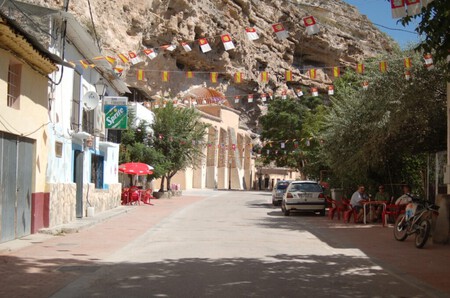
Jorquera Town Hall
What to do around Jorquera
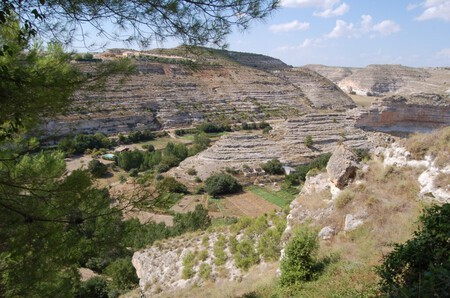
About 11 kilometers away is Cubas, a tiny district nestled in the Júcar canyon. Its cave houses are excavated in the stone walls and its sanctuary of Nuestra Señora de Cubas appears protected under an enormous limestone cliff. The road that connects both places runs alongside the river between orchards, vegetation and vertical walls, so the journey is part of the excursion.
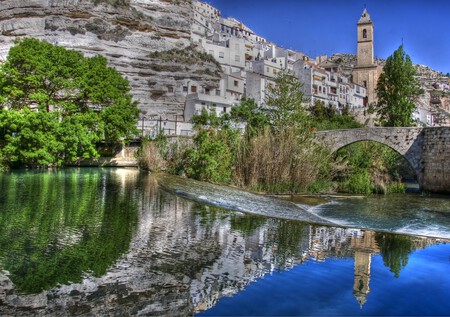
Pacodonderis
The getaway can be completed by following the course of the Júcar to La Recueja and Alcalá del Júcar, one of the best-known towns in Albacete, located just over 20 kilometers away. Another possibility is to walk one of the paths along the banks of Cubas or go to the viewpoints included in the scenic route of the Júcar River.
Cover photo | La Manchuela Tourism
In DAP | The three customer attitudes that burn out hoteliers the most: “I feel like telling them that we don't have room.”
In Xataka | “Disgusting and Despicable”: released 48 years ago, it is one of the most censored films in the history of cinema