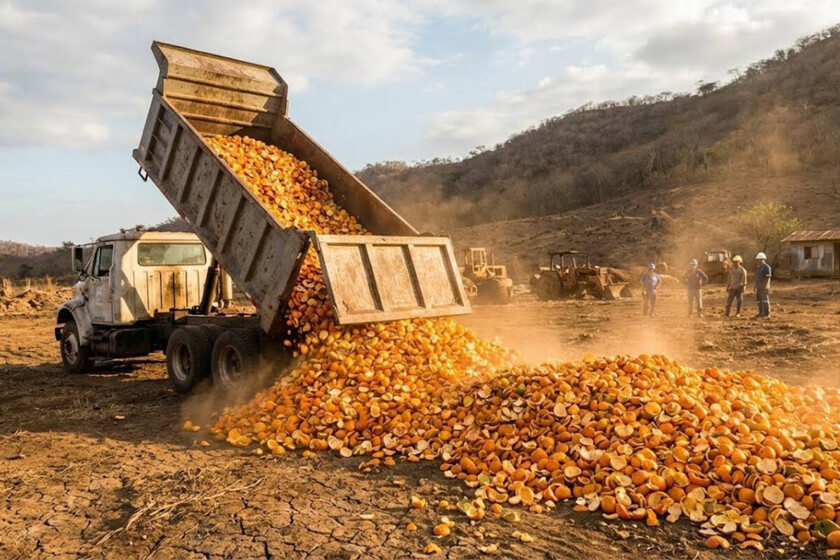
There are scientific experiments that sound good on paper and others that, in truth, seem like a joke. The one I present to you today belonged to the second group. Imagine a scene in which 12,000 tons of orange peels are dumped on a parched, almost dead field. Anyone would think that this was going to end in disaster. It wasn't even remotely like that. When scientists returned years later to assess what had happened, they found that the landscape had changed so much that they had a hard time finding where it had been done.
From biologically lost land to waste disposal area
We have to go back in time to fully understand what happened. This curious story took place in beautiful Costa Rica in the 90s. Near the Guanacaste Conservation Area, with several national parks and a wildlife refuge, the Del Oro juice company was installed. This company needed a place to dispose of orange peels, and had several forested lands adjacent to the park that it had no intention of cultivating, so it reached an agreement born from an original idea by Daniel Janzen and Winnie Hallwachs, ecologists at the University from Pennsylvania and graduates of Princeton.
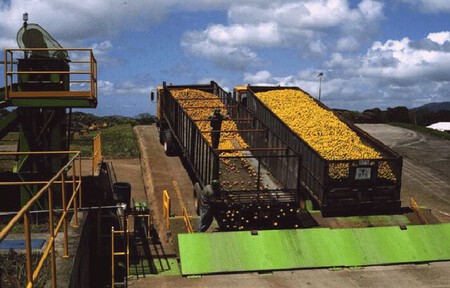
The couple, who worked for many years as researchers and technical advisors in Guanacaste, presented a proposal to Del Oro: if it donated part of its forest land to the Guanacaste Conservation Area, the company could deposit its orange peel waste for biodegradation, free of charge. They would be dumped on a part of the land, infertile and dry, that could not regenerate on its own, within Guanacaste.
For a year, a thousand trucks dumped orange peels and pulp on the land. 12,000 tons in total until the Supreme Court of Costa Rica ruled in favor of TicoFruit, a rival company that filed a lawsuit alleging that a national park had been “desecrated.” The land was already covered in orange peels, and was practically forgotten for the next 15 years.
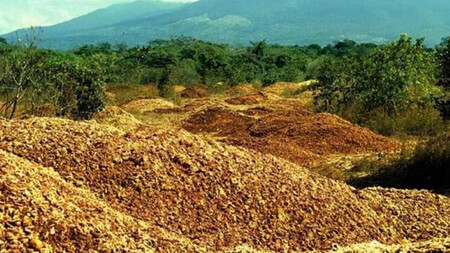
A sample of the 12,000 tons of orange peels dumped in Guanacaste. ©Daniel Janzen & Winnie Hallwachs.
The impressive change in Costa Rica
Although Janzen explained to Timothy Treuer, also an ecologist at Princeton University, that some taxonomists had gone to the area, there had been no real analysis after so many years of what the oranges had caused. According to Treuer, “waste disposal is not normally associated with benefits for biodiversity, something that is good for the environment,” but in 2013, when they returned to the area, they saw that it had gone from a desert to a completely different area. Leafy, lush and with so much vegetation that Treuer himself claimed “it was all so covered with trees and vines that I couldn't even see the 2 meter long sign with bright yellow letters that marked the place, which was just a few meters from the road.” Just a few months after the beginning of the experiment, it was seen and then disappeared among the exuberance.
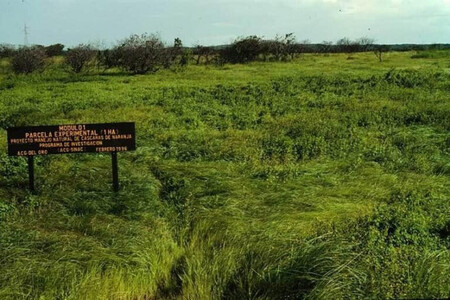
The orange peel waste had transformed the land into a jungle with three times the diversity of tree species as the adjacent control plot, more fertile soil, and much denser vegetation cover. The experiment was a success and according to the research, growth induced by the orange peels occurred. Although it is not known exactly what happened, the main hypothesis is that the husks enriched the depleted soil while smothering invasive grasses that prevented young trees from growing. In six months, the orange waste transformed a soil that recovered land that had been ecologically blocked for years.
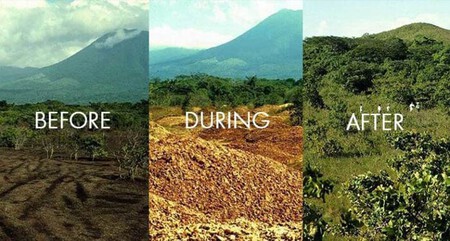
Evolution over time. ©Daniel Janzen & Winnie Hallwachs.
“It is unfortunate that we live in a world with degraded ecosystems and nutrient scarcity, but also with waste flows rich in nutrients. We would like these two factors to be integrated,” said Treuer. Costa Rica is a country that changes your life in a thousand different ways, and an example of it is possible that those two factors that the ecologist talks about can be integrated. This story is living proof that it can be achieved and that if there is a place in the world that is “pura vida”, it is Costa Rica.
In Xataka | Los Angeles has been painting its streets white for a decade to combat the heat. It's not the best idea
In DAP | Andrés Madrigal, chef: “To make garlic prawns, I introduce the garlic and chilli from the cold so that the oil slowly absorbs the aromas”