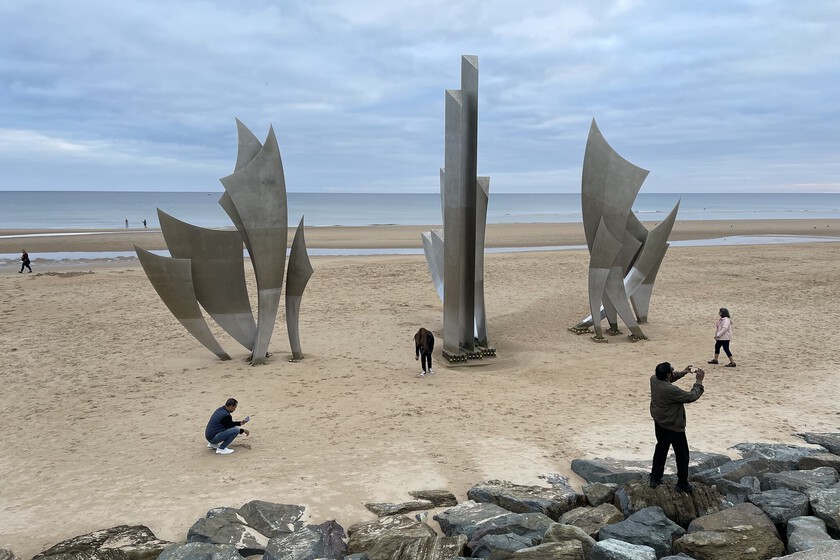
History is not always preserved in museums, archives or even monuments. Sometimes it can also be preserved on a beach in Normandy, where the passage of time has not completely erased the traces of the Allied landing in 1944. Because it turns out that, more than eight decades after D-Day, the memory of that military operation continues to be hidden among the grains of sand on Omaha Beach.
This is not a metaphor. It is a reality that can be measured and observed, even if this requires a microscope. It all started almost by chance in 1988, when Geology professor Earle McBride, from the University of Texas, and geologist Dane Picard, from the University of Utah, took advantage of field work in France to visit Omaha Beach, one of the most emblematic beaches of the Normandy landings.
That day the weather was not good. The wind, the cold and an unfriendly sky made the walk along the nearly eight kilometers of beach not particularly pleasant. However, before leaving, both scientists did something that any geologist would consider a perfect souvenir: they saved a small sample of sand.
It took a while until they decided to analyze it in the laboratory. And that's when an unexpected discovery appeared…
Follash
When the microscope revealed what the eye could not see
Among the usual grains of quartz and other minerals, McBride detected tiny metallic fragments with very particular characteristics. They were rounded, rough, laminated particles with a dull shine dotted with small spots of rust. Some were barely a millimeter in diameter and others were even smaller, just 0.06 millimeters.
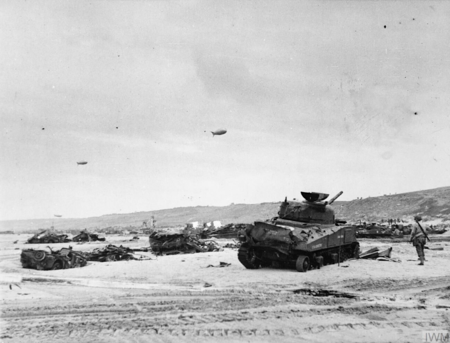
After examining them in more detail, the conclusion was as surprising as it was logical: those particles were shrapnel remains from the Allied invasion during World War II. In addition, the researchers also identified small iron and glass spheres formed by the very high temperatures generated by the explosions upon impact on the sand.
The research was later published by McBride and Picard in the journal The Sedimentary Record, where they documented a discovery that showed that a battle continued to leave a physical mark on the landscape decades after it occurred.
4% of sand has war origin
Beyond the symbolic value of the discovery, the study made it possible to put figures on this invisible presence of war. After analyzing the sample, the researchers calculated that approximately 4% of the sand collected at Omaha Beach was composed of tiny metal debris derived from the battle.
The scientists themselves warned that this percentage could vary depending on the exact place where the sample was collected or the sea conditions at that time. Currents and the constant movement of waves can concentrate or disperse both shrapnel and other heavy minerals, so the data does not necessarily represent the entire beach.
A memory that will also disappear
Omaha was one of the main Allied landing sites during Operation Neptune, although not the only one. The troops also reached the beaches of Utah, Gold, Juno and Sword, which today are part of the historic Normandy tour.
While it's surprising that these tiny fragments have survived for so many decades, geologists believe they won't last forever either. The iron continues to slowly oxidize. Additionally, the constant movement of the waves removes some of the surface rust, exposing new metal that corrodes again. That process is repeated over and over again, making the fragments smaller and smaller.
In 2011, when they published their study, McBride estimated that it would still take about a century for this metallic presence to be reduced to practically imperceptible in the sand of Omaha Beach. When that moment arrives, the beach will have lost one of its most tangible memories. The memorials, military cemeteries and collective memory of one of the most decisive episodes of the Second World War will remain, however.
Cover photo | Person-with-No Name
In Xataka | Archaeologists have unearthed a jar in France filled with tens of thousands of Roman coins from 1,800 years ago.
In DAP | White vinegar and cleaning vinegar are not the same: how they are different and how to use them well