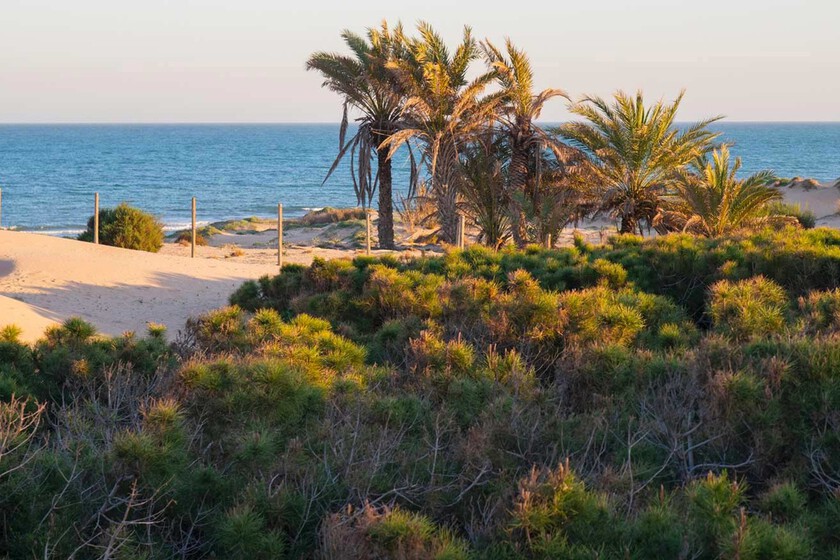
If an art director obsessed with mixing impossible scenarios designed a coastal destination in the Spanish Mediterranean, the result would probably be Guardamar del Segura, in the south of Alicante. A landscape dominated by the dunes next to the beach, where they are the protagonists of a story that was about to change the destiny of the town forever.
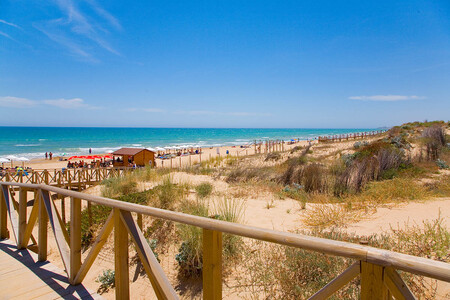
Between the tourist hyperactivity of Torrevieja and the overcrowding of Santa Pola, Guardamar tends to remain off the radar of many visitors. And perhaps that is precisely where part of its charm lies. However, behind its eleven kilometers of golden sand lies one of the most surprising forestry engineering projects in Spain. It is an 800-hectare forest planted to prevent mobile dunes from burying the town.
Tourism Guardamar
The result is a landscape different from the typical one of the Costa Blanca. Stone pines, palm trees, cypresses and eucalyptus stand out from mountains of fine sand that end up crashing into a turquoise Mediterranean. At times it is more reminiscent of the French Landes or certain corners of North Africa than of the Alicante coast.
June is probably one of the best times to discover it, when the heat already invites you to spend the day on the beach, but the forest mass still provides a pleasant sensation of freshness that completely transforms the experience compared to other more suffocating destinations on the Levantine coast.
What to see in Guardamar del Segura: dunes, castles and monasteries hidden under the sand
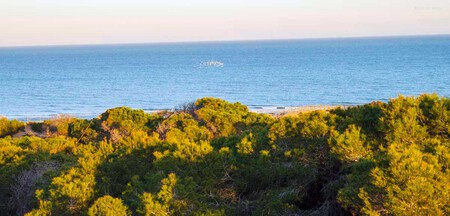
The history of Guardamar is told directly by the landscape. At the end of the 19th century, the dunes advanced, driven by the wind, threatening to swallow crops, roads and even part of the urban centre. The solution came from the engineer Francisco Mira, who proposed and promoted a gigantic reforestation between 1900 and 1930. Thanks to that project, the current Pinada de Guardamar was born, one of the most spectacular dune forests in the Spanish Mediterranean.
Tourism Guardamar
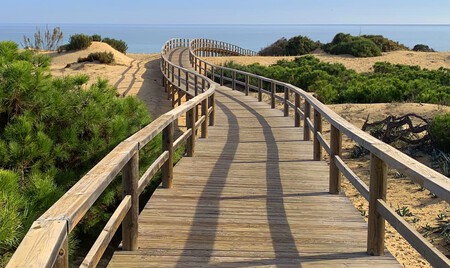
Walking through Alfonso XIII Park continues to be the best way to understand that feat. The trails cross an ecosystem where sand appears and disappears between roots, trunks and wooden walkways while the sound of the sea constantly accompanies the journey.
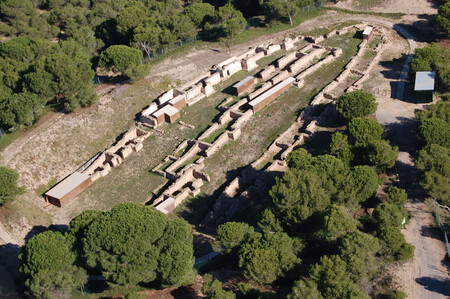
But Guardmar holds another much less known surprise. Among the dunes themselves appears the Rábita Califal, an Islamic monastery from the 10th century considered one of the best preserved Muslim monastic complexes on the Peninsula. Its small oratory cells literally emerge from the sand, creating an image that is difficult to forget. Nearby is also the Phoenician site of La Fonteta, demonstrating that this corner of the Mediterranean was already strategic long before the arrival of tourists.
Hello Heredia
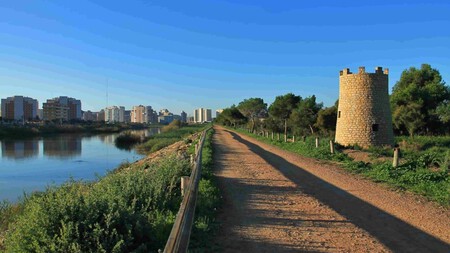
The visit can continue at the MAG, the Archaeological Museum of Guardamar, where the historical importance of the area is explained and where the discovery of the famous Lady of Guardamar is remembered. Although to obtain the best possible panoramic view of the place it is advisable to go up to the Guardamar Castle, located on the hill that dominated the old walled city before the earthquakes of 1829. From there the landscape takes on another dimension: the Segura River, the orchard, the dunes and the sea appear in harmony in a single image.
The mouth of the Segura, known as La Gola, is also worth a leisurely stop. There the river ends its journey after crossing the entire Vega Baja and creates one of the most interesting natural spaces on the Alicante coast, especially for observing aquatic and migratory birds.
Turimes Guardamar
Where to eat delicious and cheap in Guardamar del Segura
The local cuisine revolves around two undisputed protagonists: the ñora and the Guardamar prawn, famous for the reddish, yellow and purple tones of its tail. In June, many restaurants also participate in the traditional Setmana Gastronòmica de la Nyora i el Llagostí, one of the most interesting gastronomic events on the Costa Blanca.
To try good rice dishes without falling into tourist prices, a safe bet is Restaurante El Jardín. Located in front of the sea, it stands out for its Mediterranean rice dishes and a glass terrace that allows you to eat practically on the beach. Especially recommended is the senyoret rice and the fideuà they serve.
Another interesting option is Restaurante Luna Arrocería, a simple place where all the focus falls on rice dishes and traditional Mediterranean cuisine. Although if you are looking for a hearty meal like the locals, Arrocería Candela is one of those recurring names that neighbors pass around by word of mouth when talking about value for money in the area.
Tourism Guardamar
It is best to order some rice made with ñora and accompany it with fresh fish. In the end, much of Guardamar's gastronomic charm lies in continuing to function as a real fishing town even in the height of tourist season.
What to do around Guardamar del Segura
One of the great privileges of Guardamar is that it allows you to completely change the landscape in just a few kilometers. Towards the north appear the wild dunes of Tossals beach, one of the most natural stretches of the entire coast. Towards the south, Moncayo Beach preserves part of the original dune system and continues to offer that increasingly rare feeling of spaciousness and personal space even in the middle of summer.
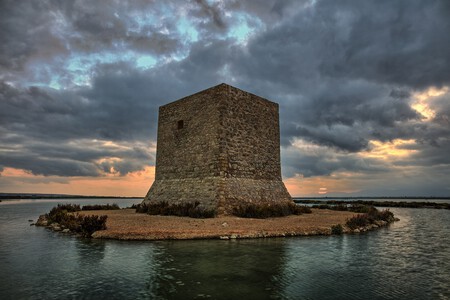
If you want to continue exploring unusual ecosystems, the nearby Lagunas de La Mata and Torrevieja allow you to discover a landscape of wetlands, flamingos and pink waters that seems taken from another continent. Also very close are the Santa Pola Salt Flats and the El Hondo Natural Park, two true paradises for fans of saltwater. birdwatching.
Werner Wilmes
And for those who want to combine sea and history, a getaway to the Island of Tabarca continues to be one of the most recommended plans in the province. Its transparent waters, its ancient walls and its leisurely character fit perfectly with the philosophy of a trip to this part of the Costa Blanca.
In summary: Guardamar offers immense beaches without a feeling of saturation, forests that were born to save a town and Islamic monasteries hidden among dunes. And that, on a coast where it seems that everything is already discovered, overcrowded and exploited.
Cover photo | Tourism Guardamar
In Xataka | In 1972 Italy wanted to fit an entire city into a one kilometer building. Half a century later he is still paying the consequences
Live to the palate | Samantha Vallejo-Nágera, chef, and her best recipe with zucchini: “It is delicious baked with eggs, onion and yogurt”