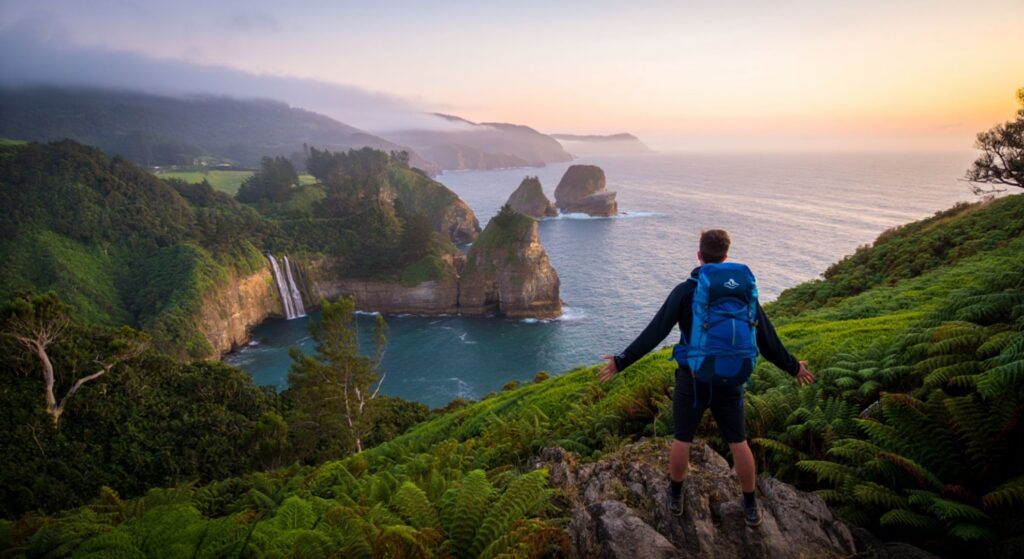
The map of New Zealand overflows with famous tracks, yet some paths still keep a whisper to themselves. On a far northern headland, a trail slips along cliffs so sheer the sea seems to breathe at your feet. Few visitors make it this far, and that’s exactly why the experience feels like discovery. “You hear your own heartbeat out here,” a hiker told me, “and the wind answers back.”
A headland that still feels secret
This peninsula sits beyond the usual loops of campervans and coach tours, which is half its charm and half its challenge. The access road winds through small settlements, and a permit is required to cross private land managed in partnership with local iwi. The result is a track that remains quiet, even on bluebird weekends.
It’s not ignored because it’s ordinary; it’s overlooked because it’s earnest. The gradients are real, the ridges exposed, and the weather can be sharp even in summer. But when the trail crest opens and the ocean unfurls in a 1000-meter panorama, you understand why “remote” is just code for “remarkable.”
A ridge that walks the edge of the Pacific
From Oke Bay, the path climbs through manukā and kanukā, the scent of resin and salt hanging in the air. One moment you’re under green, the next you’re on a narrow spine with the Pacific burning turquoise below. To the north, an island with a perfect window—Motukōkako, the “Hole in the Rock”—punctuates the horizon like a legend.
The lighthouse appears in stages, a white promise pinned to cliffs that seem to lean into the sea. The hut beside it holds a rough romance: bunks, a long wooden table, rainwater you’ll want to treat, and a door that opens to pure sky. “It feels like the end of the world,” someone scribbled in the hut book, and the line still glows like a match.
If you’re short on time, a water taxi to Deep Water Cove can trim the distance and let you walk one way. Most hikers plan a full day each direction, saving room for long pauses where even the gulls seem to hover and listen.
Moments that stop you in your tracks
There’s a point where the path threads a knife-edge, and the sea hammers the base of the cliffs with cathedral thunder. Pohutukawa twist in red bursts above coves so clear you can count kelp in the surge. “The colors look invented,” a friend laughed, and we laughed with her because invention never looked so honest.
On calm days, dolphins stitch the water with quicksilver curves while gannets drop like white arrows beyond the breakers. At dusk, the sky turns pewter, and the light on the tower wakes as if to tell the old story again. Night brings a dome of stars, and the track feels both ancient and alive.
What to know before you go
- A track fee and hut booking are often required; check DOC and local trust sites for current details.
- The hike is long, steep, and exposed; solid fitness and sturdy footwear are essential.
- Carry plenty of water and food; treat rainwater at the hut before drinking.
- Weather shifts fast; pack layers, a headlamp, and real rainwear.
- Respect cultural protocols on iwi land; keep to the track and follow any posted rāhui.
- Boat shuttles can shorten the walk; book ahead in peak season to avoid scramble.
- Clean your boots and gear at biosecurity stations to help stop kauri dieback.
Why it stays under the radar
Big-name walks pull the bright headlines, and this corner doesn’t compete so much as it waits. The narrative here isn’t quantity; it’s quality: one ridge, one lighthouse, one long conversation with weather and water. The land asks for respect, the track asks for time, and together they offer a kind of silence you can actually hear.
It helps that there are no cafés at the trailhead, no queue for the selfie, no shuttle ticking down the minutes. Just you, the next step, the wind speaking in the old language of flax and wave.
Hiking it with care
This place is alive with stories that began long before any guidebook and will continue long after our last footprint. Walk lightly, pack it all out, keep your music in your headphones, and leave the drones grounded unless you have permission. If a fence is closed, it’s closed for a reason; if the track is muddy, it’s asking you to slow down.
Most of all, bring your attention. Notice the small shells in the rock, the way the wind changes pitch along the spurs, the sudden hush when a cloud passes the sun. Out here, “remote” becomes intimate, and the journey repays every step with something you can’t pack but you’ll carry forever.