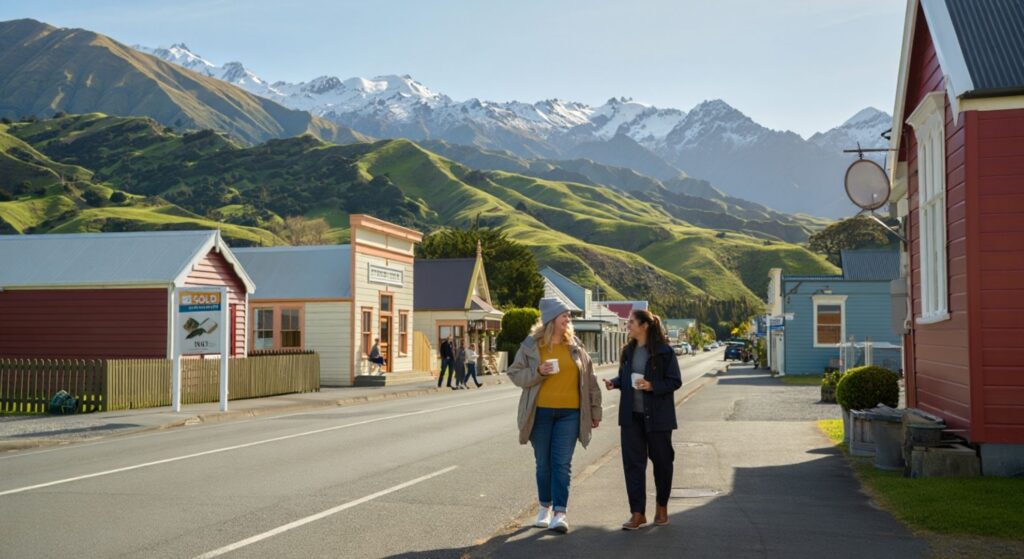
The ferry noses into a quiet cove, gulls skimming low over green water. Signal bars flicker, then vanish, and the wind carries the clean resin scent of rimu and salt. On the far edge of New Zealand, in a town where the streetlights seem to stop out of politeness, people are quietly moving in.
They don’t arrive with fanfare, just duffel bags and a plan to stay put. “I came for three weeks,” says a new resident, “and five years slipped past like a tide.” What looks like distance has become a draw, and the map’s last inlet is turning into a beginning.
At the harbor’s rim
Mornings start with slow boats and faster weather. A single main street threads between timber houses and ferns, ending where blue water folds into hills. Even errands feel a little ceremonial here; you greet the postie by name, and the grocer knows which apples you like.
Night falls early and thick, and the stars arrive with authority. On clear winter evenings, the southern lights sometimes flirt at the horizon, green and ghostly and completely without hurry. “You notice your own breathing,” a local teacher says, “and the world notices you back.”
Why people keep coming
The reasons are not mysterious, just quietly stacked. A few are practical, others entirely emotional:
- Lower housing pressure than the cities, with old fishing cottages becoming warm homes.
- Reliable, island-grade internet that makes remote work actually work.
- A pace that respects your time and demands your presence.
- Daily beauty that feels earned, not algorithmically served.
- A small, strong community that needs you as much as you need it.
Work that fits the edges
The new arrivals are software engineers, marine biologists, photographers, teachers, and people whose job titles fit inside one backpack. “I code to the sound of waves,” says a developer, “and my meeting breaks are literally tide checks.” The routine is deliberately plain. Emails by morning light, lunch from the wharf, a walk through manuka where kiwi shuffle in the undergrowth.
Connectivity took time to mature, but now it is surprisingly solid. You learn the ferry timetables, the freight cutoffs, the difference between a strong gust and something the roof will remember. “We plan two weeks ahead,” a café owner laughs, “and then we improvise like jazz.”
The arithmetic of far away
Isolation breeds its own math, and the sums rarely look the same twice. Groceries arrive on a rhythm, and you cook what’s there, not what a recipe demands. A storm can pause a project, but it also delivers a strange mercy—a sanctioned break, a reason to just watch the water climb and then fall.
Children roam with more permission, and adults recalibrate their urgency. “I used to chase the next thing,” a new parent admits, “but out here the next thing is a tide table or a moonrise time.” Distance becomes a filter, removing the noise while amplifying what matters most.
Community as a verb
Here, community isn’t a noun you visit, it’s a verb you do. The volunteer fire sirens pull everyone from dinner to duty. There’s a communal tool shed, a timebank of borrowed skills, and a noticeboard that functions like a living calendar. “You can’t be anonymous,” says an older fisher, “and that’s the whole point.”
The town practices “slow welcome” rather than glossy promotion. New faces are invited to show up—potluck, beach clean, school concert—and to keep showing up. The reward is not just friendship, but a role in a machine that refuses to run on autopilot.
Nature that argues softly
Nothing here is spectacular in the billboard sense, and that’s the seduction. The Rakiura bush breathes in broad strokes, tui loop through sunlit gaps, and low tide paints the eelgrass a velvet green. At night, kiwi step out with old dignity, unbothered by your quiet awe.
“Some places shout; this one whispers,” a ranger says. “If you pay attention, it tells you exactly why you should stay.” The pitch isn’t a slogan, it’s the slow accumulation of unremarkable, precisely human days.
Growing without losing the thread
With every newcomer comes a question: how to grow without becoming elsewhere. Housing needs a careful hand, supply chains need more redundancy, and the wild edges deserve ongoing respect. Local iwi remind visitors that the land isn’t just scenery but a relationship with real obligations.
No one pretends it’s simple. But the town has a habit of solving problems sideways: shared vans instead of more cars, a co-op freezer, flexible schedules that slope around the weather. “We don’t scale,” a librarian grins, “we sharpen the focus.”
In the end, people stay for reasons both obvious and stubbornly personal. They wanted less noise and found more signal. They traded convenience for clarity, then discovered the swap was better than advertised. The ferry leaves, the lights dim, and the quiet slides back into its seat—making room for whoever decides to join it next.