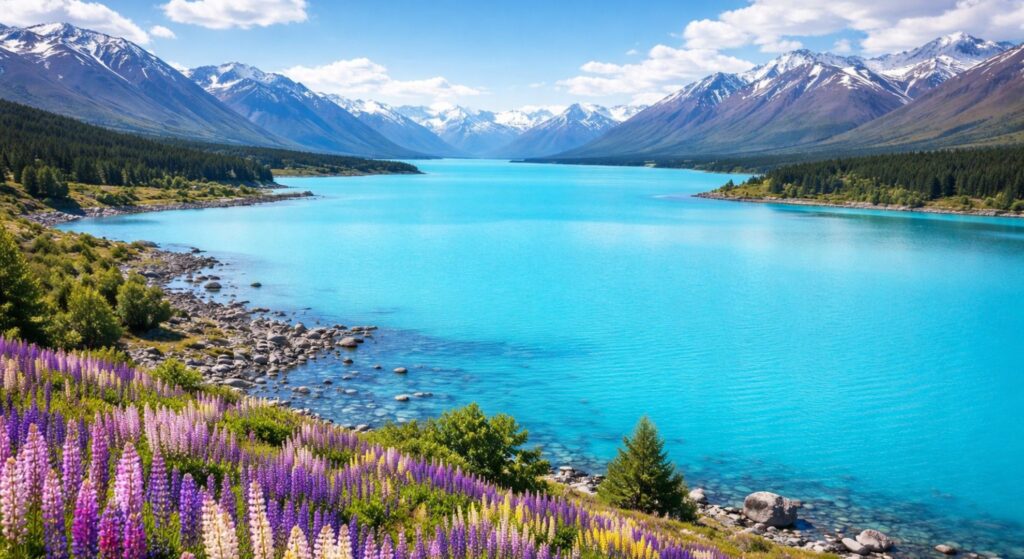
The water looks different each season, and lately, it’s been hard to pretend it’s just a trick of the light. Photographers chase the same shoreline and come home with entirely new palettes; locals swap stories of sudden shifts after storms. “Color is a signal,” people like to say here, and the signal is getting louder.
A lake that won’t sit still
Across New Zealand’s South Island, one alpine basin keeps rewriting its own shade. Fed by glacial rivers and capricious mountain weather, the lake can swing from milky turquoise to deep, glassy blue—and sometimes a bruised green—over a single year.
What used to feel like a seasonal rhythm now arrives in sharper peaks and stranger troughs. “The lake is a sensor,” goes a frequent refrain, “and the catchment is the story it’s trying to tell.”
Why the color flips
Color, at its core, is physics plus ecology. Different particles scatter and absorb light, and the mix changes with flow, heat, and life.
- Glacial “flour” adds that iconic turquoise by scattering blue-green wavelengths, while big melt or rain events deliver extra mineral loads.
- Warm, calm spells can spike phytoplankton and cyanobacteria, tilting water toward green or brown, especially when nutrients are high.
- Strong winds churn deeper layers, resuspending fine sediments and muddling the clarity.
- Low sun angles, cloud cover, and fresh snow on nearby peaks alter what our eyes perceive, even when chemistry hasn’t changed much.
In short, the lake’s color is an ever-updated ledger, recording what’s flowing in, how the water is mixing, and which organisms are waking up.
The climate twist
A warming atmosphere is not a backdrop—it’s an active editor. Earlier snowmelt and more intense downpours push sudden pulses of silt-rich water into the basin. Hotter summers lengthen stratified periods, favoring buoyant, bloom-forming species. And wildfire seasons can dust the catchment with ash, priming nutrient spikes after the first big rain.
“Think of color as an integrated metric,” one scientist would tell you: it bundles hydrology, biology, and chemistry. With climate extremes stacking up, the bundle is getting messier.
What scientists are watching
Satellites now read the lake like a weekly diary. Sensors such as Sentinel‑2 can detect subtle shifts in surface reflectance, flagging unusual greens or browns long before they’re obvious from the shore.
On the water, teams track clarity with Secchi disks, measure chlorophyll‑a for algal biomass, and sample the fine mineral fraction that gives glacial lakes their ethereal glow. Drones add hyperspectral detail, mapping bands of color across currents and coves.
There’s also the human record—boaties, anglers, guides, and mana whenua whose observations often arrive first. “If the hue feels off, something upstream has changed,” is a simple rule that rarely steers people wrong.
Why it matters beyond the postcard
Color shapes more than photos. Sudden green turns can signal cyanobacterial blooms, which sometimes produce toxins unsafe for pets and people. Shifts in underwater light alter how plants grow, where fish feed, and how native species compete with invasive ones.
Tourism hinges on the lake’s famed clarity, while nearby towns rely on dependable water for drinking, irrigation, and hydro operations that must balance ecology with energy. When a lake becomes less predictably blue, it often means the system is losing stability.
The mechanics behind a “new normal”
What looks like an aesthetic change is actually a process change. More frequent “atmospheric rivers” can dump rain onto snow, supercharging floods that scour riverbeds and sluice extra silt into the basin. Prolonged heat helps buoyant cyanobacteria outcompete other plankton, tipping the water tint even when nutrients aren’t sky‑high by historical standards.
“Color is a symptom, not a style,” as one field note nicely puts it. When the hue swings wider each year, the diagnosis points upstream and into the air.
What can be done
Some levers are straightforward, some are not. Catchment work—fencing vulnerable stream margins, restoring wetlands that trap fine sediments, and tightening stormwater controls—reduces the raw material that fuels extreme swings. Smarter reservoir releases can damp the sharpest pulses, while keeping more cold water in play during late‑summer heat.
Early‑warning systems help managers pivot quickly: satellite alerts, rapid toxin tests, and transparent public advisories keep people safe without blanket closures. Long‑term, cutting greenhouse gas emissions remains the only lever big enough to ease the pressure behind the trend.
A palette worth protecting
It’s tempting to treat dramatic color as a scenic upgrade, but this spectacle is also information. The same light that thrills a camera tells a story about runoff, mixing, and microscopic life. Paying attention—systematically, humbly, and with the people who live by this water—is how you keep the wonder while fixing what the color is trying to say.
Because when a lake repaints itself year after year, it isn’t just performing; it’s warning. And it’s asking us to read the signal while there’s still time to change the script.