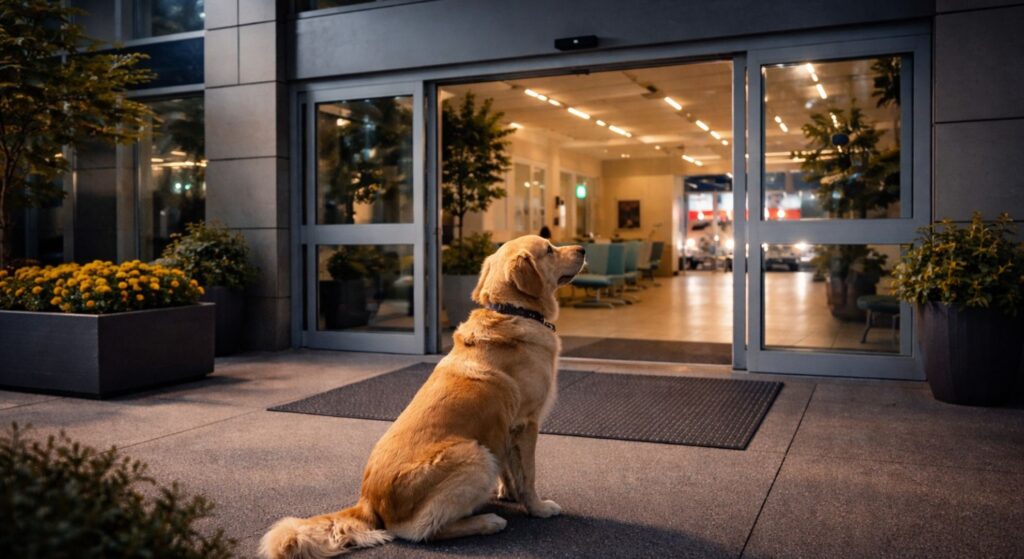
He arrived at dusk, a quiet silhouette against the glass, and settled by the automatic doors as if they were a hearth. The hospital air smelled of sanitizer and rain; his fur smelled of grass and salt. He didn’t whine, didn’t beg, didn’t wander. He simply waited. Staff began to time their breaks to pass by him, tucking a biscuit into a pocket, nudging out a bowl of water. By the third night, someone had given him a name: Tui.
A shadow at the sliding doors
Tui was small but sturdy, ribcage like a bell, eyes the color of tea. He claimed a spot beneath the fluorescents, where cool air pressed out every time the doors hissed. He flinched for no one—ambulances, stretchers, the 2 a.m. rush. He watched each face as if searching for a single one.
“We don’t allow dogs inside,” the security guard murmured, setting down a folded towel. “But he’s got manners. Better than most blokes after midnight.”
Nurses began leaving quietly: a blanket, a clean bowl, a note taped low for children not to touch. They made a space for him without saying they had.
Guesswork and gentle rules
For three evenings, the registry desk watched him. On the fourth, a junior doctor asked if they should call Council, and the answer was a soft no. The night charge nurse shrugged. “If he’s waiting, he’s waiting for someone. We can wait with him.”
They checked his collar—no tag, only a notch worn shiny where a tag had been. Someone posted to a community group. Someone else phoned the after-hours clinic. A porter joked he was a new kind of volunteer. In the lull between beeps and buzzers, the hospital became a village, passing a dog story like a shared thermos.
“Every time the doors opened,” said Hana, a nurse on Ward 5, “his head tilted. You could feel his hope like a real thing.”
The reason that made the ward go quiet
It was the cleaner who knew first. She pointed to a photo on her phone—a man with a knitted beanie, thumbs-up beside a dialysis chair. “That’s Mr. Reeves,” she said. “Lives out by the coast. Comes in for night sessions. Always talks about his dog.”
The room shifted shape. The waiting wasn’t abstract devotion anymore—it had a ward, a schedule, a story. Mr. Reeves had been rushed in the week before, edema swelling and lungs heavy. The ambulance went fast. The dog, left in the drive, must have tracked the scent or the route or the stubborn line all love draws across a map.
When nurses told this to the charge, she sat down, then stood again. “And all this time,” she whispered, “he’s been watching our doors for his person.”
In the dialysis unit, a junior asked if they could move Mr. Reeves’ chair closer to the foyer. Too many rules said no. So someone brought Mr. Reeves a scarf, the one he wore on fishing days, and set it near the entrance. Tui’s nose lifted, then he settled, as if a thread had been thrown from inside to his paws.
“We cried because it was so simple,” Hana said later. “He waited. We made room for the waiting. That was all, and it felt like everything.”
How a hospital learned a dog’s rhythm
By the end of the week, the routine had a shape. Day staff would nod to Tui on their way in, night staff would murmur goodnight on their way out. A cafe down the street saved the ends of meat pies. A schoolchild drew a sign: “He’s safe; he’s loved,” with a crooked heart and a bowl.
- Someone left a spare leash and a note: “If the fire alarm goes, take him to the taxi rank—he knows the spot.”
The list lived on the noticeboard, next to bed assignments and rosters. It didn’t disturb the serious work; it made a little space for it to breathe.
The morning the doors opened just right
It happened at dawn—sky the color of a bruise, sea-wind shouldering down the corridor. A porter rolled Mr. Reeves toward the entrance, machine-dulled and wrapped in that stubborn scarf. The automatic doors kissed open, and Tui rose like something sprung from the floor.
He didn’t bark. He pressed his head low against Mr. Reeves’ chest and held it there. The old man’s fingers found the soft ear, and his laugh came out like a cough breaking open. “There you are, boy,” he said. “You clever, clever boy.”
Everyone pretended to busy themselves, pretending the air hadn’t gone wobbly. A nurse studied a chart she’d already signed. Another tightened a blanket that wasn’t loose. The security guard cleared his throat, then looked away.
“We’re not supposed to get attached,” the registrar said later, eyes rimmed pink. “But what else is medicine for, if not to keep the threads intact?”
After the tears, a standing invitation
Mr. Reeves went home two days later, a list of instructions and a leash wound tight in one hand. Tui trotted like he had written the orders himself. The hospital remained the same—monitors, lists, and the steady march of alarms. But there was a bowl that didn’t get put away, and a folded towel behind the desk.
When storms blow in from the harbor, Tui sometimes returns to the doors, curls up as if remembering where the waiting goes. Someone always notices. Someone always refills the bowl. On nights when the corridors feel too bright and the hours too long, staff glance toward the foyer and feel the weight of a small, steady promise.
In a city of strangers, beside the hum of machines and the shuffle of shoes, a dog taught a hospital to keep a door a little more open, and a heart a little more ready. That was the reason, and it was enough to make even the most practiced hands tremble, just for a moment.