If you are traveling through south-central Portugal and suddenly a construction appears on the horizon that forces you to slow down, you are probably arriving in Elvas, a small town in the Alentejo that some describe as the “Portuguese Segovia.”
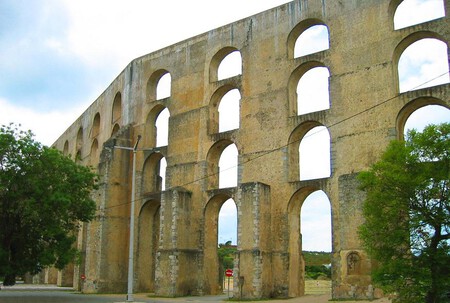
The comparison is neither coincidental nor an exaggeration. Before even entering the town center, the first thing that appears before the traveler's eyes is the impressive Aqueduto da Amoreira, a monumental construction that extends for kilometers with hundreds of stone arches and that, at times, inevitably reminds us of the famous Aqueduct of Segovia.
Only here the postcard is different because the aqueduct is not limited to crossing a square, but crosses entire landscapes before reaching the city.
A monumental aqueduct in the heart of Alentejo
Built between the end of the 15th century and the 17th century, the Amoreira Aqueduct was born with a very specific mission: to guarantee the supply of water to a city that, due to its strategic position on the border with Spain, had been growing for centuries within an increasingly complex defensive system.

Stephen Colebourne
The result was an engineering work that reaches about 40 meters high in some sections and has hundreds of superimposed arches that seem to disappear into the horizon. Seen from afar, there is something almost cinematic about the structure: an endless line of stone slowly approaching Elvas. And, when he finally enters the city, the effect is even more striking.
A star-shaped fortified city
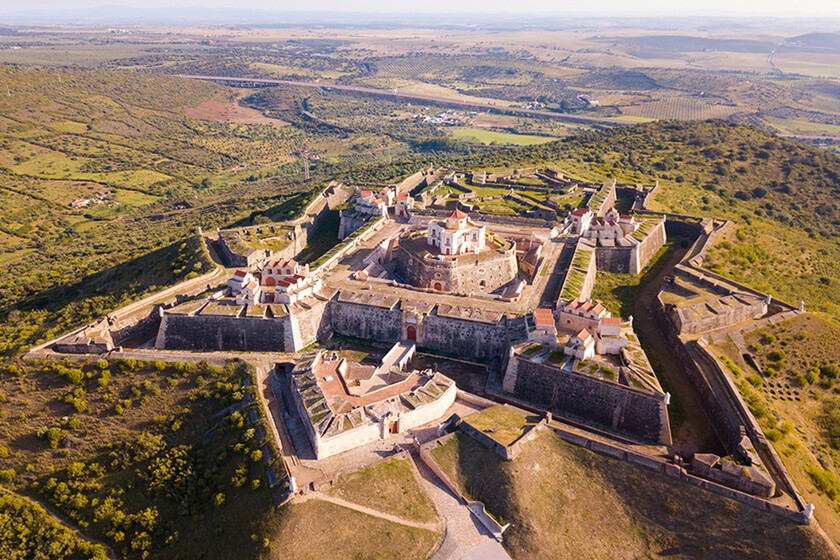
However, Elvas is not only notable for its aqueduct. For centuries it was one of the most important defensive enclaves on the Portuguese border, which explains why today it preserves what many consider the largest bastioned fortification in the world.
Walls, bastions and bastions draw a star-shaped structure that surrounds the entire city. This defensive system, built and expanded between the 17th and 18th centuries, turned Elvas into a true stronghold.
This historical importance was precisely what led UNESCO to declare the city a World Heritage Site, recognizing its exceptional set of fortifications.
Henrique Matos
Inside the walls: cobbled streets, churches and viewpoints
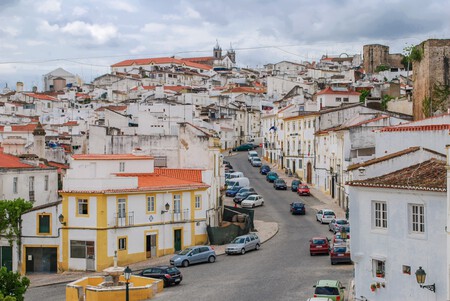
The historic center unfolds on a hill of narrow streets, white facades and irregular pavement that force you to take the walk slowly. Part of the charm is precisely there: in that calm pace with which you are forced to discover the city. Because between historic churches, museums and medieval towers, Elvas is traveled without haste, discovering small squares, unexpected viewpoints and remains of walls that constantly remind us of its military past.
At the top is the Elvas Castle, built between the 12th and 14th centuries and today converted into one of the best viewpoints from which to contemplate the city. A few minutes away is the lively Praça da República, the urban heart of Elvas. There stands the old cathedral, the Igreja de Nossa Senhora da Assunção, a 16th century temple designed by the royal architect Francisco de Arruda (the same one who participated in the construction of the aqueduct).
Concierge.2C
An international getaway just a stone's throw from Spain
One of the most curious things about Elvas is how close it is to Spain. The city is located just 20 kilometers from Badajoz, which makes it a perfect getaway to cross the border and discover one of the most unique towns in Portugal.
Because although the comparison with Segovia helps to imagine the magnitude of its aqueduct, the reality is that Elvas has its own personality: a mix of border history, military architecture and picture-perfect landscapes that make it one of those places that surprise when they suddenly appear at the end of the road.
Cover photo | Antelejo Tourism