Buddhism is the fifth most followed religion in the world, inside and outside Asia. In Europe there are more and more Buddhist centers and one of the most impressive is in the Pyrenees. Dag Shang Kagyu is hidden among imposing mountains in the highest peaks of Huesca, where its Tibetan architecture surprises the visitor and transports them to the Himalayas themselves without leaving Spain.
The temple was founded in 1984 and, since then, it has grown to occupy almost 100 hectares in the town of Panillo, in the Ribagorza region. However, not everything is open to visitors. Dag Shang Kagyu is divided into two parts: the private area is the largest, where volunteers, lamas and monks reside in search of silence and intimacy. There is also a hostel for visitors here, but only practitioners and participants of Buddhist rites are accommodated.
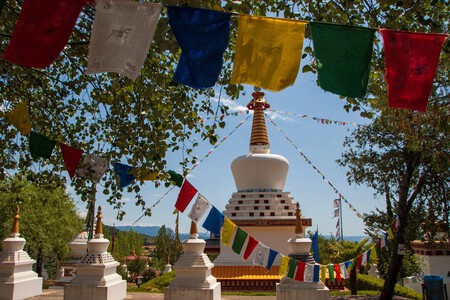
The other area can be visited and is quite a spectacle. It is accessed through a monumental gate, which leads up a slope to the top of the mountain, where the temple and other ceremonial buildings are located. Its architecture follows the aesthetics of Tibetan Buddhism, with vibrant colors, murals and golden stupas.
Dag Shang Kagyu Temple
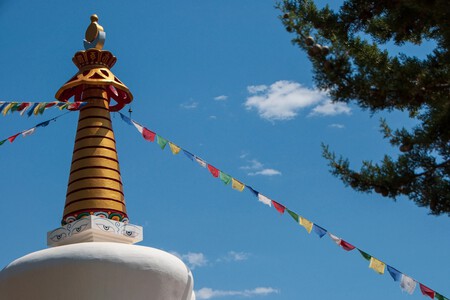
Upon crossing the door we arrive at the temple that fills our eyes with reds, yellows, blues and gold in the form of mandalas, flowers, figures, pennants and lanterns arranged to fill the space without regard and without measure. Above this sea of colors stands out the enormous golden stupa, a Buddhist dome that represents the enlightened mind of Buddha, who contemplates the world with those eyes drawn at the base, looking towards the four cardinal points.
Hundreds of Buddhist flags come out of this stupa in blue, white, red, green and yellow. They are not tones chosen at random, they represent the sky, water, fire, air and earth. Prayers are written on them, which unfold in the wind following the beliefs of Tibetan Buddhism.
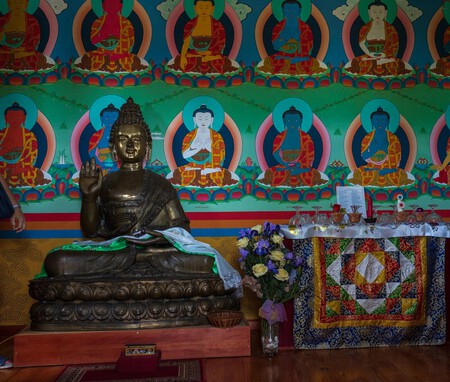
The stupa is surrounded by prayer wheels, which the faithful turn while you pronounce their mantras. The magic also continues inside, as colorful and maximalist as the façade. There we find a sculpture of Buddha, as well as many musical instruments to accompany ceremonies, seminars and yoga and meditation sessions.
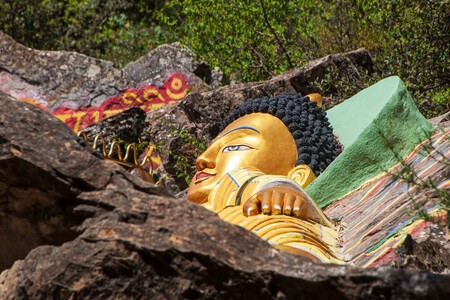
Outside the temple there is still a visit, because the surroundings are full of details. From the Little House of Light Offerings to the large reclining Buddha, placed on the side of the open-air road, welcoming Buddhists, travelers and the curious alike. Whoever says that feeling in Korea or Japan without leaving Spain is impossible has not been to Panillo.