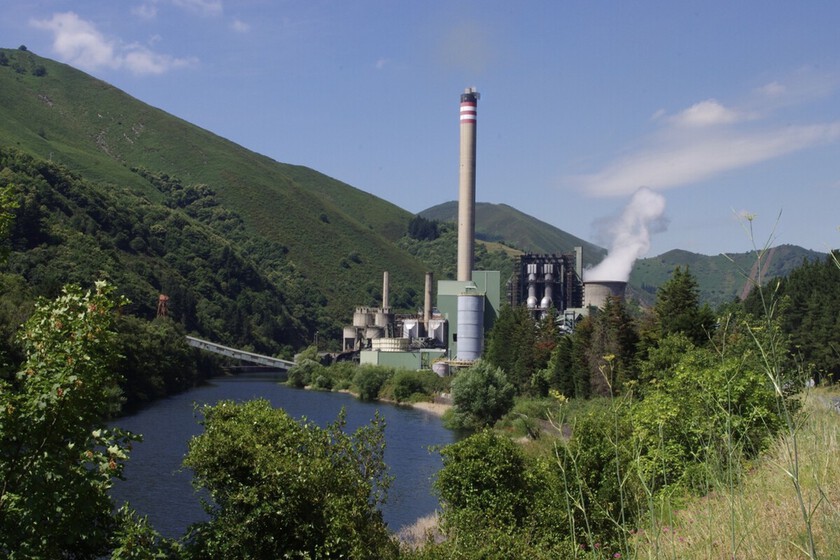
Having work next to home was just one of the many benefits that the industrial town of Soto de la Barca once offered to its employees. The children could also go to school right there, they had a swimming pool and even had spaces for entertainment and socializing. The reason is that, in this corner of the Asturian council of Tineo, a company operated that had built more than just homes for its staff: a small world around the Narcea thermal power plant. Today, among deserted buildings and vegetation that makes its way through the concrete, it is difficult to recognize that promise for the future.
Nicknamed the “Asturian Chernobyl” because of the image of an abandoned industrial town that it currently offers, both stories really have nothing more than that in common. The Narcea facility burned coal and its closure was not the result of any nuclear accident. Nor should we confuse the company's residential area with the entire town of Soto de la Barca. In fact, in the traditional urban center there are still about 24 inhabitants. However, the former workers' town is most striking for its ghost town appeal.
The town where a company organized all of life
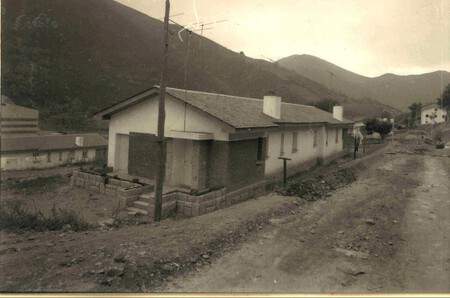
Architect Ramón Vázquez Molezún was commissioned with that residential project in 1963. His task was to house workers linked to the plant and other electrical installations in the area. For this, blocks and homes of different types were built, with sizes whose square meters responded to the professional hierarchy of their occupants.
M. Santiago Pérez Fernández
Educational, health and leisure services were incorporated around the houses. School, cinema, social club, doctor's office, church and swimming pool made up an offer that allowed a large part of daily life to be carried out within a town that once had around half a thousand inhabitants.
This is a model known as “corporate paternalism,” in which providing housing and services to workers allows the company to extend its influence over the lives they lead outside the factory. Rubén Domínguez, a researcher at the University of Oviedo, points out precisely this double aspect when studying Soto: on the one hand, the improvements that he introduced in the environment and, on the other, the business control that he exercised over the free time of his employees.
The abandonment began before the thermal closed
The loss of activity and population did not occur suddenly. Since the 1980s, business changes and staff cuts have reduced the community linked to the plant. In June 2020, the facility was definitively closed, as part of the decarbonization process.
Although by then the town's decline had been underway for years, it was not until the plant was closed that work began to dismantle it, including the demolition of its cooling tower through a controlled explosion. Furthermore, the thefts and destruction have not stopped. In 2024 the bronze bust of Higinio González, which presided over the entrance, disappeared and the neighbors removed the copper bells from the church due to the risk of theft. After two thefts of the electrical cable, the church was finally left without electricity.
The main problem in giving new uses to the plant's land is that a good part of the plot is in a flood zone. In this way, the advantage of having electricity connection, water and industrial land coexists with significant obstacles to attracting other activities. After the dismantling, a transfer agreement was made to the Tineo town council, considered a “poisoned gift”, since the town is a heritage site of cultural interest and preserving it requires a large budget.
Homes that seek to have neighbors again
A second life came to fruition for the residential town. After the transfer agreement to the City Council, the recovery project included rehabilitating 14 single-family homes, recovering community facilities and improving the urbanization and green areas. Its objective was cohousing: homes with shared common spaces and management through a non-profit cooperative. In this way, the houses would once again be used for what they were built for, although through another, more modern form of coexistence.
However, the initiative did not go ahead. At the beginning of this year, the council was still exploring alternatives for housing and cultural uses, still without having found a solution. Meanwhile, cracks, humidity and vegetation continue to deteriorate the complex.
Domínguez does not allow himself to be overcome by pessimism and defends a comprehensive recovery that respects the original architecture that allows it to be inhabited again. Because behind the striking nickname and the colorful photographs of abandonment there is also a residential complex with historical value. A place that was built to have work, school and the pool close to home, and whose recovery involves something as simple as having neighbors again.
Cover photo | (Rareling)
In DAP | Lidl has launched an auxiliary cart perfect for adding storage to small kitchens for less than 15 euros
In Xataka | In 1977, a Saudi prince took a 2-ton ancient iceberg from Alaska to solve the world water crisis. He ended up putting ice in the cubatas