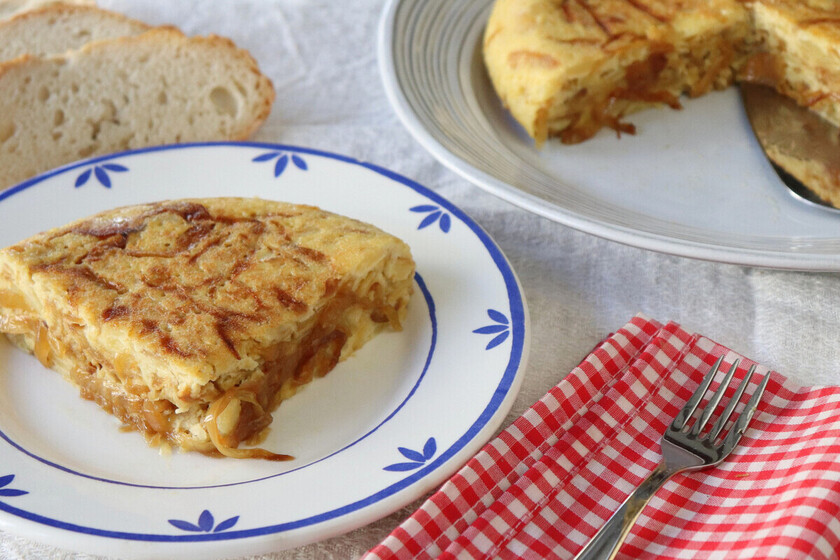
As can be read in the work of Benito Pérez Galdós, 'National Episodes', the potatoes that had arrived in Spain centuries ago were not well received and I quote verbatim, “in my town people do not eat this, but rather the nuns for penance, as they say, and the pigs.” At the end of the 18th century, the potato was consumed as a second-class food. 'History of the potato omelet' by Ana Cordero, places the birth of the potato omelet in Badajoz and as a remedy after a series of famines. That is to say: it was poor people's food. Now the potato omelette is experiencing a new change. It is going to go from being something everyday, with that daily snack that you have in the office, to a luxury. And all because of the rise in eggs.
The rise of eggs and its black future. The massive slaughter of birds due to avian flu, record demand and suspicions of speculation are some of the reasons behind the spectacular rise in a product as basic as eggs. In just twelve months, it has risen 22.5%, being the food that has increased the most in price in the last year. Pedro Barato, president of Asaja, assures that its price will continue to rise and touching it has a much greater impact than the eggs we eat at home. It also has an impact on our routine because it is one of the ingredients with which that delicious tortilla skewer is made.
The tortilla skewer: the small daily luxury that we thought was untouchable. The tortilla pincho in Spain is much more than a typical dish of our gastronomy. It is a social ritual for many. It's the mid-morning break, that break at the usual bar, with co-workers. For years, the tortilla skewer has been one of those minimal certainties that gave stability to the day. It was not a whim or a luxury. For many it is a custom that marks the rhythm of the day and a ritual so daily that it seemed impossible for it to change. Until now.
The real cost of a tortilla skewer, in data. Making a potato omelet at home now costs 9.44 euros, 67% more than in 2023 and 162% more than in 2021 according to Raisin data. It's not just the eggs that are to blame. Olive oil has become more expensive, as have potatoes. In addition to the cost of ingredients, other elements must be taken into account such as energy for cooking, and in the case of bars, labor. I'll give you an example, that of Eugenio, owner of a bar in Zaragoza who spends 14,000 eggs a month. The increase costs an additional 840 euros.
The victim: the tortilla skewer (and you). Looking at the CPI confirmed by the National Institute of Statistics (INE) and which confirms that this last month the prices of eggs and olive oil have increased, how is it not going to affect the sacred tortilla skewer and turn what was previously an easily bearable expense and part of a routine, into a luxury. In bars, some businesses cut the amount they serve to avoid this expense, others assume the extra cost so that the customer is not harmed, and others raise prices.
The tortilla skewer is not a macroeconomic indicator, it does not appear in the reports, but its rise says much more about how everything is changing than many graphs and statistics. Especially for ordinary citizens, because when even this small everyday refuge from the pincho at the bar is no longer acceptable, what is changing is not just the price of a dish: it is the very feeling of normality.
Note: some of the links in this article are affiliated and may provide a benefit to Trendencias.