If we told you that in the north of Spain there is a place where palm trees, colonial houses and stories from overseas are part of the everyday landscape, you would probably think we were lying. But not. It is called Colombres and it is an Asturian town, a stone's throw from Cantabria. Small, quiet, and with more Indian mansions per square meter than you imagine.
Indians: traces of the American dream
In Asturias, those who emigrated to America between the end of the 19th century and the beginning of the 20th century are called indianos. Some returned just as they had left, but others returned with fortune and with the desire to leave their mark. In this way, neighbors who prospered in countries such as Cuba, Mexico, Argentina or Chile built mansions and mansions in their native land but in colonial style, which today are known as Indian houses.
Although they did not stop at private housing either because they also built schools, streets, squares and gardens following this style, transforming entire towns. Colombres is, still today, one of the best examples of this phenomenon.
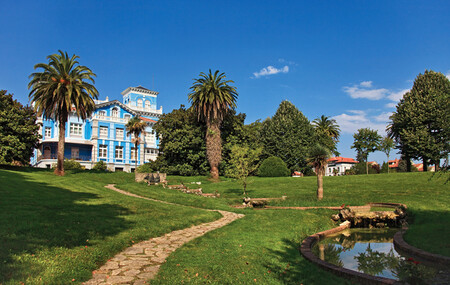
The jewel of the town: Quinta Guadalupe
The symbolic and architectural heart of Colombres is the Quinta Guadalupe, an imposing mansion built in 1906 by Íñigo Noriega Laso, an emigrant returned from Mexico. Today it houses the Indianos Archive Foundation and the Emigration Museum.
Its interior combines reconstructed rooms with period furniture and a permanent exhibition dedicated to Asturian emigration to America. It also has a specialized library and an important documentary archive on the subject. All within an enclosure with stately gardens and exotic details that tell us about the ambition and imagination of those Indians.
A town with its own fair (and Caribbean soul)
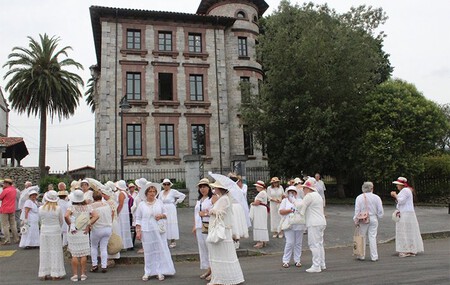
Every July, Colombres celebrates its Indian Fair, a festival in which the town is transformed even more: colonial decoration, period costumes, a market with overseas products as protagonists, Latin American music, habaneras, theater, conferences and exhibitions on the theme. A way to pay tribute to those who marked the history of the town, preserve it and exploit it.
Asturias tourism
Route through the Indian mansions
The distribution of the town revolves around an elliptical plaza, which constitutes its nucleus. It features buildings such as the Town Hall, the baroque-inspired church and the Quinta Guadalupe itself. From there, a signposted route allows you to discover more than a dozen mansions with monumental facades, ornate fences, galleries, patios, chapels, balconies and details that mix Asturian with American.
More jewelry near Colombres
Beyond the town center itself, Colombres also functions as a strategic point to move around eastern Asturias, thanks to its location between the Cantabrian Sea and the Sierra del Cuera. A few kilometers away is the Pindal Cave, in Pimiango, with rock art thousands of years old, as well as the San Emeterio hermitage and lighthouse, which have their own interpretation center.
Asturias tourism
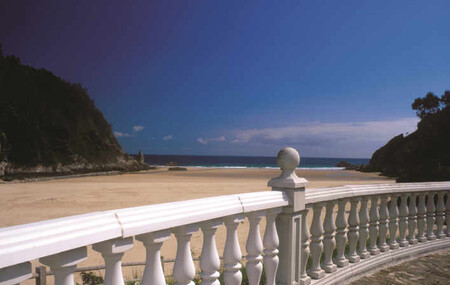
From the Mirador del Picu there are open views of the sea and the Picos de Europa, while the Tina Monastery can be reached through a short walking route between vegetation and stone. Also very close is La Franca beach, large and open, considered one of the most beautiful on the Asturian coast, and the Tina Mayor estuary, at the mouth of the Deva river, with its beautiful landscape of marshes and coast.
Cover photo | Carlos Urteaga Pintado