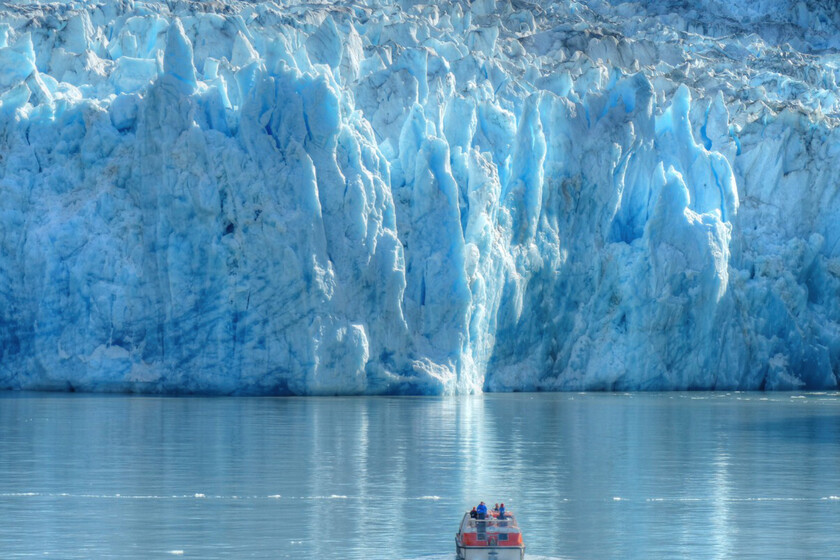
Since the 1850s, Alaska yarn has been treated as a commercial product. It was collected and transported to the United States to cool the drinks. But in October 1977, when water problems began to exist, it occurred to a Saudi prince that that same ice could be a solution to the drought in the Middle East desert. That's why he decided to transport a huge 2-ton, 10,000-year-old iceberg to the center of the United States.
An iceberg in Iowa. He managed to make a piece of iceberg travel more than 5,000 kilometers from Alaska to the university city of Iowa. It was not a small block of ice, but a mass of 1.1 tons (although some chronicles speak of up to two tons), which was removed from the Portage Glacier, near Anchorage, and which arrived in Iowa with a after a team of divers extracted it, a helicopter took it out of the water and a plane and then a refrigerated truck took it to the university.
The objective was to use it to receive the participants of the first International Conference on the Utilization of Icebergs, some 175 scientists from 18 different countries, which had been organized with the support of Prince Mohammed Al-Faisal and would be held on October 2 and 6, 1977.
From Antarctica, straight to the desert. The Saudi prince thought that spending between $5,000 and $7,500 (the figure depends on the source consulted) was the best idea to attract attention and bring Antarctica to the desert. Until that time, fresh water in Arabia was partly obtained from desalination plants, the cost of which in money and energy was enormous. Mohammed Al-Faisal, who belonged to the country's royal family, was linked to the development of these desalination infrastructures, but population growth was increasing demands so Al-Faisal thought of alternatives. And that's where the polar circle comes into play.
An iceberg of 100 million tons and a project of 100 million dollars. What the prince thought is that if blocks of ice break off from the icebergs of the glaciers every year and all they do is wait until they melt and stop turning into fresh water to be part of the salt water of the oceans, why not keep them? The idea was to intercept them and take them to their country so that it could become their drinking water reserve.
The prince-led company, Iceberg Transport International, developed a plan to select a 100-million-ton Antarctic iceberg to tow to the Arabian Peninsula. The engineering team thought about wrapping the iceberg with insulating materials to prevent melting, and using tugboats to drag it across the ocean. The trip would last eight months and cost $100 million. Although at that time it could lose up to 20% of the volume, the prince assured that the water they would obtain would be economically competitive. He even announced that within three to five years an iceberg would be floating off the coast of Saudi Arabia.
From debating that idea to drinking it. Once at the conference, the idea of Al-Faisal was discussed with glaciologists, engineers and hydrologists. Discussions ranged from how to tow the frozen mole to what impact it would have to leave an iceberg next to a desert coast. Projects were also proposed to bring Antarctic water to California and other drought-affected regions. The problem is that that eight-month journey across half the world was not as easy as they thought. Wilford Weeks, a researcher specializing in cold regions, warned that when passing the equator, the tugboats could end up dragging only one rope because the iceberg fragmented or melted.
Furthermore, building effective insulation, in addition to having ships powerful enough to move the 100 tons of ice across the ocean and then manage the water upon reaching the destination, made this project an unprofitable and impossible undertaking. And that is why that ice that arrived in Iowa as a “demonstration” that Antarctica could reach Saudi Arabia, ended up in the glasses of those attending, as documented by TIME. An ice thousands of years old, which ended up in glasses of apricot juice and punch containers.
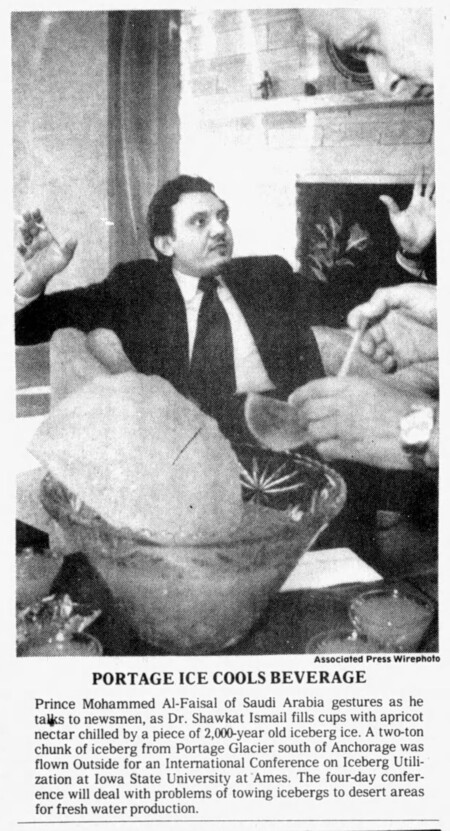
A project that is still “alive”. Prince Mohammed Al-Faisal, who died in 2017, failed to carry out his project to tow an Antarctic iceberg to Saudi Arabia, but over the years his proposal continued to resurface again and again. French engineer Georges Mougin returned to the calculations in 2011, and in 2017 a company from the United Arab Emirates announced its intention to move icebergs from the Arctic to the Persian Gulf. None has managed to overcome the obstacle of transporting such an iceberg through the waters. Of course, humanity continues to think of new formulas to obtain fresh water and polar glaciers are still on the table.
In DAP | Lidl has launched an auxiliary cart perfect for adding storage to small kitchens for less than 15 euros
In Xataka | The Asturian Chernobyl: the abandoned town located next to an old thermal power plant that has a cinema, school, social club and even a doctor's office