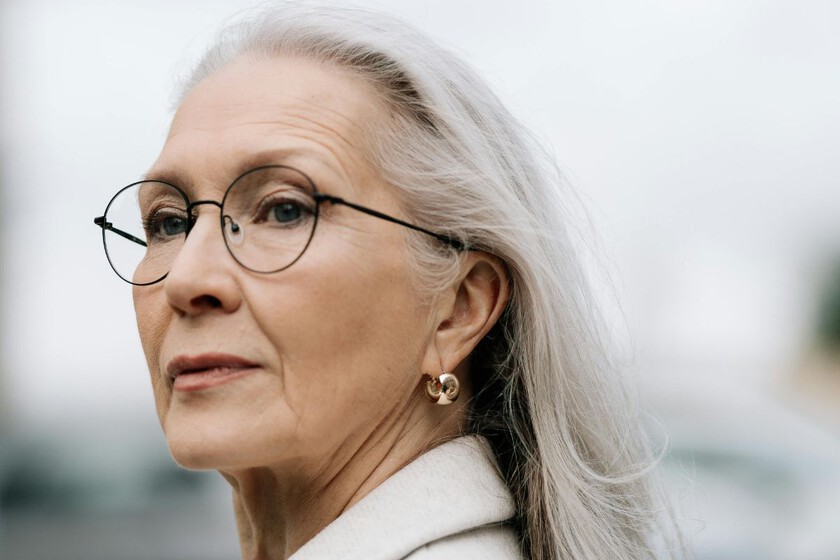
It is undeniable that as we age, our hair also changes and hormonal changes have a lot to do with it. One of the turning points is menopause, which affects practically everything and yes, hair is not spared either. As indicated by pharmacist Helena Rodero in her personal blog: “From the age of 40, especially during perimenopause and menopause, hair experiences visible changes that worry many women: more loss, less volume, finer fiber and slower growth.”
Precisely because of these changes, hair needs different care than when you are 20 years old. You have to think that at 50 “hair loses density and volume, tends to be more brittle, falls out more and is usually drier and duller,” hair experts from Ma Belle Salon comment to the Glamor publication.
To improve the appearance of your hair and its health at this stage of life, you must have a good hair routine. Hormonal changes after 50 are so sudden that “we must constantly rely on experts, frequent a salon where they know our hair and offer us the products and treatments we need to improve its general appearance, stop aging and hair loss,” they say from Ma Belle Salon.
Hormonal changes greatly affect
According to expert Helena Rodero, menopause affects the hair so much because there is a “decrease in estrogen and progesterone. These hormones directly influence the hair growth cycle, especially in the anagen phase, which is the phase of active growth. When this phase is shortened, the hair falls earlier and grows less,” adds the pharmacist.
But not only does the loss of estrogen do its thing, but in many women it also increases the sensitivity of the follicle to dihydrotestosterone, the famous hormone known as DHT, which adheres to the hair follicles and “this favors the progressive miniaturization of the follicle in women with a genetic predisposition, giving rise to female androgenetic alopecia,” says Rodero.
Not only do you have to take care of your hair, but also your scalp.
Something quite common is to think only about the hair when in reality we should also focus on the scalp. “From the age of 40, the scalp can become more sensitive, more reactive and prone to imbalances such as flaking, itching or excess oil,” says Helena.
Additionally, as trichologist Jay Small tells Vogue, “our scalp ages six times faster than the skin on our face,” explains Small. When we notice the first signs of aging on the skin, we quickly try to resort to anti-aging products and care to have a more rejuvenated appearance, since we should follow this same line with respect to the scalp. “If you use products and ingredients to promote healthy skin aging, you should incorporate that same philosophy into your hair care routine,” adds the trichologist.
All of what the experts say makes a lot of sense, after all, hair is born in the scalp, which means that “an inflamed or poorly cared for scalp cannot support strong hair. Therefore, the hair routine during menopause should always start with the scalp,” says Rodero.
How to care for hair during menopause
In order for your hair to be as healthy and beautiful as possible, you must have a well-thought-out strategy. One of the key things is that “cleansing should always be adapted to the scalp, not the hair type,” says the pharmacist. Therefore, if we have an oily scalp we must use a specific shampoo for oily hair, since the scalp is the area we want to treat.
But if there is something that experts usually place a lot of emphasis on when it comes to maintaining healthy hair, it is washing. Many people think that by washing their hair their hair will fall out more and they end up spacing out the washes too much, and this is a mistake. “Washing little does not stop hair loss; on the contrary, it can worsen it if grease, sweat or residue accumulates. Hair should be washed whenever the scalp needs it, even daily if necessary,” says Helena.
According to dermatologist Anetta Reszko, for Vogue, the best hair care after 50 takes into account postmenopausal changes in the health of the scalp and hair. “Gentle cleansing, advanced hydration and specific strengthening treatments are especially important, with product options focused on strengthening barrier function and controlling inflammation,” says the doctor.
As for hair care as such, “conditioner is essential in the middles and ends in each wash to avoid breakage, which is often confused with hair loss. Protecting the hair from heat and the sun is key, since the hair fiber in menopause is more fragile,” highlights the pharmacist.
Last but not least, “dietary supplements have a profound effect on hair health,” says Small. Since, as the dermatologist indicates, it is very likely that nutrient deficiencies accelerate changes in the hair, making it finer, more brittle and slowing down growth.
In Xataka | In 2008 China was installing metro stations in the middle of nowhere. In 2026 we have discovered how naive we were
In DAP | The most expensive potato omelette in the world is served in Catalonia: it costs 2,200 euros and will only be available for two weeks