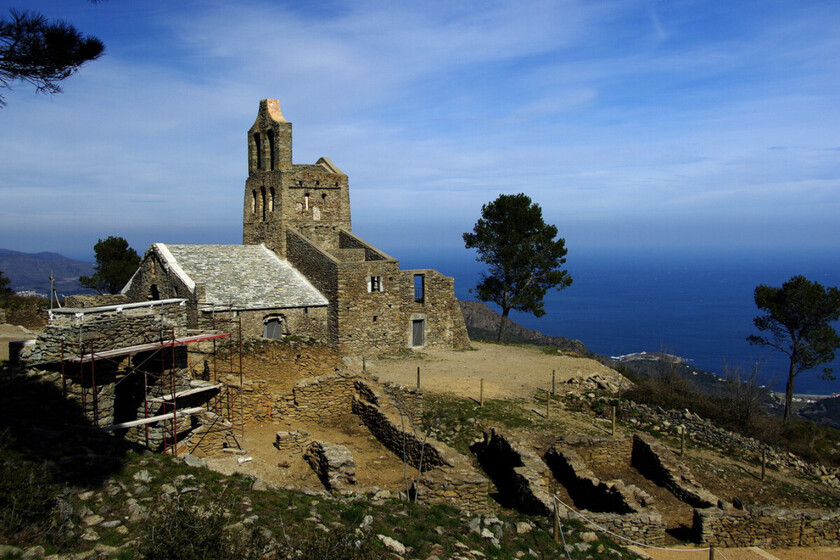
Although Spain has some of the most interesting cities, it stands out especially for its charming towns. And they are perfect for taking a trip to the past without needing a time machine, or disconnecting from urban stress without having to go far away from it. A good example of this is Santa Cruz de Rodes, a small town in Girona, located in the Crap de Creus Natural Park, where the rear facades of the houses serve as a wall. In fact, it can only be accessed through the fortified portals.
In medieval times, Santa Creu de Rodes was founded and grew in the shadow of the monastery of Sant Pere, at that time the most important in Empúries due to the relics it guarded. Thanks to him, this was a prosperous place for innkeepers, tailors, bakers, shoemakers, blacksmiths, tavern keepers or notaries, among other professionals, who attended to the needs of the monastery and offered their services to pilgrims. In addition, fairs and markets were held, as we are told by the Empordà tourist office.
In its heyday, Santa Creu de Rodes had about 250 inhabitants, protected by the castle of Sant Salvador de Verdera. This castle had been given to the monastery by the counts of Empúries but its strategic value, dominating Cape Creus, made the counts try to recover it, which generated continuous confrontations with the abbots.

Montserrat Mataro
Finally, wars, looting and the havoc caused by poor harvests and epidemics turned it into an abandoned town. Thus, it currently has several houses in ruins and a Romanesque church built between the 10th and 11th centuries to welcome pilgrims, but which is still preserved in good condition.
In fact, the church square is its nerve center. Their houses were built around it, separated by the streets that lead to the square. These are large buildings, with a ground floor and one floor, covered with tiles and which, in many cases, have a patio, orchard or corral.

Bernard Blanc
However, its most notable construction is the monastery church, as explained by the Department of Culture of the Generalitat, due to its originality and antiquity. And this building stands out for the great height provided by an original system of pillars and double columns, as well as for the ornamental richness of the capitals and the almost disappeared portal, the work of the master of Cabestany. In short, it is an exceptional piece of Catalan Romanesque that captures the splendor that the monastery experienced.
Cover photo | SBA73
In Xataka | In 1963, the US launched nearly 500 million needles into space to win a war. 63 years later, some are still orbiting the Earth
In Motorpasión | Mechanics and experts agree: “The difference between changing the belt at 60,000 and 160,000 kilometers lies in the manufacturer.”