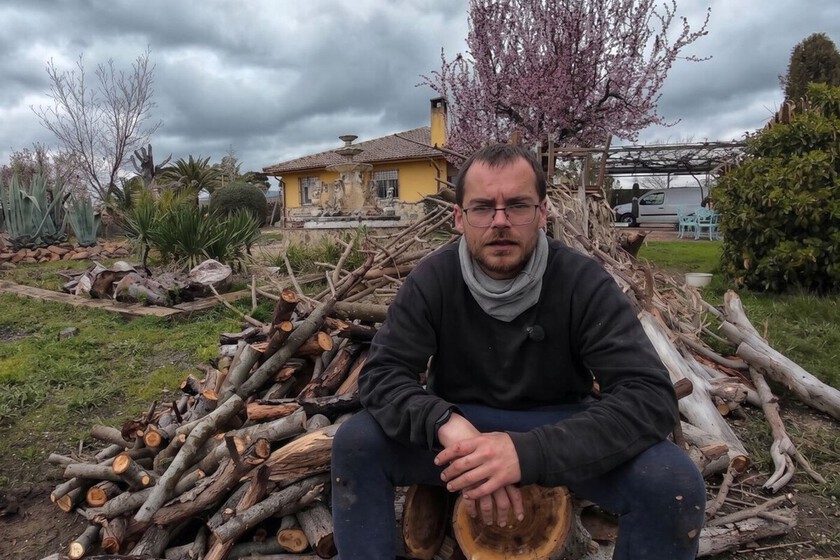
His grandfather's goats and chickens were the reason why a 25-year-old man from Madrid, who is now 32 and we know on networks like Stocks and Tomatoes, ended up living in the countryside. When his grandfather died, someone had to go to the farm to feed the animals while the family decided what to do with them.
He had just asked for a leave of absence and could stay with them for a couple of weeks. However, that visit ended up being prolonged to such an extent that on November 24, 2024, he uploaded a video to his YouTube channel titled: “7 years ago today I left Madrid and came to live in the countryside.” And, just over a month before the end of 2026, it is still there.
In Madrid, he was in charge of a fast food restaurant. He liked to go out with his friends and enjoy the leisure of the city but, between the number of hours he spent working and what was going out of his salary on rent, food and transportation, he found less and less meaning in his lifestyle. “Basically I was not happy,” he said in one of his videos.
The burnout caused chronic digestive problems, insomnia, constant headaches and anxiety. Added to the fact that his salary was barely enough to live on, he decided to take a leave of absence to rethink his future and that was when his grandfather died. That family plot of one hectare allowed him to discover a lifestyle in which he could make different accounts in which he could get eggs from the chickens, obtain oil from the olive trees and eat from the garden according to the season. Although it is true that he earns less than in Madrid, he also needs less money to live.
The good things about living from the garden and the less good things
Of course, although self-consumption and the firewood that he cuts himself for heating saves him a large part of the purchases, he still has to pay for everything else. To do this, he works as a freelancer and obtains part of his income by telling what his life is like on the farm through the networks.
Being able to work from home solves one of the biggest difficulties that he sees for anyone who wants to follow in his footsteps, because looking for a job in the surrounding area is not easy. According to him, the opportunities offered by the area are distributed between small businesses in the towns and agricultural campaigns. The latter are strenuous activities, poorly paid and exposed to the weather. Furthermore, some of them are only temporary, such as olive harvesting. So the big question is what to live on for the rest of the year.
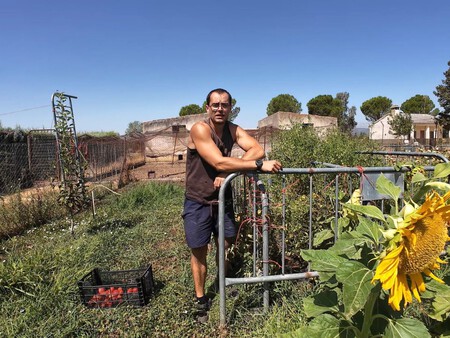
“In the countryside there is a lack of industry, a lack of investment and a lot of things are missing. If you are a young man with education, what are you going to do? Study engineering to spend eight hours bending your back and harvesting olives?” he argues and emphasizes that moving to a rural environment without a cushion of savings or without a previous remote job is a big risk.
In your case, working from home also saves you considerable time commuting, for which you depend completely on your own vehicle. The nearest town is 20 kilometers from the farm, a distance that has to be traveled even for something as basic and everyday as supplying drinking water, since there is no drinking water network on the plot. What it receives is community irrigation water for five hours a day, which it stores in tanks for the garden and the house.
However, to drink, you have to load the bottles into the car and go to town. If you need to make a purchase in a large store, the closest one is 50 kilometers away. While the hospital is 70 away. In addition, he denounces that there is a lack of public services.
And then there is the garden itself, which doesn't always work out. One of his first projects upon settling in was to plant 110 almond trees. That winter it rained a lot and, as he remembers, he still had little experience to carry out the plantation. He ended up losing them all. “In the countryside you have to deal with fungi, hailstorms that destroy your tomato plants in five minutes, the wild boar or the fox that attacks your chicken coop,” he explains. And he adds bluntly: “People believe that farming is throwing a seed like in 'Stardew Valley' and that's it.”
Despite everything, he still does not consider returning to Madrid. Their testimony is proof that it is possible to find a way to make a living in the town. However, for another person who arrives with the same desire, the story may be very different. Even if you can telework, the physical work required in the countryside, the isolation, structural deficiencies and loneliness can end up making urban life what seems idyllic. Its message is clear: the countryside gives nothing to those who are not willing to get their hands dirty and live with constant uncertainty.
In DAP | A man from Madrid goes to live in the countryside at the age of 32 and breaks the myth of the idyllic rural life: “There is a lack of job opportunities and a lack of basic services”
In Motorpasion | They cost much less than a motorhome and convince more and more travelers: caravans skyrocket their sales by 67% in Spain