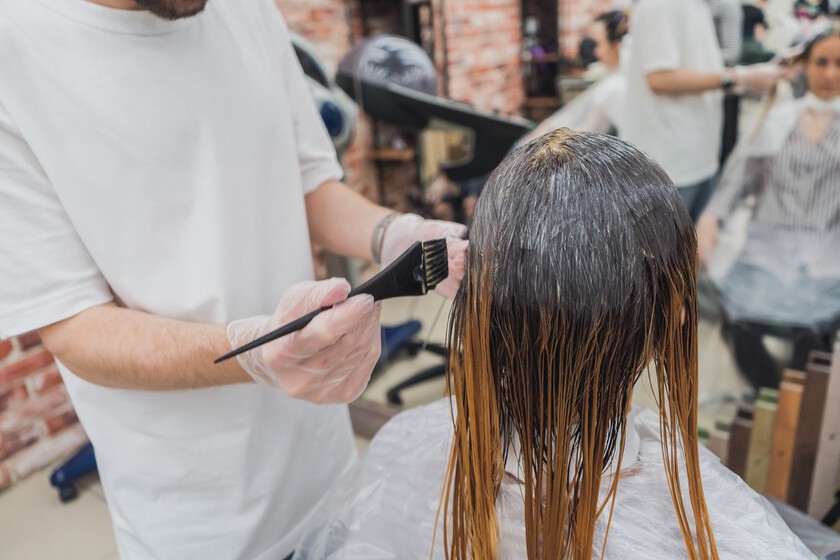
We love showing off beautiful, well-kept hair, but what we like least is that root effect that, sooner or later, is inevitable with hair growth. For this reason, we wanted to speak with José Miguel Gallardo, director of the TeaCut Hair Salon, so that he could give us some tips or tricks with which to delay the moment of returning to the hairdresser a little.
As he himself tells us, the key to a color is always the root. If it is too intense, light or dark, the color stops being natural and takes on that dyed hair look that we don't like so much. Twenty days is the time that the color usually lasts on the roots before growth is detected. Even so, we usually last up to a month, which is the average frequency in which a client comes to your salon to put on color.
However, with these little tips that José Miguel told us, we could extend the root touch-up time by 20 or 30 days and keep the color perfect for as long as possible. We know, you are eager to know more, we were too.
First of all, he tells us not to clarify the root. “We must try to ensure that the root maintains our natural color. Regardless of the tone of the hair, the root must be as similar as possible to the color of our natural hair. With this we will ensure that the growth is not noticeable and the color duration will be considerably longer.”
Of course, at this moment we may be wondering about gray hair, which does not depend on us. Well, don't suffer because the solution is to opt for transparent gray hair. And as José Miguel comments, “The more covered the gray hair is, the more we will notice its growth. The ideal is for it to be as transparent as possible, dyeing it a lighter color (just one tone) than our natural color.” The first few times we may feel strange, but over time it is appreciated.
Likewise, as the expert tells us, depending on the percentage of gray hair we will act in one way or another. Thus, for hair with less than 70% we can put some very fine veiled highlights (just a row of hair) on the front contour, so that we will be able to hide its growth quite a bit without having to lighten the entire hair. For higher percentages we should opt for a lighter color whenever possible.
Of course, this does not mean that in the rest of the hair we should opt for highlights or gradients,… trends that provide as much color as we want, always ensuring that at least one centimeter of the root is a color that is as close as possible to your natural one.
Here, he also makes a point to advise us about the first gray hair. “I don't recommend using highlights to cover those first appearances.” His recommendation is to use transparencies that hide them since, if not, in the end we will have changed the color of our hair, the gray hair will still be there and to this we will have to add the roots that the transparencies will leave us with.
It is much better that you use a tone-on-tone dye of the natural color or a lighter one which we can apply only to the gray areas and brush there.
Then he also recommends that we dye our hair with dyes without ammonia (or any other alkaline substitute) since this is the reason for the unwanted oranges that we don't like so much. In these ways we prevent the color from developing in the cortex of the hair (the innermost part of the hair) and therefore we will ensure that the melanin does not oxidize so markedly.
Finally, José Miguel gives us two tips to make our color look natural, as follows:
- Whatever the color of our dye, the roots should never be lighter than the tips. Dark tips scream that your hair is dyed.
- Whatever the color of the dye, the roots should never be more intense than the tips as they will highlight the less flattering areas. The color intensity should be at the level of your eyes, your cheekbones, your jaw.