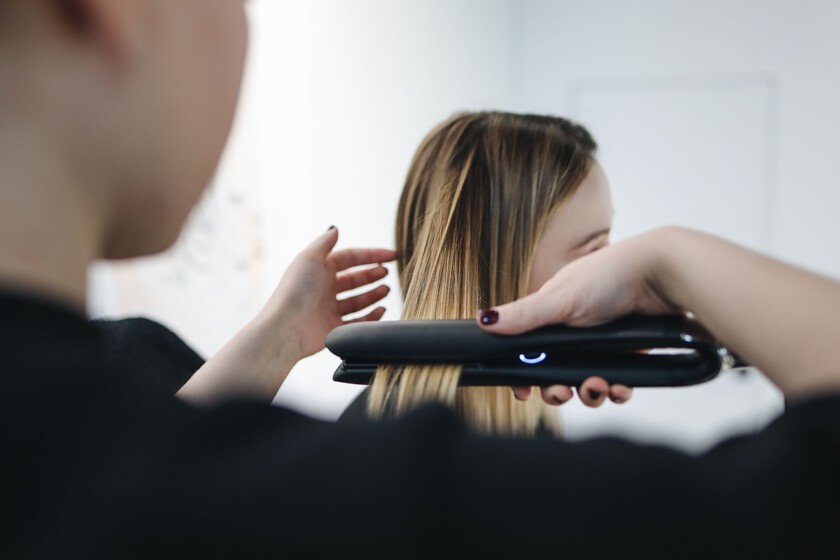
Frizz is one of the hair problems that causes the most headaches. To combat this and achieve shinier, softer and more polished hair, straighteners have become an essential tool for many women. The result is a more beautiful looking hair without frizz, but the problem is that it is only a visual effect.
Although straightening irons achieve a more beautiful hair finish, in reality, the heat of this device is very harmful. Little by little, the hair fiber weakens, loses hydration and becomes more prone to breakage. The result is drier, coarser and more difficult to manage hair, which can lead us to use the straightener more frequently to hide these signs of damage, further aggravating the problem.
The pharmacist and professor of trichology and hair cosmetics Verónica Vivas on her Instagram (@veronicavivasl) has commented that: “With the straightener, the hair looks beautiful until it ends up breaking and you don't really understand why it is happening.”
It is normal that if when using the straightener you see such good results and your hair looks like never before, it is hard to believe that it is actually damaging your hair. This happens because this damage is not seen immediately, “it is progressive damage on the outside and massive on the inside,” says Vivas.
“When you iron your hair, both the heat you subject it to and the pressure force the cuticle to flatten and super contract,” explains the expert. With this gesture, the light is reflected better and therefore the hair shines more because the surface of the hair is temporarily smoother.
In addition, when you have ironed your hair, it takes longer to curl again because “it enters the overdrying zone and therefore the hair is not able to recover the water it had internally until it gets wet again, and over time the edges of the cuticle fuse,” he explains.
What is clear is that heat damage accumulates over time. When hair is subjected to very high temperatures, such as 180°C, its internal structure can be altered, making it more vulnerable to breakage. As a consequence, the hair loses shine, becomes drier and the frizz is accentuated, exactly the opposite of what we are looking for when using the straightener.
The hair does not get used to the iron
Many women who use the straightener practically every day have the perception that their hair is getting used to it, and that for this reason, they no longer obtain the same results. But as the hairdresser Mariano Castrilli explains on his networks (@mariano.castrilli), “hair, being dead tissue, cannot generate any type of dependency or get used to something,” he points out.
What does happen is that “the use of repeated heat without protection progressively damages the hair fiber and damaged hair tends to look frizzier and less manageable in its natural state,” says the expert.
“That's why it feels like you need the iron more and more when in reality what you need is to recover from the damage,” he says. Each unprotected pass causes the damage to accumulate and eventually the hair is completely damaged.
The solution is not necessarily to give up the iron completely, but to make more conscious use of it. The hairdresser recommends reducing the frequency of use and always applying a heat protectant to minimize damage caused by heat. It is also essential to avoid excessively high temperatures and only use the straightener on completely dry hair, since applying it to damp hair can cause additional damage to the hair fiber.
In Xataka | A cave in Cantabria was blocked for 16,800 years. They have seen that it preserves a Stone Age house
In DAP | On Monday, October 26, a double-compartment trash can arrives at Lidl, ideal for separating waste comfortably