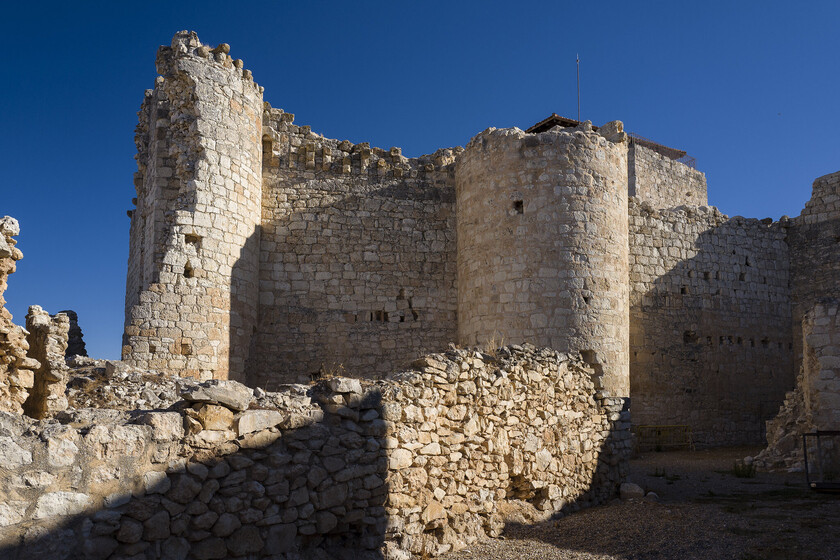
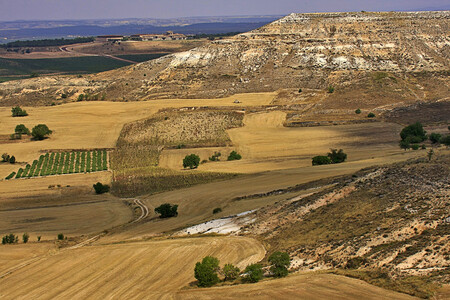
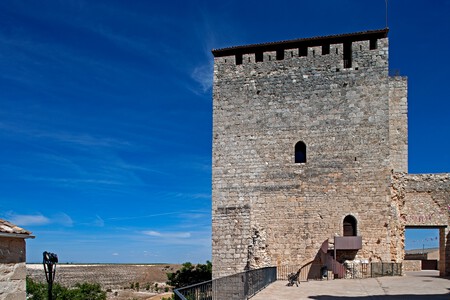
In Haza, views had a use long before anyone thought of simply coming to enjoy them. From this hill in Burgos, access and movements through the territory were monitored. However, that defensive position now allows you to look out over the Ribera del Duero from a hamlet that still preserves its walls and a keep that stands out between the roofs.
It only has 33 inhabitants and just 17 kilometers separate it from the bustle of Aranda de Duero. However, the size of its current population says little of the importance it once had. Haza was the head of a Village and Land Community that included fifteen villages. Here justice was administered, taxes were collected and decisions were made on pastures, mills and defense. There was a lot of life around those walls that had to accommodate the irregularities of the hill.
Haza's own silhouette at the top is part of its heritage, to the point that the protection of the historic complex takes into account both that image and the views from the town. The visit thus has two perspectives: first, the town outlined on the hill; then, the territory spread out at their feet.
Alfredo Miguel
What to see in Haza
The walls give the first clues about the history of Haza. They did not rise all at once nor remain intact while everything changed around them. The town was part of the defensive line of the Duero during the Middle Ages and, later, its fortifications were also adapted to disputes between Christian lords. The walls were expanded, the defenses were reinforced and, in the 15th century, elements for the use of firearms were incorporated. To go through them is to follow the successive ways that the people had to defend themselves.
The castle, linked during a stage to Don Juan Manuel, author of 'El conde Lucanor', is another point where you can stop and look a little more carefully. Its keep is not like others but is advanced with respect to the line of the wall; A bastion adopts a triangular shape and a moat reinforced part of the complex. Even the entrance has its history since the current access does not coincide with the original. With these clues, the ruins stop being just ancient walls and become a game in which you have to imagine where you entered and what had to be protected.
You can also see the tower from the inside. Its interpretation center covers the history of Haza and the castle, with special attention to the county of Castilla and the Duero border. After reading about the strategic value of the location, if you look out again you will see everything with different eyes.
Surround
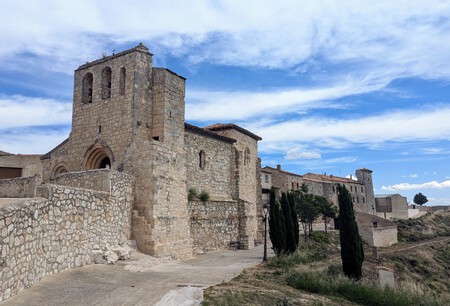
The close relationship between architecture and defense continues in the church of San Miguel, integrated into the wall itself. Its Romanesque origin dates back to the end of the 12th century and the beginning of the 13th century, although one of its greatest attractions awaits inside. They are the twelve Hispano-Flemish panels of the main altarpiece, with scenes from the childhood of Christ and the life of Saint Michael. From the outside, the church allows us to appreciate how the defensive enclosure conditioned the shape of the town.
The walk ends at the southern viewpoint, open to the Riaza valley. From here, Fuentemolinos can be seen on the slopes of the Corcos moor and, beyond, the Pradales mountain range. These towns, the farmlands and the different heights are the territory that Haza dominated from his hill. Without a doubt, this is a good place to stop without rushing.
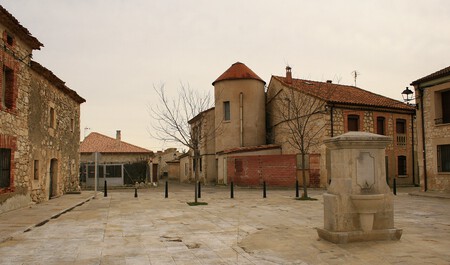
Outside the walls, the wineries are distributed on several levels, with their entrances facing north to favor the conservation of the wine. Among them are the winepresses where the grapes were pressed. It is the part of the walk that brings the tourist closer to the work that sustained the life of the town, beyond lords and fortifications.
Miguel Angel Garcia
A little further down is the hermitage of Santa Juana, built in the 18th century in memory of Juana de Haza, mother of Saint Domingo de Guzmán. During the descent we discover that other side of the town, with its wineries and its religious ties, before doing the exercise of looking from below at everything we have just covered.
Where to eat delicious and cheap in Haza
If the idea is to stay to eat in the town, the reference is La Casa de Haza, at number 1 in Plaza de la Fuente. Homemade cuisine, skewers and portions define a menu in which suckling lamb, grills and stews make residents from other towns come here to eat and have lunch. It is ideal to sit at the table without having to get in the car in the middle of the visit. In addition, the establishment also functions as rural accommodation.
In nearby Castrillo de la Vega, another option is El Ventorro, with a daily menu and Castilian cuisine. Their proposal includes lamb in a wood oven, lamb chops and pickled meats; for dessert, fried milk, puff pastries or fruit tarts.
Tourism of Castilla y León
What to do around Haza
The extensive landscape that can be seen from the top of the walls can also be explored on foot. The Riaza Valley Trail (PRC-BU 79) traces a 10.4 kilometer circular route that leaves Haza, passes through Adrada de Haza and returns to the starting point. It is classified as low difficulty and takes about two hours to complete.
The path begins next to the fortifications and goes down between the old wineries. As altitude is lost, vineyards, orchards, crop fields and poplar groves appear. The Riaza accompanies the route, which returns along the other bank and leaves the climb for last, passing next to the hermitage of Santa Juana. Of course, before returning to the hill, the trail returns the image of Haza from below.
Adrada de Haza is a town that is worth a break, whether you arrive there on foot or by car. The church of Santa Columba, from the 16th century, preserves a main altarpiece with influences from the workshop of Juan de Juni, and the place also preserves the Romanesque hermitage of Cristo de los Remedios. To continue pulling the thread of its history you have to look to the other side of the river, where the Casa de los Moros fort is located.
Ribera del Duero Tourism
In Hontangas, another town linked to the old Community of Villa y Tierra, the rock once again conditions the architecture. The hermitage of Nuestra Señora de la Cueva occupies a cavity whose entrance is framed by a Renaissance façade. Inside is a Romanesque carving of the Virgin, dated between the end of the 12th century and the beginning of the 13th century. The church of San Juan Bautista is also built there, thus being two temples that take advantage of the same relief in a different way.
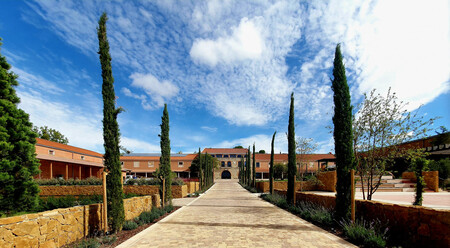
The getaway can end among vineyards. Viña Arnáiz, within the municipality of Haza, offers a guided tour of the vineyard and winery that concludes with a tasting. After looking at these lands from a tower and passing by the winepresses where the grapes were pressed, we would only have to taste the wine that is made there.
Cover photo | Felipe Cuenca
In Xataka | In 1986, miners left two 150-meter pyramids of garbage in northern France. 40 years later, the sun turned them into something that no one had predicted
In Motorpasión | Marc Márquez, MotoGP rider: “A miracle is what doctors do. My comeback is the result of work day by day”