
It has been 100 years since Spain has experienced what it will experience next August 12, a total eclipse of the sun. It will be the first of three. The thing about a solar eclipse is that the Moon will pass between the Sun and the Earth, blocking the face of the Sun from observers. That is, it will block the sun and it will do so completely in some areas of Spain. As NASA explains, this only happens occasionally, because the Moon does not orbit in the exact same plane as the Sun and Earth, and the fact that it is complete is even stranger.
As astronaut Pedro Duque indicates on his social networks, “the best places to see it will be on a line from Galicia, to Castellón and also in the Balearic Islands.” It will only be seen completely in the north of the Iberian Peninsula, but according to the former Minister of Science and Innovation, “if you live north or south of that strip, it will also be seen but as a partial eclipse,” he explains. If you have doubts about what it will look like where you are, you can consult the National Geographic Institute and see exactly what it will look like in your area.
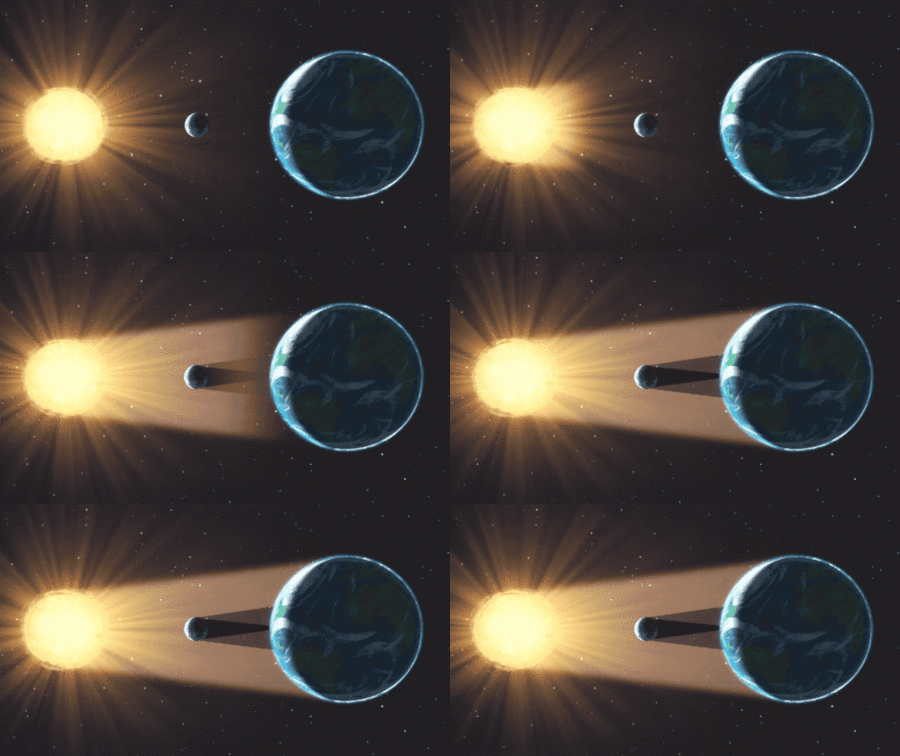
Duque explains that during a total solar eclipse, “the shadow of the moon touches our planet. That shadow turns day into night and in many ancient cultures it had very powerful meanings.” For example, in Viking culture it was associated with the beginning of Ragnarök and according to Babylonian scholars, eclipses could predict the death of the king. In China it was believed that they occurred when a celestial dragon attacked and devoured the Sun and for the Inca, it was a demonstration of the wrath of the god Inti, the god of the sun.
Now, thanks to scientific advances, we know when everything will start. Duque assures that “the moon will begin to cover the sun around 7:30 p.m. The light will become strange, the colors will fade and the temperature will drop. Animals, especially birds, will behave strangely,” he explained.
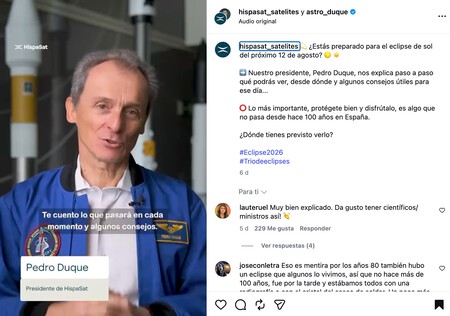
The aeronautical engineer added that “as the light passes through the leaves of the trees, on the ground, we will be able to see small images of the sun setting as if it were a half moon,” and when that eclipse progresses, “around 8:30 p.m., the diamond ring will arrive, the last ray of sun that sneaks between the mountains of the moon.” And it warns of something important, and that is that when we still see dots, we will still need the eclipse glasses on.
“Right after, the sun will disappear completely,” explains Duque. “The day will be last night and we will see the solar corona, a halo of light around the dark disk. Only at that moment, during totality, will we be able to take off our glasses and appreciate that halo of light,” he says, but warns that this will only last a couple of minutes. Although yes, it will be two absolutely magical minutes for everyone.
In Xataka | In 2001, a yacht took refuge on a remote island in the Atlantic. Days later its inhabitants breaded fish with coca
In DAP | Andrés Madrigal, chef: “To make garlic prawns, I introduce the garlic and chilli from the cold so that the oil slowly absorbs the aromas”