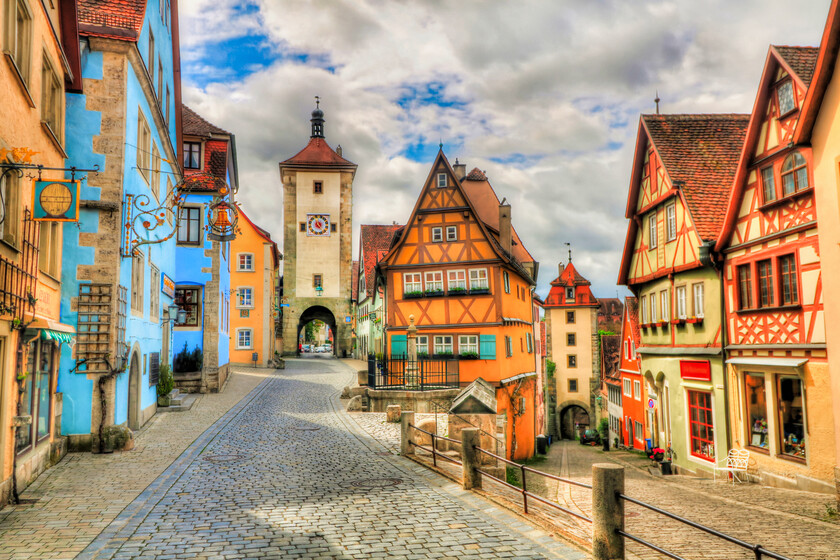
It is enough to cross one of the medieval gates of Rothenburg del Tauber (or Rothenburg ob der Tauber) to understand why it is considered one of the most beautiful cities in Europe without being a large capital or one of its best-known destinations. Cobblestone streets, half-timbered facades, defensive towers, church bells and Christmas windows open even in the middle of August are some of its main attractions. In fact, it is sometimes hard to believe that it is not a tourist recreation or a medieval theme park.
Rothenburg survived for centuries almost intact and, although part of the city was destroyed during World War II, its reconstruction respected the original aesthetics. The result is a place that seems suspended in another era but that, even so, continues to have a life of its own. It's small, yes. But with an enormous capacity to obsess anyone who enjoys towns with history and slow cities.
LBM1948
What to see in Rothenburg am Tauber
The best way to discover Rothenburg is to get lost walking. Although it may sound cliché, here it is literal because any side street can end in a silent square, a medieval fountain or a house with flowers in the windows that looks like something out of an old illustration.
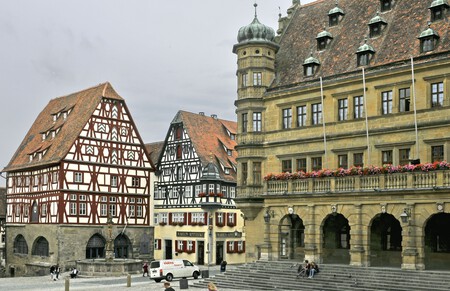
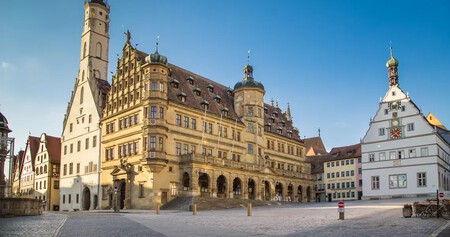
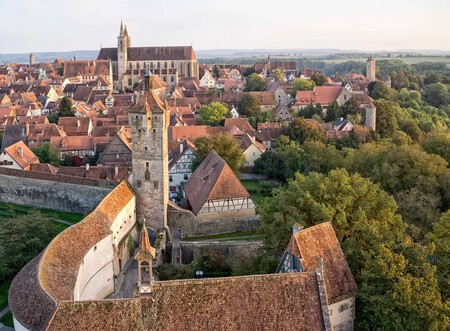
The heart of the city is the Marktplatz, the market square, presided over by the Renaissance town hall and surrounded by historic buildings that encapsulate centuries of bourgeois prosperity. It is worth climbing the Town Hall tower to understand from above the magnitude of the medieval complex, with its sea of reddish roofs, perfectly preserved walls and the green valley of the Tauber river embracing the city.
Rothenburg ob der Tauber tourism
Nearby is one of the most photographed corners of Germany: the Plönlein. That small yellow house wedged between two streets and two medieval towers that has become the symbol of the place in networks. And yes, in person it is even prettier than on postcards. Of course, getting up early here is rewarding because it is the only time when, for a few minutes, the city seems completely empty.
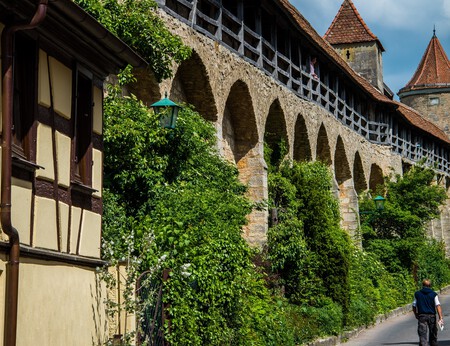
The walls are another of the great jewels of Rotenburg. Few European cities preserve such a complete defensive enclosure. You can walk long stretches along the top, passing through towers, covered passageways and fortified gates while offering beautiful views of the historic center. The Spital Bastion, to the south, is especially impressive for its defensive complexity and enormous circular structure.
Rothenburg ob der Tauber tourism
Among the churches, the one of San Jacobo stands out, a monumental Gothic temple that houses the famous Altar of the Holy Blood, a very delicate wooden carving by Tilman Riemenschneider considered a late Gothic masterpiece. Very different is the fortified church of Saint Wolfgang, integrated directly into the walls.
There is also room for the curious with the Medieval Museum of Crime and Justice, which is one of those places that is difficult to forget with its archive of torture instruments, ancient absurd laws, stories of medieval trials and public punishments that remind us that the Middle Ages had much less charm for those who lived through it.
And then there is the most kitsch and endearing part of Rothenburg: permanent Christmas. The Käthe Wohlfahrt shop and museum turns any visit into something emotional even if you travel in the middle of summer. Giant nutcrackers, handmade ornaments, decorated trees and Christmas music all year round. An absolute excess. The Grinch's worst nightmare.
S.kapfer
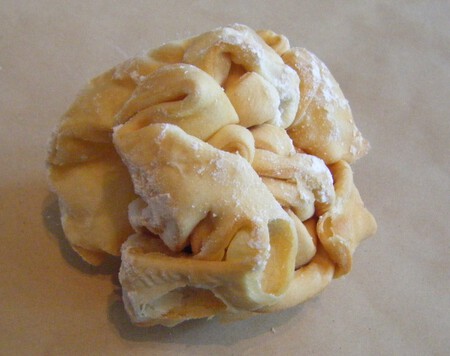
Also, before you leave, there is a gastronomic obligation: try a Schneeball, the typical local sweet. A crispy ball of fried dough covered in icing sugar, chocolate or cinnamon that has been prepared for centuries in this area of Bavaria.
Where to eat delicious and cheap in Rotenburg del Tauber
Although Rothenburg is one of the most tourist destinations in Germany, it still has restaurants where you can eat very well without inflated prices.
A favorite among travelers and locals is Zur Höll, considered one of the oldest restaurants in the city. The interior looks like an authentic medieval tavern and serves typical Franconian dishes such as sausages, knuckle or spätzle in abundant and quite reasonably priced versions.
For something more casual, Brot & Zeit has earned a reputation for its hot sandwiches, soups and local charcuterie boards. Perfect for a quick meal without ending up in a tourist trap. Another highly recommended option is Baumeisterhaus, located in a beautiful historic house. You will find classic Bavarian dishes, local beer and a very pleasant terrace in good weather.
Ted McGrath
And to take a break from the medieval circuit with a coffee and a piece of cake, many travelers end up falling in love with Café Lebenslust, especially at dusk, when the lights start to come on and the city empties of organized excursions.
Things to do around Rothenburg ob der Tauber
Although Rothenburg could perfectly be seen at a slow pace for an entire weekend, its surroundings are also worthy of attention. The city is part of the famous German Romantic Road, an itinerary full of historic towns, vineyards and fairytale landscapes.
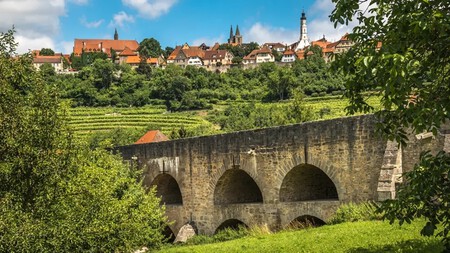
One of the most beautiful walks is to go down towards the Tauber valley following the paths that surround the city. From below, the medieval walls and towers make up a spectacular panoramic view. The walk to the Double Bridge (Doppelbrücke), a curious stone construction with overlapping arches from the 14th century, is easy and very photogenic.
Rothenburg ob der Tauber tourism
Less than an hour away is Dinkelsbühl, another walled medieval gem that is much less famous and, precisely for that reason, quieter. Nuremberg is also worth a getaway, with one of the most interesting historic centers in southern Germany and a quite powerful gastronomic scene.
The Franconian region is also known for its white wines. In summer and early autumn there are many small wine festivals and taverns where you can try local specialties accompanied by local cheeses and sausages.
And if you visit Rothenburg in winter, the landscape changes completely: Christmas markets, the smell of mulled wine, snow on the walls and illuminated shop windows turn the city into something even closer to a classic Central European tale. There are few places in Europe where Christmas seems so exaggeratedly perfect.
Cover photo | Daniel Mennerich
In Xataka | In 1967, Canada built futuristic homes like Lego pieces. Half a century later they still don't know how to repair them
In Xataka | An Atlassian engineer was fired. He then published a video on YouTube explaining how the company works