Oil is essential in our kitchen. Depending on the dish we want to make, we opt for EVOO or opt for others. The one we use raw to dress the salad or put on toast in the morning is not better than the one we use in the pan to fry some potatoes. Of course, a couple of tips from an expert chef of Jordi Cruz's caliber won't hurt us at all, so we have taken note of all the tips he has shared with his followers on Instagram, to improve our culinary skills.
The chef has created a selection of the most optimal oils and fats online according to the type of preparation and it turns out that the fats we use raw should have complex aromas, balanced acidity and a healthy lipid profile. “To season: flavor, aroma and nutritional quality,” he insists. The first one we are going to talk about is of course none other than EVOO, our infallible favorite and Jordi Cruz's: “It is the queen fat for seasoning.”
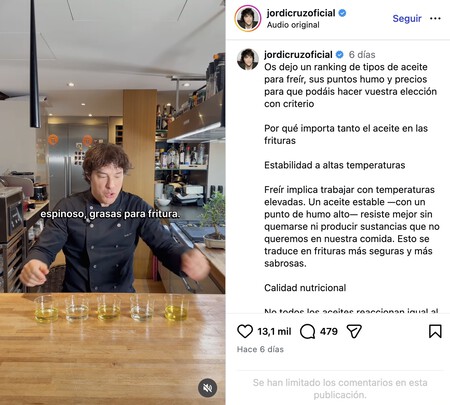
On the other hand, walnut, hazelnut or almond oils should be avoided by heating as they oxidize very quickly. The chef points out that due to their more aromatic flavor: “they are perfect for salads, fresh cheeses or warm vegetables.” Instead, it is always better to use sesame oil raw and add it at the end of preparation. “It is used in small quantities to add character to Asian dishes.” The same goes for linseed or chia oil: “Only raw and preserved cold,” he insists.
We do not forget the lard, and this animal fat resists heat very well, that is if it is not so healthy as other options. For this reason, he points out coconut oil, as an alternative, which is also very stable due to its high saturated fat content. “It is useful for high-temperature cooking or recipes where its aroma is present,” the chef clarifies.
If we are going to heat the oil, the chef points out that what matters most is the smoke point: “that is, the temperature at which the fat begins to degrade and produce undesirable compounds.” And not all oils react the same to heat: “those that have a good fat profile (such as those rich in monounsaturated) maintain their properties better and do not oxidize easily.” Here the one that takes the gold is virgin olive oil, ideal for frying, stews and more. “Frying involves working at high temperatures. A stable oil, with a high smoke point, resists better without burning or producing substances that we do not want in our food,” says Jordi Cruz.
We know well that fried foods are not a healthy dish to abuse, but when we cook them we always want them to be crispy on the outside and juicy on the inside. This is why virgin olive oil is a good option. And as Jordi Cruz explains: “Avoid that heavy feeling that poorly done fried foods leave.” This is always a plus.