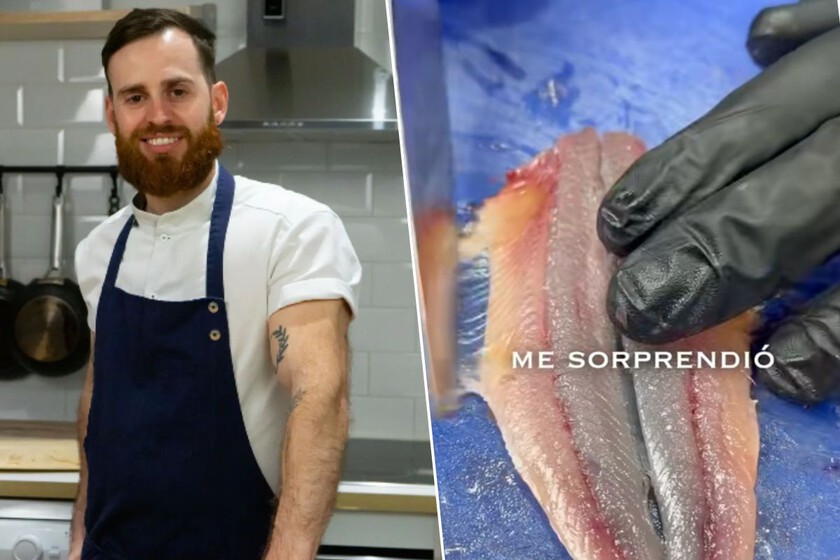
Anisakis is a marine parasite whose larvae can be found in many fish and cephalopods. If these fish and shellfish are consumed raw or undercooked, they can cause an infection in humans known as anisakiasis that can cause severe abdominal pain, nausea and vomiting, and in the most serious cases, allergic reactions. I'm telling you about it because it is a growing concern but it is possible to prevent it according to chef Alfredo Vozmediano.
In addition to having worked in Michelin star kitchens such as Noma, Enjoy and Maaemo, he uses his social networks to spread gastronomic knowledge and teaches cooking courses. Recently he shared that while cleaning some anchovies, he had discovered anisakis in them, although it is usually found in fish such as hake, cod, mackerel or horse mackerel. For example, all European hake have anisakis, according to a Basque scientific report collected by Directo al Paladar, and also 20% of anchovies and anchovies.
“I have a lot of experience cleaning fish and removing anisakis, but from now on I am going to freeze all the wild fish I buy,” the chef explained. The reason is that this anisakis can be much smaller in size and cause anisakiasis if we consume it.
@avozmechef I make this video above all to show that even if it is not seen, the anisakis can be there. I always trusted my eye and my experience to clean the areas near the belly and I ate it without freezing and at about 40º inside. But since I saw that it can be so small, I don't risk it. Remember that my online academy has a 25% discount for Black Friday. Code: chef25 you have the link in my profile!! 🔥
♬ original sound – Alfredo Vozmediano Romero
“The belly part is where the anisakis is mostly housed,” he says, and the tail part and upper loins would not have it. According to the Spanish Agency for Food Safety and Nutrition (AESAN), there are two ways to treat fish to destroy the parasite. The first is heat treatment. “Preparations such as cooking, frying, baking or grilling, when the temperature reaches 60°C for at least one minute throughout the piece” would kill the parasite. But freezing involves fewer risks. “A safe alternative treatment is to freeze the fish at -15°C or lower for at least 4 days,” but count at least 5 days from when you put it in the freezer to ensure that the freezing process is complete.
Vozmediano explains to us that “river and farmed fish do not have anisakis. The rest must be frozen.” Although the vast majority of farmed fish do not have it, according to the European Food Safety Authority (EFSA), parasites have been detected in some farmed fish species raised in the sea, so prior freezing would be necessary if you buy it fresh. Freshwater fish, such as trout for example, do not have anisakis because the parasite only develops in salt water.
If what you buy is already prepared fish, such as smoked salmon or pickled anchovies, don't worry. According to AESAN “if you buy these products ready, the freezing has already been done by the manufacturer and it is not necessary to freeze.” Fish that are going to be cooked at 60ºC for one minute, oysters, mussels, clams, coquinas and other bivalve mollusks, freshwater fish, semi-preserved fish such as anchovies or traditionally salted dried fish, such as cod or mojamas, do not need to be frozen either.
It is important to understand that anisakiasis can only be contracted if these foods are eaten raw or in preparations that do not kill the parasite, such as ceviche or sushi. But if you follow the experts' instructions and freeze the fish after gutting (you can ask the fishmonger to do it), there is no risk.