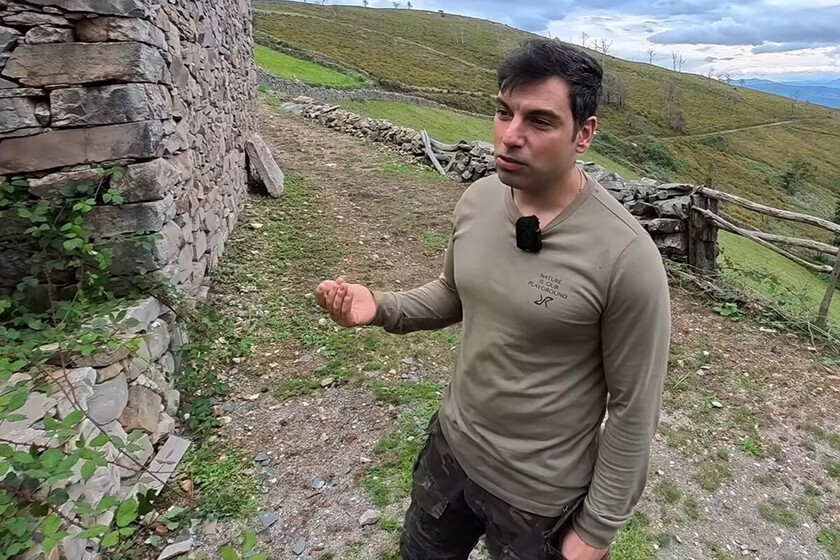
For Virgilio, confinement caught him living in a one-bedroom apartment in Oviedo. So later he began to spend more time in his grandparents' town and, when that same year he found out that a neighbor was selling a stone cabin a little further up, he was encouraged to buy it to restore it little by little. The roof was about to collapse and Virgilio, at that time, had not yet prepared a cement mixture in his entire life, but it cost only 3,000 euros. Of course, then the final figure would amount to about 800 euros more, between notary and taxes.
Six years later it is still under construction, but the investment has ended up paying off more than he expected, thanks to something completely unexpected and quite unusual. It occurred to Virgilio to run a metal detector through the interior of the cabin and inside the original floor he found an ancient coin. More specifically, a maravedí of Philip V from the year “1740, around there”, as calculated in the video by hilux_aventura, a content creator dedicated to exploring “the forgotten Asturias”.
Based on the age of said object, Virgil puts the cabin between two and three hundred years old. However, such a discovery carries another question: what happens now with the coin? Virgilio paid for the cabin, but does that give him the right to also keep whatever he finds in it? The answer depends, to begin with, on the currency itself.
If the coin had appeared by chance when lifting the floor during the renovation and had archaeological value, Virgilio would have had 48 hours to report the discovery and deliver the piece to the Department of Culture. He says that he found it when he passed a metal detector through the interior of the cabin, although he does not explain what he was looking for. In 2020, Asturian law only required prior authorization to use these devices in areas where it was presumed there were archaeological remains.
However, from December 2025, this permit is also mandatory to search for cultural remains with a metal detector outside those areas. So, if Virgil wanted to look for ancient coins in his own cabin, he would have to ask permission first as well. However, what determines who keeps the find depends on the object itself. Thus, if the coin (or any other piece) is determined to have archaeological value, it is in the public domain, even if it appeared on Virgil's private property.
Cover photo | @hilux_aventura