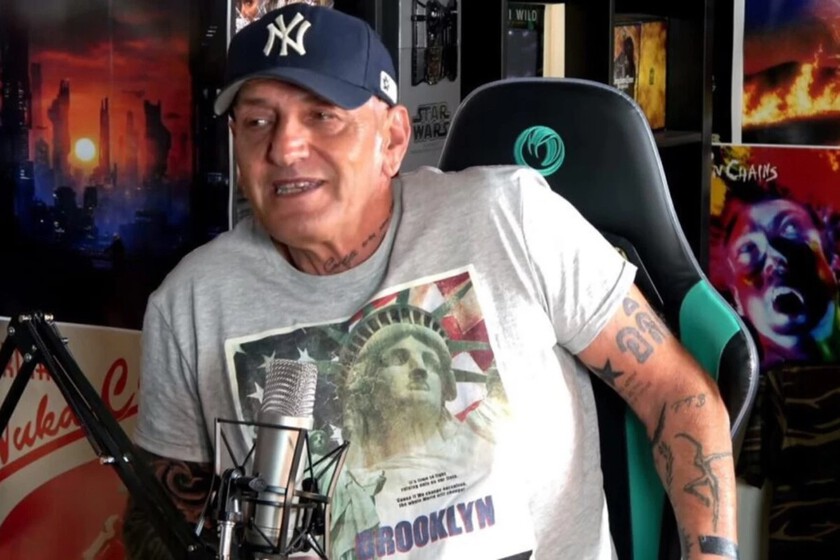
Kiko Matamoros turned to social media last summer to get people to help him discover the whereabouts of his twin brother, Coto, with whom he had not spoken for more than twenty years. Meanwhile, the missing person was in his apartment in Bastiagueiro, a coastal town in A Coruña. It was not difficult for his Galician followers to locate him. The former collaborator of 'Crónicas Marcianas' published almost daily on his own networks and had shared a selfie in the Thirteen Roses Park, which indicated that he had rebuilt his life in the municipality of Oleiros.
It was not the first time that Coto stopped in Galicia. The first time he came to A Coruña he was 16 years old, to study Nautical. Afterwards, he returned to visit several times, although the decision to settle there permanently came much later. It was during a summer in which he remembers precisely how the balance ended up tipping: “I saw that it was 20 degrees here in the middle of July and I said: 'This is spectacular,'” he said.
In Bastiagueiro he currently lives with his partner, a Galician, and from there he makes a living through communication. Part of his job consists of doing live shows on his YouTube channel, @universocoto. Although the other is completely anonymous. As he himself explained, he works for communication agencies, but always signs with a pseudonym. He also leaves Oleiros on occasions to collaborate with other content creators, as he did in 'The House of Twins 2'.
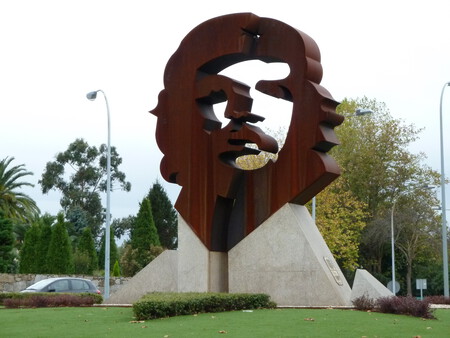
What Che Guevara does at a roundabout in Oleiros
Elisardojm
Whoever goes along the road that connects the parish of Perillo with the town of Santa Cruz has an unmistakable reference to find Bastiagueiro beach. At the height of the sandy area, in a roundabout called Nirvana, stands an eight-meter Che Guevara. It is an unmistakable image even for those who see the sculpture for the first time. The beret, the star and that gaze directed at a point outside the frame that Alberto Korda's famous photograph has turned into an icon are present. Here, however, it is reproduced in steel on a stone base, the work of Cuban artists Juan Quintanilla and Karoll William.
The location has part of its charm since it is in a residential municipality that is among the highest income in Galicia. In 2023, the gross disposable income in Oleiros amounted to 30,879 euros per inhabitant, which is 62% above the Galician average, according to the Galician Institute of Statistics. In fact, the tribute was an initiative of the city council that divided the neighbors.
In June 2008, when what is the largest statue of Che outside of Cuba was inaugurated, it marked 80 years since the birth of the Argentine revolutionary. His son Camilo traveled to Oleiros for the occasion. The day before, while he was talking about his father in a nearby auditorium, a hundred neighbors demonstrated in front of the statue, still covered.
Coto also has an opinion on local politics. When they asked him what he liked about Oleiros, he started with how clean the area is and ended up praising the mayor, Ángel García Seoane, who is known there as Gelo. But the detail that best explains his attachment to the place is another that he dropped in that conversation. Between the years of his youth in A Coruña, the house he shares with his partner in Bastiagueiro and how well the Atlantic summer suits him, the man from Madrid was already joking that, at that point, he was more Galician than anything else.
Cover photo | The Wild Project
In Genbeta | Arturo Pérez-Reverte's reflection on dogs: “No one who has not lived with them will know how far loyalty goes”
In DAP | Toshisuke Kanazawa, 90-year-old Japanese bodybuilder: “I don't eat meat, fish, milk or yogurt. My three daily meals are based on brown rice, natto and miso soup”