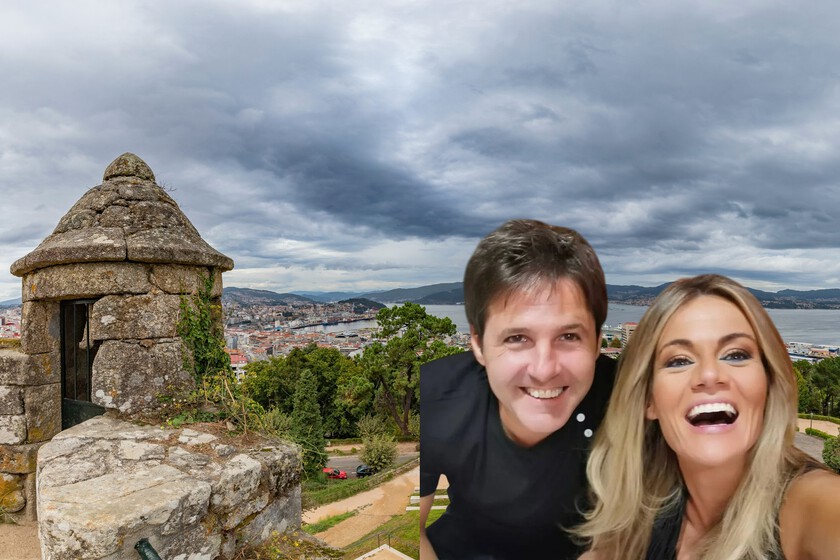
Rocío Delgado and Jesús Cintora have inaugurated new professional stages in recent months and weeks. While the former now occupies the afternoons of La Séptima with Sobre la mesa, the latter shares the mornings of La 1 with Adela González in Mañaneros 360. Although they share a profession on different channels, the two journalists have maintained a relationship since 2017. The signing of Delgado has also meant their return to Madrid after working on Galician television, a season during which the couple had to live in different cities.
But, before sharing both a profession and a city, their biographies began in very different landscapes of Spanish geography. She was born in Vigo and he spent his entire childhood and adolescence in the Soriano town of Ágreda, at the foot of Moncayo. Between the Galician city open to the estuary and this town on the eastern edge of Soriano, there is material for two getaways with little resemblance to each other.
Vigo, Rocío Delgado's hometown with fishing neighborhoods
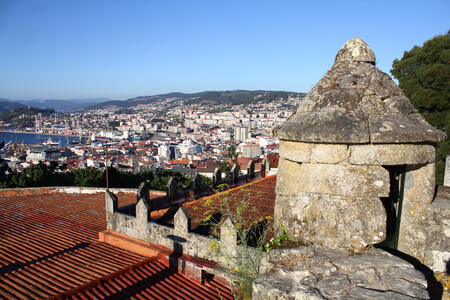
To get to know Vigo at a glance, it is worth starting at the top. From Mount O Castro, the panoramic view allows you to visually understand how the city extends along the estuary. On the slope, in addition, an archaeological site is preserved with three reconstructed fortress buildings and, higher up, the paths lead to the gardens and the walled enclosure of the O Castro castle. All this without leaving the center, although with a few hills in between.
counting stars
Back down, the walk continues through Casco Vello. The arcades of Praza da Constitución, where merchants once settled, are a good place to make a stop before continuing towards O Berbés. The porticoed houses of this old fishing neighborhood remind us of how close the water came to be, since the sea reached its arcades, today separated from the shore. It is one of the details that most helps to glimpse today the vestiges of the old fishing village that remain within the current city.
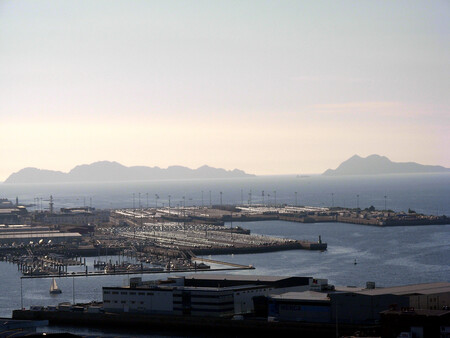
Without leaving the neighborhood, Rúa da Pescadería introduces oysters as a plan within the walk. This can be a good first stop for lunch or a snack before spending another round in Bouzas, which was an independent village until 1904 and which retains its own old town by the sea. Its food market, the urban beach and the parish church, built on a rock, make up a very interesting route for which you can reserve as much time as you need.
@farrangallo
In Bouzas, the streets lead to the promenade and the terraces offer another good excuse to enjoy Galician gastronomy again. An empanada, some mussels or some razor clams can complete the meal after walking so much along the estuary.
Ágreda, the town of Jesús Cintora at the foot of Moncayo
“I wouldn't trade my childhood in the town for twenty amusement parks,” Cintora has even declared. Son of a housewife and a rancher, he still remembers the squares in which he played, the cabins in the mountains and the early mornings to accompany his father to work. He grew up in Ágreda, in an area of Soria where the proximity to other territories meant that he went to school in Soria, high school in Aragón and university in Navarra.
Tourism of Castilla y León
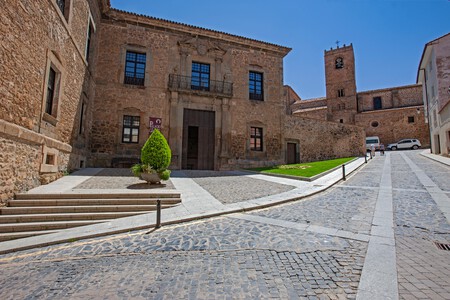
In fact, long before the journalist was born, other borders marked the history of the town. Ágreda is known as the town of the three cultures due to the heritage left by the Muslim, Jewish and Christian communities. In the Moorish neighborhood there are still sections of wall and doors with horseshoe arches that allow you to visit that past at street level and without having to pay the entrance fee to any museum. Among them is the Puerta del Agua, named after the cistern that once stood next to it.
The walk, however, also has its palace moment. The Castejón family wanted to build a residence there worthy of receiving kings and nobles as they passed through Ágreda, and the result was the Castejón palace. Its gardens deserve as much attention as the building. The Renaissance style brings together flowerbeds that draw knots, aromatic plants and a plant theater. Next to it, the Garden of Memory follows a baroque-inspired layout, organized in diagonals and avenues.
Soria Provincial Council
To get to know the natural landscape that surrounds the town, the Arabic Huertas path proposes a 3.5 kilometer circular route from the Puerta de Felipe II. The path passes next to the farmland and allows you to see Ágreda with the Moncayo in the background, in addition to meeting monuments such as the Torreón de la Muela and the Emiral Arch.
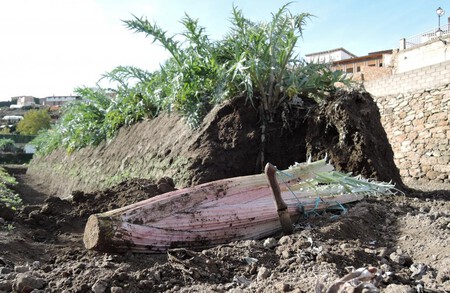
In terms of gastronomy, the Ágreda red thistle is grown in these orchards, which has its own agenda during the autumn. Around Todos los Santos, farmers raise mounds of earth to cover the plants and protect them from frost. Then, it begins to be consumed in November, but it is one of the traditional Christmas Eve foods. It is also served in a salad, something that should be noted now to remember when it is time to sit down to eat.
Cover photo | @rociodelgadotv and Jordi Vich Navarro
In Motorpasión | Spain has been waiting for years for its new bombers to put out fires. Galicia has gotten tired and has signed a Black Hawk military helicopter
In Xataka | A father and his son work for eight years in a shipping container to build a replica of the Lancia Stratos with an Alfa Romeo V6