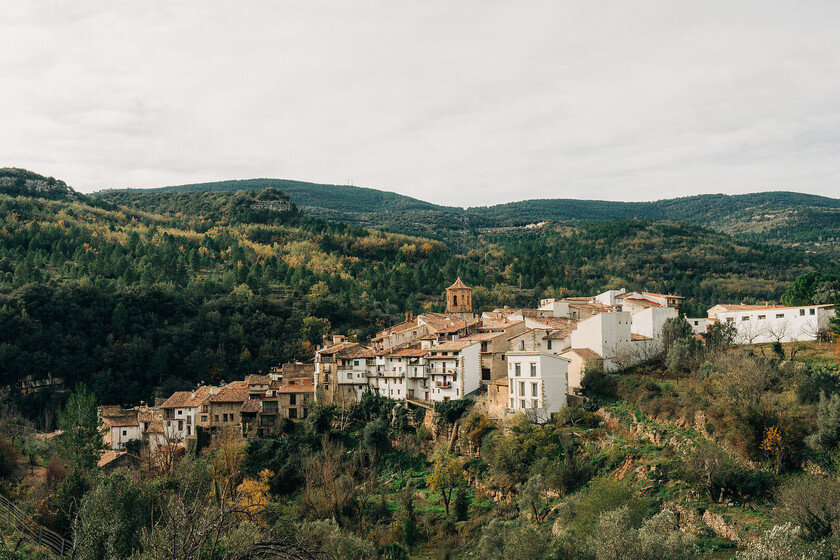
From the Rossell road, Vallibona welcomes tourists with a kind of optical illusion because looking at the outline of its houses from this point is like seeing the silhouette of the map of Spain. It is a curious pareidolia that has been making the town famous for years. In fact, it is a postcard that has its own viewpoint to go and contemplate it. It is a good way to start the visit, from a distance, before entering the streets that form the drawing.
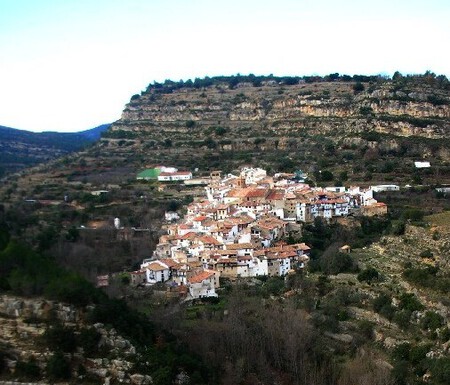
This picturesque setting is located in the mountainous region of Els Ports, in the interior of Castellón, where the Cérvol river runs through a valley between the Turmell and la Creu mountain ranges. Vallibona sits on a hillside, with large rock formations behind it and a medieval layout in the middle of the slope. In this way, while some streets advance following the curves of the terrain, others rise to communicate the different heights of the hamlet with the involuntary shape of the Spanish Iberian Peninsula.
Xufanc
Furthermore, the forests that surround the town are practically another neighbor since they had a lot to do with the livelihood of its inhabitants in the past. This is because the wood used to make charcoal came from them, a craft that left its mark on the local economy, especially during the 19th and 20th centuries. This relationship with the mountain is, without a doubt, another of the excuses to make a getaway to Vallibona and understand its history in the shade of the oaks.
What to see in Vallibona
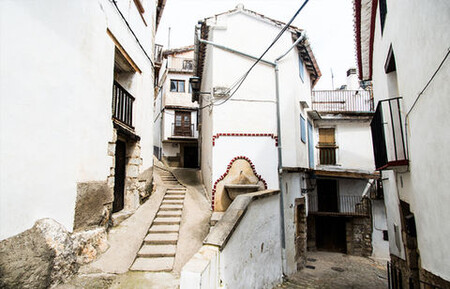
The church of the Assumption of the Virgin, built in the second half of the 13th century, occupies the upper part of the town, surrounded by houses. Outside, a wooden covered porch protects the side entrance and covers the alley that borders the temple. This section is also accessed through pointed arches. This is the church where, between 1411 and 1414, some of the meetings held by King Ferdinand, Pope Benedict XIII and Saint Vincent Herrero were held, to conclude the ecclesial and papal division, known as the Western Schism.
The history of the building inside has been accumulated in layers. Its baroque covering hides a good part of the medieval construction and, above the vaults, a polychrome pine wood roof is preserved. Shields, human figures, animals and plant motifs appear in his pieces, with a predominance of red, green and yellow. This is one of the elements why it is declared an Asset of Cultural Interest.
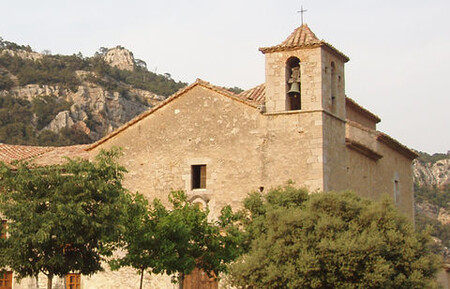
The Communion Chapel houses a museum with part of the restored pieces of the roof. There are chivalric scenes, fantastic animals and Mudejar motifs. Back on its streets, you will also find a building that stands out from the rest. It is about the Mudejar bell tower, one of the three defense towers that the town had.
The next stop leads to the basement of the Town Hall. There, the old medieval prison preserves three of its cells with the original doors and locks, as well as small barred openings. However, it is currently home to the Charcoal Interpretation Center, a museum that exhibits period work tools and explains how charcoal was produced in the town from forest wood (mainly holm oak). The building thus brings together two very different chapters of the town's history in the same rooms.
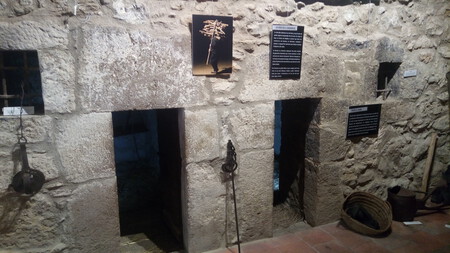
Vallibona Town Hall
Where to eat delicious and cheap in Vallibona
In the regional recipe book of Els Ports, stews, soups, meats and sausages have weight, as well as cheeses and desserts such as curds. Also flaons, sweets filled with cottage cheese, almonds and honey. It must be taken into account that it is a gastronomy linked to livestock and mountain products, with spoon dishes that go especially well when it gets cold.
To eat without leaving the town of Vallibona we have the Hostal La Carbonera, which has a bar-restaurant in the Plaza de Sant Antoni. Their specialty is local homemade food in a natural environment. Cultural events such as book presentations and concerts are also organized.
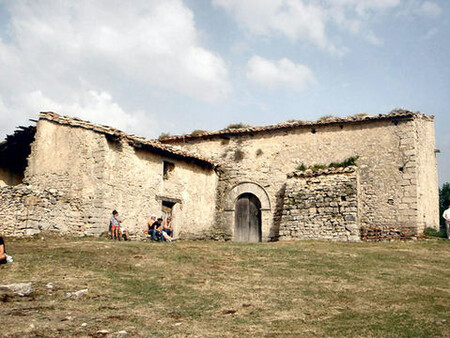
What to do around Vallibona
Vallibona has a natural attraction that we cannot forget. To continue exploring it on foot, there is a botanical itinerary of just over a kilometer and low difficulty around the town. On this route, the Cérvol riverside forest, the oak tree and old crop fields follow one another. It is a way to extend the visit and get to know the variety of landscapes that coexist around the houses.
Those who want to spend even more time walking have a crossing point for the GR-7 and GR-331 in Vallibona. The journey to Vallivana is 11.5 linear kilometers, medium difficulty and takes about three hours and forty-five minutes. Of course, since it is linear, you have to organize the return on another side.
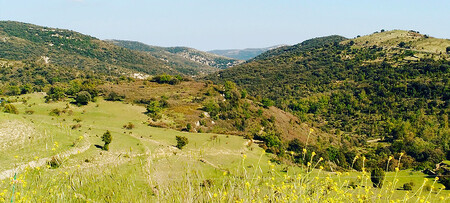
You can also follow the valley by car. The Cérvol Route links the Giner Factory, in Morella, with Vallibona, Castell de Cabres and Herbeset. Its circular proposal is around 55 kilometers and uses the track between Vallibona and Castell de Cabres. It is a possibility to dedicate another day to that territory of farmhouses, hermitages and small towns that the river links.
In DAP | They order some tripe to take away in a bar in Malpica (A Coruña) and threaten to file a complaint because they contain chickpeas