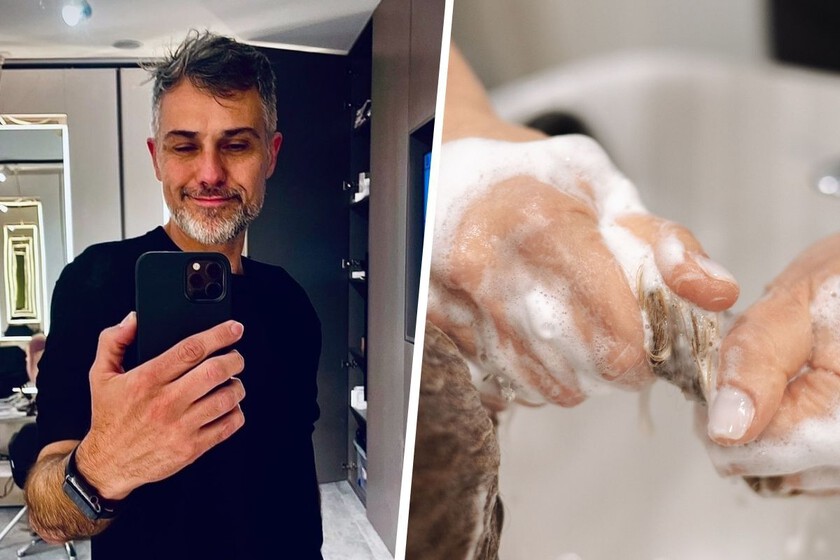
Hair care has managed to be at the same level as facial care, this is due to the increasingly fervent desire to show off impeccable hair: shiny, hydrated and frizz-free. For this reason, on social networks there is no shortage of tricks and methods to take care of your hair, the latest trend being the sandwich method of washing.
This washing routine is characterized by changing the traditional order of products to protect and hydrate the hair. It consists of first applying the conditioner, then the shampoo and finishing by applying the conditioner again. The formula is simple but it may not be made for everyone.
As Pedro Moreno, Education Manager of Jean Louis David, commented to the Clara publication: “In recent months we have been seeing a lot of viral advice that recommends applying conditioner before shampooing. My answer is always the same: we cannot turn specific advice into a norm for everyone. Each hair has a different history and, therefore, completely different needs,” he explains.
It is evident that each hair and scalp will have its own needs, for this reason, depending on what each person needs, they should shape their hair routine. So, the sandwich method may be fine for some hair types, but for others it may not have any benefit.
What is the sandwich washing method?
As we said at the beginning, it is a very simple technique that alternates the use of hair washing products. Instead of applying the shampoo and finishing with the conditioner as we would do in a classic routine, in this case we will reverse the order and form a “sandwich” with the products.
The first step is to apply the conditioner to damp hair from the mid-lengths to the ends; then use the shampoo to wash only the scalp and rinse to remove the shampoo well and the first application of the conditioner. To finish, reapply the conditioner from mid-lengths to ends, let it act for a few minutes and rinse.
This proposal, unlike the traditional order, according to experts, what it does is create a protective layer before applying the shampoo. The conditioner will prevent the shampoo's cleansing ingredients from damaging or drying out the hair fiber, ensuring that the hair is clean but at the same time hydrated. Although it is true that this makes sense, not everyone considers this method necessary. “If the hair is healthy, applying a conditioner before washing does not usually provide a real benefit. And if the hair is very sensitized by technical services such as balayage, bleaching or repeated coloring, I do not consider that to be the solution either. What you really need is a professional diagnosis and using the appropriate treatment before washing,” says Moreno.
The difference between protecting and repairing hair
What we can highlight about the sandwich method is its great function to protect the hair, especially when it comes to fine, fragile or bleached hair. In this aspect, the conditioner prevents the shampoo from drying out the hair fiber, although we can also use a specific product for this purpose. “Today we have pre-shampoos and specific treatments that prepare the hair before cleaning it. Not all of them work in the same way. Some help protect the fiber during washing, others eliminate mineral residues or product accumulations and others balance the scalp before applying the shampoo. That is the real difference,” says the expert.
It must also be taken into account that the main function of the conditioner is not to repair as such, but rather to facilitate detangling, soften and provide superficial hydration. For this reason, some of its ingredients are usually silicones or other conditioning agents that surround the fiber. “Many low-quality conditioners make the hair look spectacular for a few minutes simply because they coat the fiber with polymers or silicones. The hair feels soft, shiny and seems repaired, but in reality that sensation disappears as soon as we wash it again because the fiber has never received the treatment it really needed,” says Pedro.
In Xataka | Puerto Rico introduced mongooses to combat rats in the sugar fields. 150 years later, they are the main source of rabies on the island
In DAP| On Saturday, August 29, a cutting board with a built-in sharpener arrives in Lidl stores for less than 5 euros