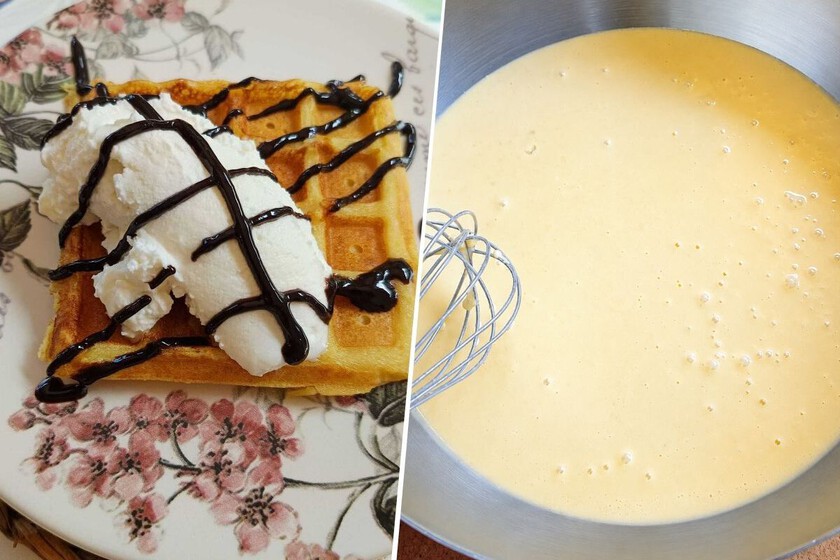
Those of us who don't like cooking too much appreciate the easy and delicious recipes. One of those sweets that I really wanted to know how to make were waffles, and in the most unexpected way I found the authentic recipe for Belgian waffles, one of those that has been passed down from generation to generation.
A few months ago my mother took a trip to Brussels and some friends took her to eat at her parents' house, and the surprise was that she had waffles for dessert. They quickly took out the waffle maker, the dough was already made and rested, and they began to make a bunch of waffles that they accompanied with different toppings.
Obviously my mother couldn't come without the recipe (she cooks like hell), and her friends' mother took out a super old book of traditional recipes in French and there were the waffles. A very simple recipe that makes delicious waffles and since it fell into my hands, I have won every visit I have.
Belgian waffles, unlike Liège waffles (which are also Belgian), are much more neutral in flavor, which is why they are usually accompanied by cream, chocolate or strawberry. On the other hand, those from Liege are sweeter and are usually consumed alone, although they can also contain topping. Another difference between both waffles is their dough, Liege waffles have a thick dough and Belgian waffles are liquid.
Belgian waffle recipe
What I like most about this recipe is that it is not complicated at all and that anyone can make it with delicious results. The ingredients that I am going to leave you are to make 20 waffles, for example for five people we would have 4 for each one, although I can do it with two. Regarding sugar, they practically do not contain it since they are not consumed alone, even so for those who prefer to give it a touch they can add a few tablespoons of sugar.
- 500 gr. of flour
- 200 gr. butter
- 30 gr. yeast
- 3 gr. a pinch of salt
- 6 eggs
- 800 ml of milk
Preparation of the recipe
The first step is to pour the sifted flour into a bowl or bowl, add the yeast in this step if it is dry yeast and a pinch of salt.
On the other hand, we put the milk in a saucepan at medium temperature and add the butter so that it melts slowly. If the yeast is fresh we can add it to the milk so that it dissolves, but it is important to keep the temperature of the milk soft; if it is too hot the yeast fungi will die and will not do their job.
The next thing is to make a well in the flour mixture (which we made at the beginning) and add the milk mixture and the beaten egg yolks; and mix well until you achieve a uniform but liquid mass. Once we have this prepared, it is time to add the egg whites that we will have previously made until stiff. Here I make a stop, to confess that sometimes I skip this step, and add the whole, beaten eggs directly to the flour instead of separating the yolks from the white, so it takes less time and on top of that I have proven that they turn out just as good. But come on, the recipe is what it is.
Another point of the recipe that I modify is the yeast, and instead of adding fresh yeast (in cubes) or dry yeast (in powder or grains) because I don't have any, but I do crave waffles, I apply Royal and ancho es Castilla yeast.
Once we have the dough, we cover it with film and let it rest in the refrigerator for one to two hours if it has fresh or dry yeast, and if it is Royal, fifteen to thirty minutes is enough, this step is for the flour to settle.
Now we move on to the waffle maker
Obviously to make this delicious sweet we need a waffle maker, they come in all prices and with different capacities. Mine specifically is for making four waffles at a time, the one I have is the Fun Gofrestone 4Inox from Cecotec which is non-stick with the stone coating. The truth is that they are made very well, they don't stick and when there are guests being able to make waffles four at a time is great.
As we have already said, the batter for Belgian waffles is liquid so we will use a saucepan to pour the batter into the waffle maker. It is important to cover each square of dough well, but do not overdo it as the waffles have to puff up. Although the plates are non-stick, it doesn't hurt to add a little oil with a brush.
To make them perfect, fluffy on the inside and crispy on the outside, it is important to control the temperature. At the beginning the waffle maker must be very hot, generally the iron must be closed, and when the device tells us we pour the batter. The waffles will become golden brown but to ensure they are done well without losing fluffiness, I lower the temperature a little. Between three and five minutes is what it would take to make depending on how we regulate the temperature.
I carefully remove them with a spatula when I see that they are already golden, but this is a little to each person's taste, it is just trying how you like them best. When we take them out it is important to place them on a rack, if we transfer them to a plate they will overcook and soften.
The moment of topping
Something that may surprise you when you try these waffles for the first time is that they are not sweet, and this is because they are actually designed to be accompanied by some topping such as chocolate, cream, jam or fruit. If they were sweet, the result would be too sweet, and with this neutral base the waffle is perfect and is one of the clear differences with the Liege waffle.
Among my favorite options is the most classic version, which is cream with chocolate, but when I have blackberry jam (completely homemade) it is another delight if we mix it with cream. But the options can be very varied, such as chocolate with pieces of banana or strawberries; or nuts with caramel syrup.
Furthermore, if there is leftover dough, we can keep it perfectly for the next day in the refrigerator. It lasts intact and you can have a good weekend marathon. Like the one I did this weekend.
In Xataka | Puerto Rico introduced mongooses to combat rats in the sugar fields. 150 years later, they are the main source of rabies on the island
In DAP| On Saturday, August 29, a cutting board with a built-in sharpener arrives in Lidl stores for less than 5 euros