There is only one week left until the expected total solar eclipse takes place on August 12 and, if you are one of those who have been compulsively opening the weather application for days, we have bad news: you have probably been looking at the wrong prediction.
While thousands of people are trying to find out if the clouds are going to allow them to enjoy one of the most anticipated astronomical events of the century, AEMET meteorologist Benito Fuentes has issued a personal recommendation that may seem contradictory at first: “Do not consult the prediction in your locality, but in that area located a few dozen km to the west (approximately).”
It is neither crazy nor eccentric, it has a very simple explanation and can make the difference between seeing the eclipse or missing it behind a cloud.
The eclipse is not visible above your head
We are used to checking the weather forecast for the place where we live or where we are going to spend a certain day. However, for a sunset eclipse, things work differently.
When the climax of the phenomenon arrives, the Sun will be very low above the western horizon. That means that our gaze will not be directed to the sky above us, but to the west. Therefore, a strip of clouds located several tens of kilometers in front of us can hide the Sun even if there is hardly any cloudiness in our location.
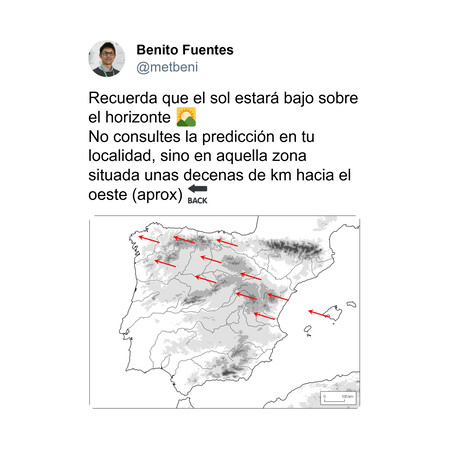
It's exactly the same thing that sometimes happens when you try to watch a sunset: it can be a completely clear day and still a cloud on the horizon prevents us from seeing the last rays. That is why Benito Fuentes insists on looking at the weather forecast for that area located to the west and not only that of the municipality from which we are going to observe the eclipse.
What does the latest forecast say?
Although, officially, the AEMET will not be able to issue a completely reliable prediction until Friday, the meteorologist updates a map daily in which he differentiates various areas according to the degree of uncertainty.
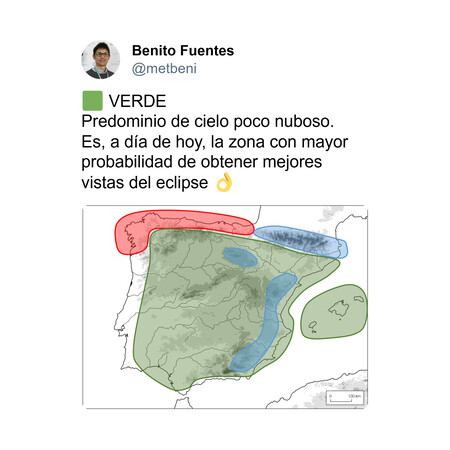
In its latest provisional prediction (dating from August 4 at 8 p.m.), most of the Peninsula appears marked in green, the most favorable scenario for now. This does not mean that the sky will be completely clear, but rather that, with the information currently available, no particularly worrying situations for observation are expected.
The areas marked in blue require a little more attention. As he explains, “evolution clouds could grow after midday and dissipate by the end of the afternoon,” although he adds that “the nature of these developments has yet to be determined.” On the map, these blue zones mainly affect part of the Cantabrian coast, some sectors of the Iberian System and a strip of the east and southeast of the peninsula.
The meteorologist himself also sends a relatively optimistic message: “Possibly, the affected area will be smaller than that indicated in the image. The developments will be specific and may affect mountain areas. We must monitor their evolution.”
Galicia is, for now, the great unknown
The area marked in red is concentrated mainly in the north and northwest of the Peninsula, especially in Galicia. Here Benito Fuentes is much more cautious and recognizes that “it presents great uncertainty and nothing can be stated.”
The reason lies in a factor that can still change over the next few days: “Everything will depend on the position of the anticyclone, which will dictate the direction of the wind in lower layers and the possible affected areas.” In other words, small variations in the position of the anticyclone could significantly modify the evolution of cloud cover.
Regarding the Canary Islands, the meteorologist foresees “predominance of the trade wind”, which is why he considers cloud cover less likely on the southern slopes of the islands.
The AEMET asks for patience
The doubts that these maps still reflect are not coincidental. In fact, they coincide with the conclusions of a study prepared by the State Meteorological Agency (AEMET) to analyze to what extent clouds can be predicted during the eclipse.
After years of comparing European model forecasts with actual satellite observations, the agency concludes that cloud cover forecasts begin to be truly reliable approximately five days before the phenomenon. Before then, even the best models have too much uncertainty to know for sure what will happen in a specific location.
Jongsun Lee
That's why meteorologists recommend against jumping to conclusions from apps that show forecast weather a week or more in advance.
In fact, Benito Fuentes himself remembers that the map shared on his social networks does not replace official information. The AEMET will refine its forecasts over the next few days as uncertainty decreases. So if you plan to travel to watch the eclipse, perhaps the best advice is the simplest: wait for the latest updates and, when you check the weather, also remember to look at what's happening a few kilometers to the west.
Cover photo | Nat
In Espinof | The new 'The Mummy' movie with Brendan Fraser and Rachel Weisz has just announced the return of two other mythical characters from the saga
In Xataka | Someone is doing business with the European heat wave: China and its trains full of air conditioners