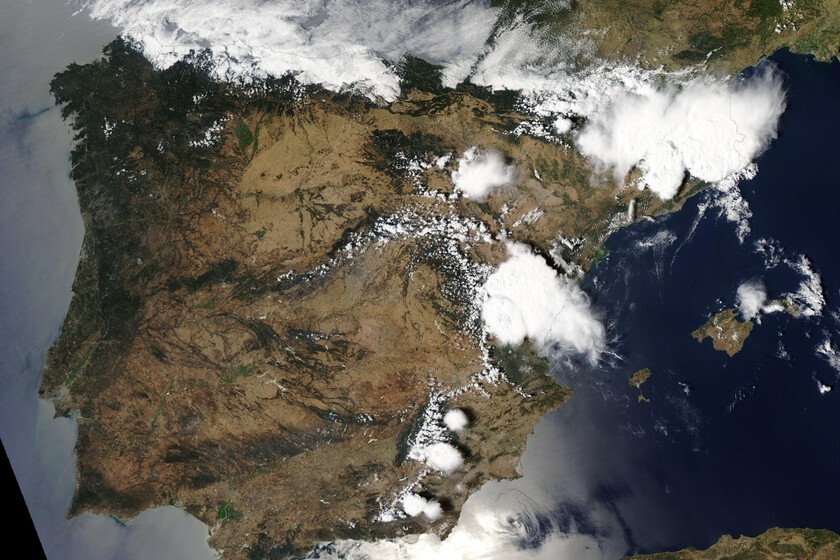
The weather forecast for the total solar eclipse on August 12 depicts a more complex scenario than expected. Although the Peninsula will be dominated by a “ridge” (a large mass of very warm air that usually brings sunshine and high temperatures), meteorologists Álvaro Oliver and Benito Fuentes warn that this does not guarantee absolute stability. In fact, the heat accumulated in the ground could become the perfect fuel to unleash sudden storms that threaten the visibility of the astronomical phenomenon.
The main problem is that slight changes in the upper layers of the atmosphere are enough to activate instability. As Oliver explains, when the suffocating air on the ground receives the slightest push in height, it rises suddenly and generates storm clouds. The expert demonstrates how easy it is for this to happen by recalling a recent case, where a gust of wind high above the Mediterranean (a “jet maximum”) was enough to trigger severe storms in the middle of a heat episode.
Specialists agree on pointing out three major risk areas on the Peninsula where cloud cover could ruin the show:
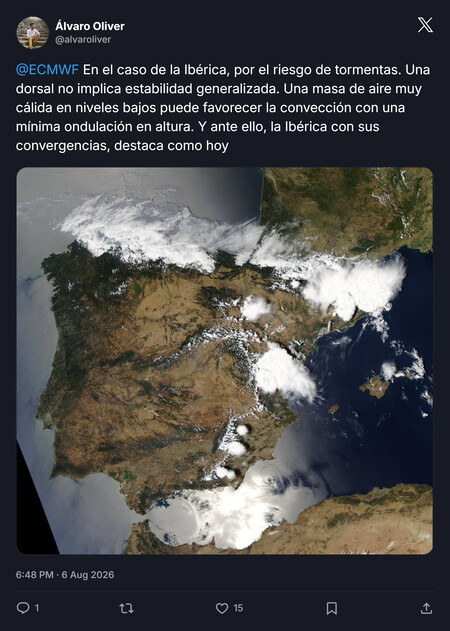
The Iberian System and the Northern Subplateau
The mountainous terrain acts as a natural chimney by colliding air currents. Oliver points to Castilla y León (Northern Submeseta) as the area most likely to develop this type of storm.
The Cantabrian coast
In the north, the threat is not storms, but “strata”: a continuous layer of low clouds and mists caused by humid sea air pushed by breezes (a phenomenon that was present 70% of the days in July).
Eastern interior
The satellite map published by Fuentes confirms this uneven panorama, with large areas of sun next to very localized storm spots in the east.
The greatest difficulty for those who plan to travel lies in the speed of these phenomena. Summer storms form in a matter of hours, so a municipality can wake up completely clear and have the sky covered in the afternoon, just when the sun is low and the totality phase of the eclipse occurs.
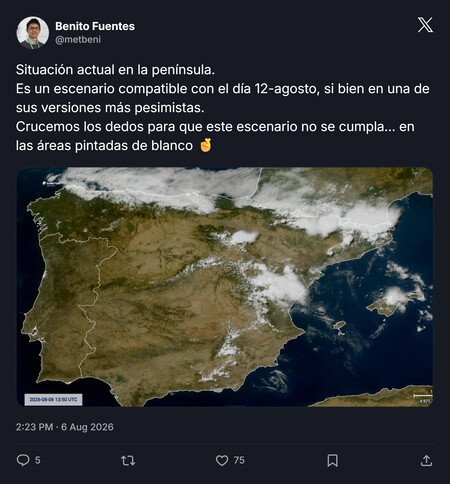
However, meteorologists clarify that this is not a definitive sentence. Benito Fuentes describes this storm map as the “most pessimistic version” of the models and asks people to cross their fingers “so that this scenario does not come true… in the areas painted white.”
With several days left until the astronomical event of the year, any small change in winds or humidity can still displace these storms. However, for now, the warning is clear: extreme heat will not be a guarantee of clear skies, so the evolution of the weather will have to be closely monitored until the last moment.
Cover photo | Alvaro Oliver
In DAP | Alicia Martínez, cleaning expert: “So that the house always smells good, I spray this homemade air freshener on the curtains”
In Compradicción | On Saturday, August 8, Skechers-type sneakers for daily use arrive at Aldi for less than 12 euros