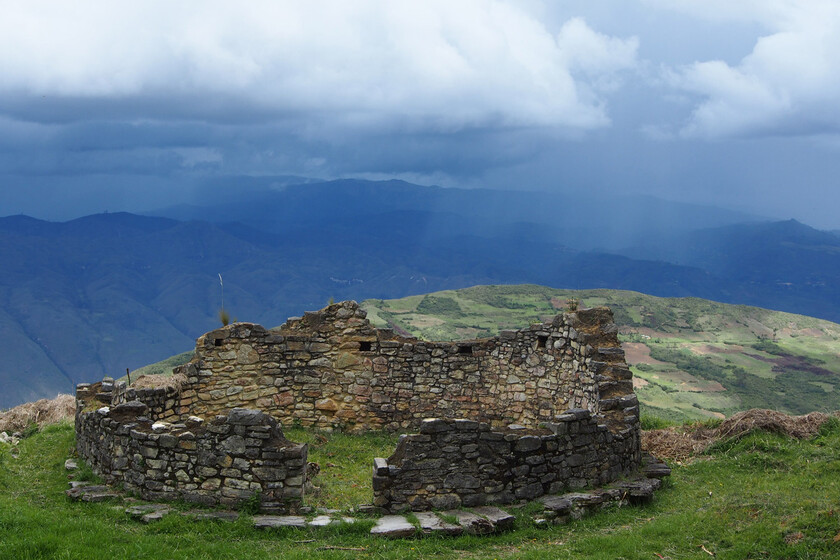
Some archaeological discoveries, in addition to seeming straight out of an adventure movie, also manage to alter the way we understand an entire civilization. That is exactly what has just happened in Kuelap, often called the Machu Picchu of the Peruvian jungle.
In this gigantic pre-Inca fortress hidden among the Amazon mountains in Peru, a group of researchers has found an approximately 600-year-old tomb with human remains and ceremonial objects that open new questions about the funerary rituals of the Andean world.
Although we popularly associate Machu Picchu with the monumental image of ancient Peru, Kuelap (with its stone walls raised more than 3,000 meters high and surrounded by jungle fog) has long been positioned as one of the most fascinating archaeological sites in all of South America. And with this he adds another mystery to his story.

Government of Peru
The discovery by specialists from the Kuélap Archaeological and Interdisciplinary Research Program (PRIAK) occurred in an area where, until now, systematic excavations had never been carried out. Right at the point where the main entrances to the citadel converge, a strategic location that suggests that that space not only had a funerary function, but also a symbolic and ceremonial one.
The tomb, built of stone and shaped like a horseshoe or “U” shape, was on a raised platform that was accessed by two steps. Inside, archaeologists found the remains of five people: four adults and an infant. But the most intriguing thing was not the number of bodies, but the way in which they were arranged.
One of the skeletons appeared on top of other previous bone remains, something that, according to researchers, could indicate that the funerary site was reused at different times. Therefore, that tomb would not have been a single burial, but rather a living ritual space, modified over time and possibly linked to complex spiritual practices.

Government of Peru
It is precisely at this point where the discovery becomes especially fascinating. Because beyond the romantic image that we may have of an ancient tomb, what archaeologists believe they have found are clues about how Andean societies understood memory, death and the connection between generations.
Among the ceremonial offerings, ceramic pieces inspired by fruits and plant elements appeared, as well as a phytomorphic paccha (a ritual vessel used in ceremonies linked to water and fertility) shaped like a pacay, a typical fruit of the Andean region. An object carved in bone with a stylized human face and a Chachapoya headdress (used by the elite, priests and warriors of this culture) was also found, along with fragments of Spondylus shells, stone mortars and small metal pieces.
All of this may sound very technical until one remembers that, in many pre-Hispanic cultures, funerary offerings were not simple decorations to accompany the dead. They functioned as spiritual symbols, objects of transit and elements deeply linked to the idea of continuity between the earthly world and the afterlife.

Jorge Gobbi
Experts also believe that several of the objects found reflect a cultural interaction between the Chachapoyas (the civilization that built Kuelap) and the Inca Empire during the so-called Late Horizon, the period between 1470 and 1532 AD That is to say: the tomb could tell not only a story about funerary rituals, but also about cultural mixing, political domination and symbolic exchange in the last years before the arrival of the Spanish.
However, if this discovery shows us anything, it is that there are still many stories buried under places that we thought we knew. Each new discovery seems to demonstrate that we still know very little about the societies that inhabited the Andes before colonization. In this way, while much of global tourism remains obsessed with Instagrammable destinations, archeology continues to remind us that some of the most impressive stories are not in viral trends, but under layers of earth, stone and silence accumulated over centuries.
Cover photo | Andreas
In Xataka | Today on Netflix: possibly one of the best action series of all time and it has 6 perfect seasons
In Xataka | A mix of Indiana Jones and Mission Impossible: at 72 years old, Jackie Chan will return in the fourth film of one of his best action sagas